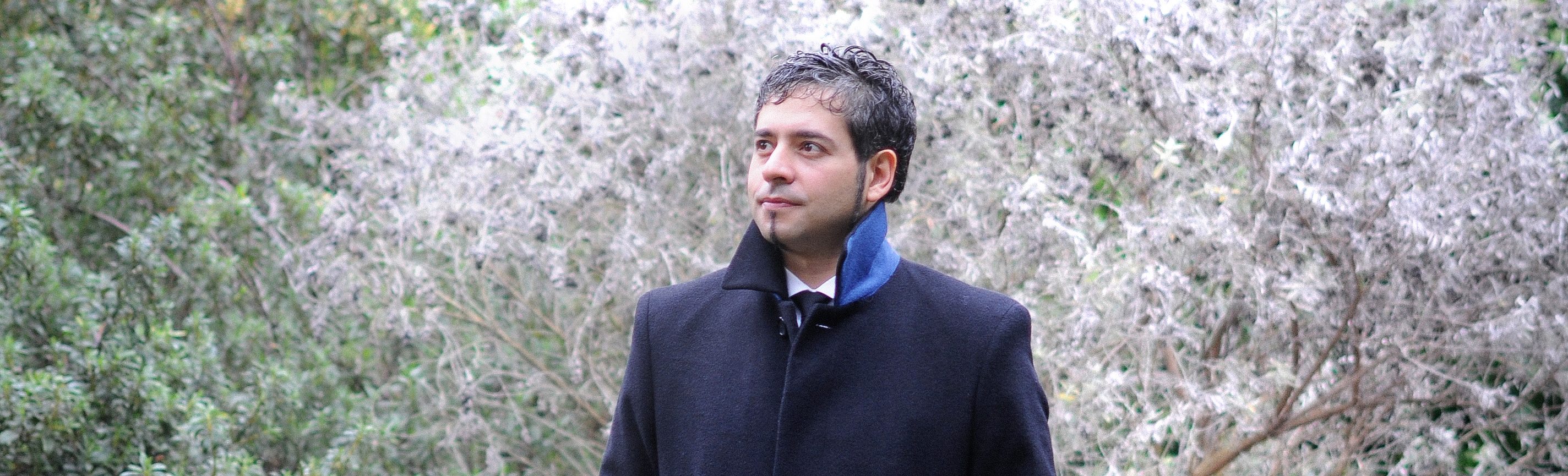
I’m thrilled to be conducting Eliza Brown’s a toy boat on the serpentine at the Mondavi Center in Davis on June 1, alongside Gershwin’s Rhapsody in Blue, with Erina Saito, and Daniel Brewbaker’s Playing and Being Played, with Rachel Lee Priday. Eliza is a composer whose work moves seamlessly between disciplines, drawing on literature, sound ecology, and collaborative creation with other artists and thinkers. Their music invites deep listening—not just to the sounds themselves, but to the questions those sounds ask about memory, space, and meaning.
Eliza’s pieces have been performed around the world by top new music ensembles, and their recent projects have included everything from music-theater inspired by a year of field recordings in Indiana to collaborations with sculptors and video artists. They are also a thoughtful scholar and passionate educator, currently serving as Associate Professor of Music at DePauw University.
It was a joy to speak with Eliza about the ideas that fuel their music, the power of listening, and some of the unexpected surprises that shape their creative life.
Christian Baldini: Your work “a toy boat on the serpentine” will be performed alongside Gershwin’s Rhapsody in Blue—two pieces that inhabit very different worlds. Could you tell us about the origins of a toy boat and what kind of space or imagery you hope it evokes for the listener?
Eliza Brown: This piece was commissioned by my former youth orchestra, Philadelphia Sinfonia, in honor of my mother, who served as the president of their board for many years after I graduated from the organization. I asked for her input while composing the piece, and incorporated musical elements that we extrapolated from the Classical music she finds most moving. She and I are both fans of Virginia Woolf, and the title is a reference to Woolf’s novel Orlando. Orlando, the main character, sees a toy boat bobbing on the calm Serpentine river in London’s Hyde Park, and takes it as a sign that her sea-captain husband is safe after sailing through a storm. Orlando experiences a surge of ecstasy from this simple everyday sight, thanks to her vivid imaginative inference. So the piece moves from very small musical fragments bobbing on a glittery surface to big, Romantic musical phrases and gestures at its peak. I hope listeners feel free to imagine their own imagery along with this, and to layer their own personal significance onto the piece, just as Orlando does with the toy boat.
CB: You’ve described your music as being driven by sound’s “potential for meaning.” What does that mean in practice—how do you begin shaping a piece when there’s no narrative, only sonic intention?
EB: I think there’s a lot of space, and a complex spectrum of different kinds of musical meaning, between the 19th-century poles of “programmatic” – i.e. based on an extra-musical narrative – and “absolute music” – i.e. the “purely” musical. I don’t think sound is ever completely devoid of referential meaning, because human brains are wired to interpret sensory inputs. We are always hearing sounds in reference to other sounds we have experienced, and this is deeply ingrained in our survival instincts – sounds indicate safety, danger, sources of food and water, etc. In a less life-or-death example, if we hear the sound of a cello, we’re subconsciously referencing that against other examples of cello we’ve heard in the past. Every experience we have with sound contributes to the way we listen and understand what we hear. The meanings of sound and music are of course very complex and layered and culturally and personally contingent, so we can’t use sound to sort of paint meaning by numbers and have it translate exactly the same way to every listener. But we can create combinations of sonic and musical references that come from a place of awareness about their potential meanings in cultural context, and there’s a richness there, and fun to be had in combining all these different signifiers, just as there is when writing text. So as I’m developing material, I’m often asking myself questions like, what does this remind me of? Where have I heard sounds like this before, in music or from any other source? Do I want to make compositional choices that bring the material closer to or further from those origins, references, influences? If the answer is, “further,” then in what direction? How will we get there? It’s a way to kind of map my way between recognizable landmarks or reference points, or play in the space between them.
CB: In The Listening Year, you integrated field recordings, scientific insights, and community stories from a single creek in Indiana. How did that immersive process change the way you compose—or even perceive music itself?
EB: I think that The Listening Year was an outlet to deepen and confirm approaches I was already exploring, rather than a catalyst for unexpected turns in my work or listening. As someone who has done a lot of outdoor soundwalks, and spent many hours listening in silence in Quaker meeting as a child, environmental listening feels like second nature. And I often start a piece by paying close attention to something outside of myself – an existing piece of music, conversations with collaborators, recordings of the performers I’m writing for. My ideas come from that attentive, relational process. The Listening Year amplified that process, as I spent about 16 months making and studying fifty-two weekly field recordings and seeking many perspectives on the creek before writing any music. I thought of this as an ecological process, in which my composing was inextricable from the web of inputs and relationships created during that time. There’s also something attractive to me about this kind of devotional practice of attention: my creativity stems from being devoted to this place, these people.
CB: Your work sussurra grew out of a kinetic sculpture and became a cross-disciplinary collaboration. How does your creative process shift when working alongside artists in other media, especially in film or visual art?
EB: This question follows well from my previous answer, in the sense that I don’t think my process is fundamentally different when working with artists from other fields. It starts with this process of exploration, listening, attention, and seeing what emerges and following those threads. In interdisciplinary collaborations there’s also an element of translation, where we gain an understanding of each other’s thinking in the terms of both disciplines, which usually leads to really delightful moments of discovery and recognition: oh, you think about this too with different words; oh, yes, we understand each other. We’re also figuring out the intersections and spaces between our disciplines and our specific practices that we want to spend time in, that expand our thinking about what we do as individual creators. That process takes time and iteration, so I think the biggest difference is in the development timeline rather than the way I’m thinking about composing or collaborating. In some ways the biggest difference between my interdisciplinary projects and my more traditional music projects is the production infrastructure. Interdisciplinary projects are less likely to fit into traditional producing models like “concert,” “play,” “gallery exhibition,” etc., so they often involve more administrative and production work on the part of the artists to get the project off the ground.
CB: Many of your compositions have an intertextual layer—responding to earlier music, texts, or traditions. What draws you to engage with the past, and how do you balance homage with innovation?
EB: I think what has drawn me to engage with the past – particularly early in my career as I was finding my voice – is my simultaneous sense of resonance with and appreciation for it, but also alienation and distance from it. I love so much music from the Western canon, and find it fascinating and moving, but I am not of the eras and cultures that found it necessary to make that music. And I would not want to be – in those eras and cultures, I likely would not have had access to a music education or career due to sexism! So I look at these historical objects with both attraction and wariness, and have written a number of pieces that pass historical musical artifacts – style elements, forms, fragments, whole pieces – through a kind of compositional filter that reflects this duality. In these pieces one might hear echoes of the past, but they’re echoes, removed from the source – veiled, re-contextualized, reverberations rather than re-creations. I don’t think they are homages, though there is affection there – they are more the product of passing these objects through the filter of my complex relationship with them.
CB: Your academic research focuses on narratology in music—particularly in Czernowin’s Pnima…ins innere. Does that analytical lens ever influence how you compose your own music?
EB: Yes, absolutely! I have always been a very interdisciplinary thinker, and I really resonate with notions of storytelling across media. Pnima is an opera that has no textual libretto – the singers sing phonemes rather than words. Yet it is based on a novel and tells that novel’s story through what the composer calls “an internal theater,” or a sonification of the characters’ psychological journeys. My research was about the theoretical frameworks one could use to understand how this kind of storytelling works, and it drew on theories of narrative from literature and screen media as well as music theory and aesthetic philosophy. Without giving a full dissertation here, I will say that that research has been so influential to me that it would be almost impossible to excavate all of the ways it is ingrained in my thinking and practice. But perhaps the most significant thing has been understanding musical gesture, sound, and time as metaphors for embodied experience – understanding musical activity in terms of human behavior, or the ways that we experience psychological and emotional states in our bodies.
CB: As a professor and mentor to young composers, what are some values or skills you most hope your students carry forward into their careers?
EB: One of the biggest things I hope students take with them is a sense of permission to explore whatever it is that excites them artistically. I find that many students enter a music degree with a lot of assumptions about what music is, what composition is, what counts as composing. These assumptions can really limit them from exploring avenues of creation that they might love. So I hope students encounter a broad range of practices presented without judgment, and feel a sense of permission to pursue their instincts and passions into any of these directions, whether they fit their initial assumptions or not. I also hope that students shed the need for anyone else’s approval to be an artist – what makes you a composer is the fact of composing, not external recognition. Everyone needs technical skills, too, but those vary depending on individual practices and goals. It’s so difficult to make a career in the arts, so I think it’s fundamentally important that young artists develop a sense of internal permission and agency, and a personalized technical skillset, that no one can take away from them, regardless of the challenges of funding, finding opportunities, and all of the practical considerations that come along with artistic careers.
CB: Looking ahead, are there any upcoming projects—musical, theatrical, environmental, or otherwise—that you’re particularly excited about right now?
EB: Yes, I’m kind of at a turning point between projects so there’s a lot to look forward to right now! In June I’ll finish a piece for Duo della Luna (Susan Botti, voice and Airi Yoshioka, violin) setting poetry by Elizabeth Bradfield, and I’ll also be working on two small-scale interdisciplinary projects this summer, each a collaboration with another artist who is a composer-performer. In the fall I’ll start working on an opera based on a Renaissance painting that I’ve been thinking about for almost 15 years! That’s going to be a long-term project, but I’m excited to finally start getting it out of my head and into the world.
CB: Finally, for a fun one: What’s something personal or unexpected that you’d be willing to share—perhaps a favorite sound, a ritual in your composing process, or a surprising influence?
EB: I couldn’t choose a favorite sound (every sound that exists could be my favorite in the right context!) but I do enjoy “unexpected soundtrack moments” in daily life – when the music in a public space, or looping in my head, isn’t what I would first think to pair with the activity or scene around me, but somehow goes with it perfectly or adds a subversive layer to it. The most recent one I can think of was on May 4, when some nerdy DJ at my climbing gym had a playlist that was about 90% John Williams – not what one typically hears in a gym! It was pretty delightful. Three strangers and I had been working on the same bouldering route for a bit, and as soon as the Indiana Jones theme came on we all topped it out like a quartet of Williams-activated climbing sleeper agents. I don’t know if the music helped or not, but it was a fun coincidence!

Eliza Brown’s music is motivated by sound and its potential for meaning; questions about the nature of human existence, social relationships, and responsibilities; and vivid sensory experiences. Their compositions have been performed by leading interpreters of new music, including Ensemble Dal Niente, Spektral Quartet, ensemble recherche, International Contemporary Ensemble, Network for New Music, Ensemble SurPlus, Quince Contemporary Vocal Ensemble, and Wild Rumpus New Music Collective; heard on stages throughout the USA and in Mexico, Colombia, Germany, Hungary, Spain, Canada, and the UAE; and recorded on multiple labels. Eliza’s work has been supported by grants from the Illinois Council on the Arts and the Paul R. Judy Center for Applied Research, among others, as well as residencies at the Ragdale Foundation (IL) and A Position on Retreat (BC).
Eliza’s work is frequently intertextual, opening dialogues with existing pieces of music, historical styles, field recordings, and other artifacts. It is also frequently interdisciplinary, with a particular focus on music-theater and opera. Recent projects include The Listening Year (2024), an hour-long music-theater work for cello-percussion duo New Morse Code and fixed media that incorporates and responds to a year of field recordings made along Big Walnut Creek in Greencastle, Indiana. Eliza consulted with scientists, conservationists, local residents, fellow artists, and students to interpret the recordings; the form and content of the piece reflect the site’s ecology and annual cycles, human uses and understandings of the site, and the transformative experience of a year-long environmental listening practice. This work was awarded the 2023-24 DePauw University Fisher Fellowship. The chamber work sussurra (2023), commissioned by Classical Music Indy for the Micro Composition Project, was inspired by visual artist Antonia Contro’s kinetic sculpture foglia, and in turn became the sonic layer of a film featuring the sculpture that Eliza co-created with Contro and video artist Jon Satrom of studiothread.
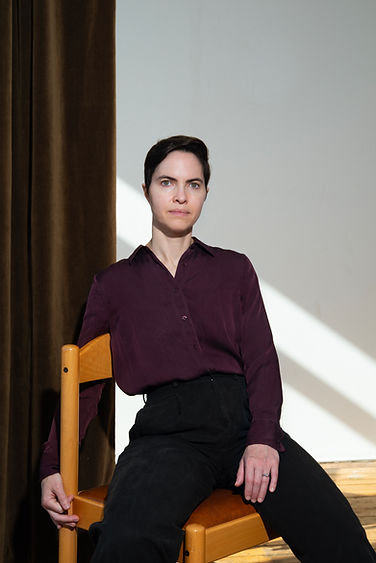
Eliza’s artistic interests give rise to questions about the interpretation and meaning of music and words that drive their scholarship, creation, and teaching. Their dissertation, A Narratological Analysis of ‘Pnima…ins innere’ by Chaya Czernowin, used methods drawn from the interdisciplinary field of narratology (the study of narrative) to examine how Czernowin’s opera tells its story by means of music alone, as singers in Pnima sing phonemes and wordless vocal sounds. Eliza writes original and co-created texts and libretti, drawing upon a wide range of influences including scholarship, contemporary poetry, and a childhood steeped in protest, folk, parody, and camp songs.
Eliza is a dedicated teacher who enjoys helping students develop as creators and engage complex ideas with rigor and enthusiasm. They are currently Associate Professor of Music at DePauw University, where they teach composition, music theory, and career development courses. Eliza has enjoyed a long-term affiliation with the Walden School Young Musicians Program, where they spent many summers in various roles including faculty and Academic Dean. Eliza holds a B.Mus. summa cum laude in composition from the University of Michigan and a D.M.A. in composition with program honors from Northwestern Universit
 Christian Baldini's Interviews