
Beauty, Brazil, California, Christian Baldini, composer, Concert Hall, Concerto, Conductor, New York, Tango, Teatro Colón

Evandro Matté in Conversation with Christian Baldini

Christian Baldini: Evandro, it is a pleasure to welcome you to California to work with the UC Davis Symphony Orchestra as our guest conductor this week. You will be conducting a wonderful program infused by your native Brazil with works by Villa-Lobos, Nepomuceno, and also Gershwin, with the great Japanese/American pianist Natsuki Fukasawa. You started your musical career as a trumpet player. Can you share with us how you transitioned from the trumpet and ended up becoming a conductor?

Evandro Matté: Christian, I started very early on the trumpet, I was 7 years old. At the age of 19, I was already a professional musician. Playing in the orchestra, I always admired the work of the conductors, especially those who achieved different results with the orchestra, with beautiful interpretations. Over time, I began to have the desire to be able to conduct and contribute to the art of classical music. I always had a managerial side and I imagined that I could also contribute to the development of music in my country. These factors led me to pursue a career as a conductor.

CB: You are music director of two important orchestras in Porto Alegre (Brazil). How is the musical landscape there now, and which similarities or differences do you see with other countries?

EM: The classical music scene in Brazil is stable. It hasn’t grown in recent years. We’ve had the same number of orchestras for a long time. What has evolved are the social projects. Many young people in social vulnerability have had the opportunity to study music for free. And this has greatly raised the level of orchestra musicians in Brazil. We now need to create new orchestras to employ these young people.

CB: What are some of the favorite musical projects that you have conducted, and why?

EM: I created two social projects that serve 200 children with classes four times a week. At the Porto Alegre Symphony Orchestra I built the new concert hall. At Orquestra Theatro São Pedro I expanded the program by 50% and in both orchestras I have recorded contemporary Brazilian composers every year. It is important to record what is currently being done in music.

CB: What is your approach to programming? What do you take into account when coming up with seasons for your orchestras?

EM: For me the most important thing is diversification. We make the backbone with traditional concerts, mainly from the romantic and classical periods. But we are looking for different repertoires that suit all tastes: pop music with orchestra, music for children, film music, contemporary repertoire. Every year we perform two operas.

CB: Tell us about Villa-Lobos and Nepomuceno. What are some of the important aspects of their music that you find in these two works? What would you recommend for people who don’t know much about their music?

EM: Villa-Lobos was the most important Brazilian composer. His music has all elements of the diversification of Brazilian society, which has its strong point in mixing different races and ethnicities. There are many different cultures within a single country. He inserted sound and rhythmic elements and popular songs from all corners of Brazil into his work. What I can highlight in Nepomuceno is the beauty of the rhythmic elements of his work and the fight he took on for the nationalization of concert music in Brazil. At that time, only music from outside Brazil was valued.

CB: Lastly, what is your advice for young musicians? We all go through challenges in life. How do we overcome them?

EM: The most important thing is determination. When we want something, we get far. Not always where we would like, but the most important thing is to feel the feeling of having done everything in our power to achieve the goals. And be aware that music elevates the soul. That’s why we have to understand the importance of our profession.

CB: Thank you for your time. We are delighted that you are here to work with our orchestra.

EM: My pleasure. I am very happy to be here and to be able to make music at one of the most important universities in the world.
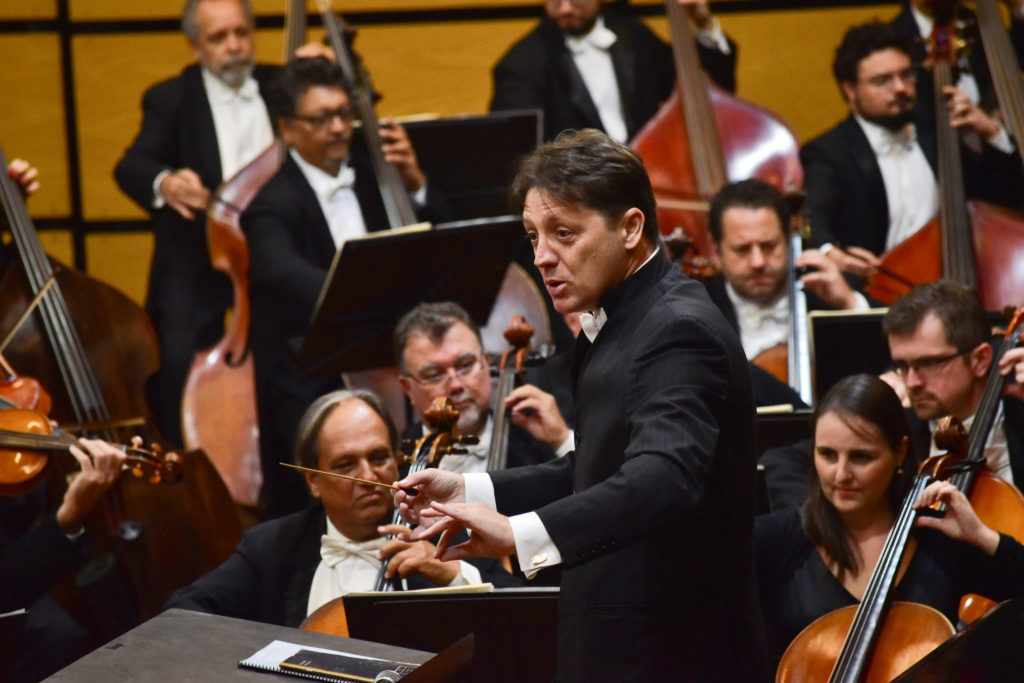
Performing a prominent role in classical music scenario, Evandro Matté holds the title of Artistic Director in the Porto Alegre Symphony Orchestra (OSPA), the SESC’s International Music Festival – Pelotas, the Theatro São Pedro Orchestra (OTSP) and the Zaffari Community Concerts (CCZ).

Recognized for leading projects with innovative results, he’s responsible for renovating orchestras, undertaking tours in Latin America and setting up social and academic programs. The development of the SESC’s International Music Festival – Pelotas and the renovation of the Music School of OSPA are some of these examples.

Furthermore, Evandro Matté has been fruitfully contributing to Brazilian culture for concepting new territories of classical music, including the construction of Teatro Unisinos and the OSPA House – the only one in South of Brazil designed to orchestral repertoire. While in discography production, his initiatives have been spotlighting national composers and performers throughout.

For his contributions, in 2019 was awarded by the Ministère de la Culture for the insignia of Chevalier de l´Ordre des Arts et des Lettres.

He’s frequently invited to collaborate as a guest conductor with orchestras around the world, including recents works in Uruguay, Argentina, Colombia, EUA, Portugal, Italy, Germany, Czech Republic, Croatia and China.


It was through the trumpet, at the age of 7, that Evandro Matté started his studies in music. When he was 15, he joined the professional orchestra of his hometown, the Symphonic Orchestra of Caxias do Sul. Settled in Porto Alegre, he started his studies at the Music School of OSPA. At the age of 19, he got the OSPA trumpeter chair and started his graduation at the Federal University of Rio Grande do Sul (UFRGS). Thereafter, he specialized at the University of Georgia (USA) and the Conservatoire de Bordeaux (FRA).

Attracted by the conducting, he started to perform as a conductor through festivals and masterclasses, being guided by prestigious maestros, such as the iconic Kurt Masur (ALE). In 2007 he took up the artistic director and conductor Unisinos Anchieta Orchestra as the. Along with the orchestra, he recorded albums emphasizing Latin American composers and performances by virtuous Brazilian musicians.

In 2011 he launched SESC’s International Music Festival – Pelotas, a project he designed in partnership with SESC. With Evandro as the artistic director, the festival has become known as one of the largest and most significant in Latin America. Besides its educational aspect, the festival also stands out for its unique role in fostering the culture of the region where it’s based.

After 25 years as a trumpeter, Evandro Matté took up the position of artistic director of OSPA. With tours, discography production, strengthening educational programs and increasing the technical and artistic level of the orchestra, his years in management are celebrated for putting OSPA back to its position of excellence among Latin American orchestras.

Further to his work ahead of OSPA, in 2013 Evandro Matté assumes the position of artistic director and conductor of the Zaffari Community Concerts (CCZ) and, in 2018, of Theatro São Pedro Orchestra (OTSP).

Beauty, California, Christian Baldini, New York

David Felder in Conversation with Christian Baldini

David Felder is an exceptional and unusual composer in many ways. While most composers treasure traveling around the world collaborating with various groups and orchestras, David Felder avoids traveling at all costs. He will not travel. Despite this he has built very strong ties to and valuable collaborations with some of the most important new music performers in the world over the course of several decades. These include Irvine Arditti, and his Arditti String Quartet, as well as the Buffalo Philharmonic (where Mr. Felder teaches), Nicholas Isherwood, Brad Lubman and his Ensemble Signal, and many more. On May 21, 2022, it will be my honor to conduct the West Coast première of Felder’s work Die Dämmerungen with the UC Davis Symphony Orchestra at the Mondavi Center. I had the chance of asking David some questions, which he responded to via voice memos, and below is the transcription of these informal but extremely illuminating exchanges.

Christian Baldini: Your music is often inspired by external sources, such as literature, painting, or even a tarot deck of cards. For this piece you utilized poetry by William Carlos Williams, Dana Gioia, and also a quote from Psalm 130, and a direct reference to Nietzsche’s Twilight of the Idols. Can you tell us how this fits into your creative process? Are there any particular ideas that come to mind first, and that inspire you to make references to these works through your music?

David Felder: Each one of the texts is set to instill an atmosphere for each one of the movements. In fact the texts were not picked first, but the music was conceived first. As I began working on the music I started searching for texts that would in some way tie the movements together but also create an atmosphere across the music.

I have a personal relationship with one of the poets. That is Dana Gioia. I have worked with his poetry before. We’ve been associated together and I very much enjoy his poetry. In this poem, he refers to Jacob and the Old testament story. Jacob’s ladder. The ladder which angels used to ascend and descend to/from heaven.

There is a sadness and lack of awareness in terms of the opportunity. The heavenly and the mundane. Jacob slept on a stone pillow through the potential experience. It’s spoken about as “Impossible distances”

1st poem / 1st movement: William Carlos Williams

“sparkles from the wheel” / the wheel can be thought of in many ways: a wheel of time

Ophanim: certain angels that surrounded the throne of Yahweh in certain Cabalistic formations

First two movements: Ascent and Descent

2nd movement: a particular location – reflective of the small town (East Aurora) where I personally reside – humanity attempting to bridge the gap between the mundane and the divine: a concern for me in this work

3rd movement: Psalm 130: ominous Old Testament text

Connecting to Jacob and his ladder

looking at a calling out from the abyss, from a very dark place

In 2017: the world began to feel very dark – I attempted to capture the ominous feeling of the world around me – it is a real calling out, a point of imitation / canonic treatment of a melodic line which is rising out from the depths and finds its expression at the very end of the movement

4th movement: a kind of scherzo

I abridge a Nietzsche’s text – “twilight of the fools”

we are living in a world which is governed by fools in every way – this is being proven more every moment that ensues

this piece has a tremendous sardonic edge to it – tremendous energy – feels like a kind of Helter Skelter and rootless energy

we are being shouted at from every particular angle 24/7 if our ears and eyes are open to it – “I shut my eyes and ears as much as possible now”

binary form: second form is highly repetitive, with a pounding energy

a couple of transcriptions of politicians ‘sloganeering’ – it has become endless today – we are inundated with inanity

as a young man I was fascinated and infatuated by the works of Shostakovich – “there is a Shostakovichian energy in this movement”

CB: To me this piece seems very spiritual. Not only do you have these trajectories of descending and going into the depths of the human soul, but you also have these “impossible distances”, as referenced in the beautiful poem by Dana Gioia. You make a reference to “the Goddess of Dawn and a sense of personal rather than collective place in the second piece. Over the course of the first three of the four pieces the music is quite dark, intense, slow evolving, extremely beautiful and expressive. And in your final movement somehow it all seems to click into place, with bursts of energy that most composers could only dream of. You also make references to the “age of shrill” and the “incessantly repetitive propaganda.” How do all these musical materials come into place for you? How do you balance out purely musical material from all these external elements that are clearly influencing you and inspiring you?

DF: This balance of programmatic and musical elements is always a challenge for any composer. Programmatic ideas come in a pre-compositional way – I know what I want to say and I find the technical means to say that.

Simple binary forms make it much easier for the listener to understand the material presented in the piece – These forms rhyme much like the poets have a relationship in this piece – from a technical point of view, music is meant to complement and reinforce itself through self-similarity

each movement begins in a similar way except for the fourth – the other three are more related to one another

rhyme: there is ascent followed by descent – sometimes the registers of the piece simply flip

We exist as members of a society and a culture, and we also exist as individuals – the piece attempts to try to address some of those various relationships

more personal: the town where I live (East Aurora) – a strong sense of place

3rd mov :a look at universal energy of despair

1st mov: universal phenomenon of sunlight and sunset and sunrise

last movement: a very specific cultural phenomenon: when societies are in intense decay, propagandas are at its highest

pulling all of this together is what one’s training as a composer allows one to attempt to do – I try to hold these divergent images together through my experience as a musician and as a composer for over 50 years

CB: Besides your extremely successful and busy career as a composer you have been a remarkable teacher to so many great composers. Your influence and your legacy mentoring and reaching out to the future generations is invaluable. How have you balanced your life as a Distinguished Professor and Birge-Cary Chair in Composition at SUNY Buffalo, and as the Artistic Director of the “June in Buffalo” Festival since 1985, with your life as a composer?

DF: For almost 50 years I’ve been producing concerts. I felt very strongly that it’s very important for young composers to have their music produced at a very high level.

balance: I’ve never only wanted to do just one thing – It became very interesting and important for me to create musical opportunities for audiences, composers

Now, reverse engineering. There’s been a cost. It’s taken enormous energy to put this into place and maintain it. It comes at some expense to the creative work that you do.

I’m coming now to what I consider to be the end of my creative moment. I recently finished a second cycle of Jeu de Tarot. 14 movements.

After that I’m going to take a hiatus. That hiatus will continue until I have a good idea.

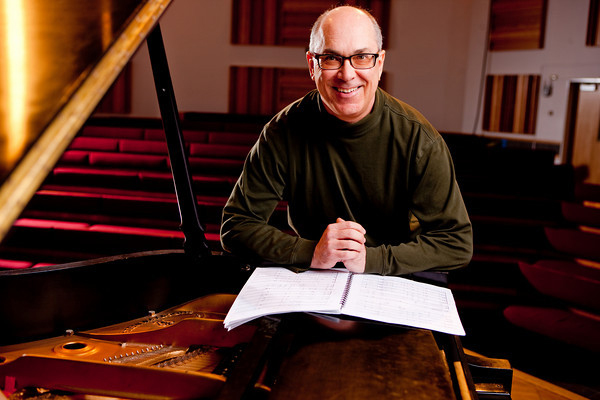
David Felder (courtesy photo)

David Felder has long been recognized as a leader in his generation of American composers. His works have been featured at many of the leading international festivals for contemporary music, and earn continuing recognition through performance and commissioning programs. Felder’s work has been broadly characterized by its highly energetic profile, through its frequent employment of technological extension and elaboration of musical materials (including his Crossfire video series, and the video/music collaboration Shamayim), and its lyrical qualities.

Felder has received numerous grants and commissions including many composer’s awards from the National Endowment for the Arts, two New York State Council commissions, a New York Foundation for the Arts Fellowship, Guggenheim, two Koussevitzky commissions, two Fromm Foundation Fellowships, two awards from the Rockefeller Foundation, Meet the Composer “New Residencies” (1993-1996), composer residency with the Buffalo Philharmonic, two commissions from the Mary Flagler Cary Trust, and many more.

In May 2010, he received the Music Award from the American Academy of Arts and Letters, a career recognition award. Shamayim was awarded a Silver Medal in Music from the Park City Film Festival in Spring, 2011.

Felder serves as Birge-Cary Chair in Composition at SUNY Buffalo, and has been Artistic Director of the “June in Buffalo” Festival since 1985, when he revived it upon his arrival in Buffalo. Since 2006, he has been Director of the Robert and Carol Morris Center for 21st Century Music at the University. From 1992 to 1996 he was Meet the Composer “New Residencies,” Composer-in-Residence to the Buffalo Philharmonic Orchestra and WBFO-FM. In 1996, he formed the professional chamber orchestra, the Slee Sinfonietta, and has been Artistic Director since that time. In 2008, he was named SUNY Distinguished Professor, the highest rank in the entirety of the SUNY system. In 2015 he was named Co-Director of the University at Buffalo’s Creative Arts Initiative, a plan to bring major international creative artists to the region as guest artists.

Felder recently released a CD on Coviello Contemporary featuring Jeu de Tarot (2016-2017), a chamber concerto recorded by Irvine Arditti and Ensemble Signal, and conducted by Brad Lubman. The disc also features his string quartet Netivot (2016), recorded by the Arditti Quartet, and Another Face (1987), recorded by Irvine Arditti. His recent orchestra piece, Die Dämmerungen, commissioned by the Buffalo Philharmonic Orchestra, will receive its complete world premiere at Kleinhans Music Hall on October 5th and 6th, 2019, under the baton of JoAnn Falletta.

A dedicated teacher and mentor, he has served as Ph.D. dissertation advisor and major professor for over eighty composers at Buffalo, many of whom are actively teaching, composing and performing internationally at leading institutions. Nearly 900 ’emerging’ composers have participated in June in Buffalo, the festival Felder pioneered and dedicated to younger composers upon his arrival in Buffalo in 1985. Felder served as Master Artist in Residence at the Atlantic Center for the Arts in February-March, 2010. His works are published by Theodore Presser, and Project Schott New York, and portrait recordings are available on Albany, Bridge, Coviello, BMOP/sound, Mode, and EMF. Two recording projects were recently completed, both of Les Quatres Temps Cardinaux in surround sound, with one being released on BMOP/sound, and the other on Coviello Contemporary.