

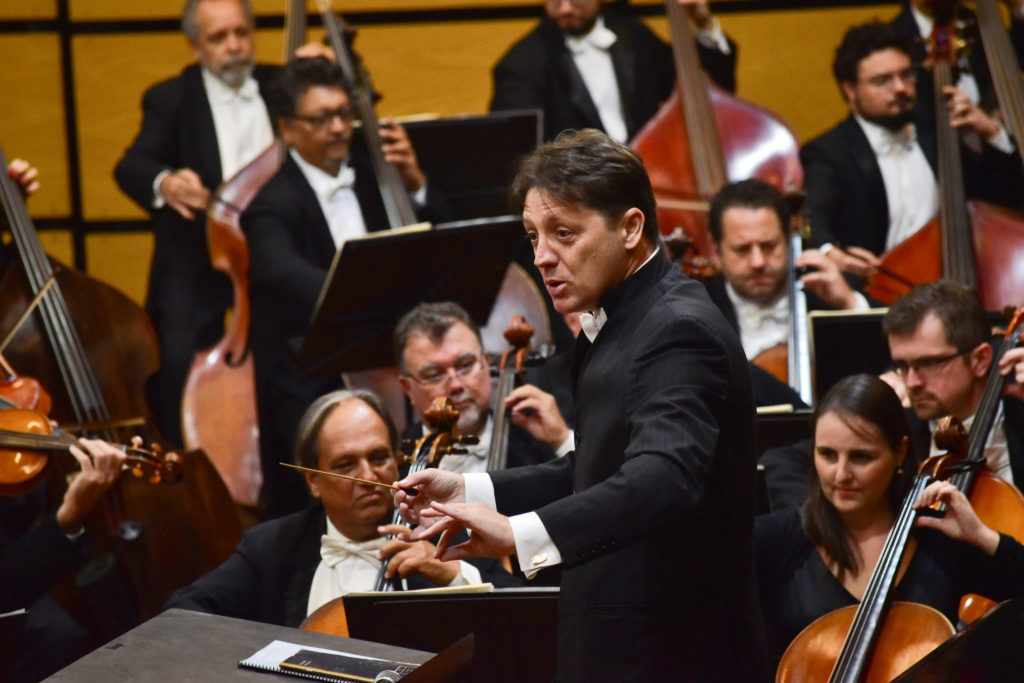
On March 9, 2024, I will conduct a program featuring the world première of a new work by composer Maya Miro Johnson, Ravel’s Piano Concerto in G Major, and Brahms’ Symphony No. 1 at the Mondavi Center, UC Davis. Below is a conversation with Maya about her new piece.
Christian Baldini: Maya, welcome, I am delighted that you have composed “in the valley of the shadow” for the UC Davis Symphony Orchestra, and that you will be in California with us for its world première, as well as running the video which will be projected with the piece. In a nutshell, I know the main source of inspiration for this piece comes from radiology/MRI images of your own body. Please tell us about this piece, how did you approach writing it, and what are the main musical sources for it? Also: how would you say you relate content from visual images to music in your own compositions? (and how does the video you created relate to the music?) What would you like people to listen for in this piece?
Maya Miro Johnson: This piece, in the valley of the shadow, is about revolving. Inspired by the structured approach of radiology, I split the orchestra into 6 layers of distinct musical ideas (each one I arbitrarily assigned to “musculoskeletal, cardiovascular/lymphatic, neurological, connective tissue, internal organs, keratin” slices, just as a helpful metaphor). Those 6 discrete blocks of sound then “rotate” around the orchestra in 3 different views of the exact same sonic material: coronal (from above), saggital (silhouette), and frontal (what it sounds like). Every time the view switches on the musical layers, the instrumentation of the ideas changes. So, for example, the “musculo-skeletal” layer might start out in the flutes and end up in the basses, for example, while the “neurological” layer could move around the percussion and celeste. Sometimes all the layers are present, like at the purposefully cacophonous beginning of the piece, and the colors sort of melt into a brown or sepia as they mix so broadly. Sometimes, especially by the end, there is only one layer present, with the “camera” of the listener’s eye and ear simply panning through the same soundworld of one idea. Accordingly, the structure of the piece is about thinning out the layers from all to just one… stripping the body down more and more, past skin and bones, guts and blood, to something more clinical and deindividualized, to literal bands of light and shape. I hope the piece evokes these endless rotations: static, floating, and organic, just like the decontextualized radiological images projected in the cyclical and continuous video art accompanying the music.
I am areligious, but the title comes from the famous Psalm 23:4, “though I walk in the valley of the shadow of death…”. I thought about the idea of living in a valley, always running to avoid the constant movement of shadows across the ground, spending life trying to escape the touch of death. This literal rotation of the sun across the sky and thus the shadows across the floor made me think very clearly of the constantly moving human body and served as an apt metaphor for all aspects of the piece.
CB: Your musical language seems like that of an omnivore. You explore sounds, you incorporate noise seamlessly into your language. There seems to be inspiration and influences from both American and European composers from different aesthetics. How would you describe your musical language, and does it vary much from piece to piece?
MMJ: My work has changed a lot in the last few years as I’ve grown, but I think I’m very contextually-driven. My work begins with a concept, and my journey with a piece is based around figuring out how to successfully connect that driving statement to engaging and sculpted content, which can be quite diverse (from indie songwriting to composed theater/performance art to intricate instrumental gestures to hardcore electronic noise music, maybe all in the same piece!). Right now, my work thematically orients around cyborgs and the idea of synthesis as using technology to be a prosthetic part of the body/ecosystem of a piece. I’m really interested in the politics of bodies (and how we treat/conceptualize embodiment) as metaphors.
CB: Tell me about your musical training. How did it all start? You are a fabulous performer on a few instruments, you compose and you conduct. What is ultimately the ideal “job” for you? What would you like to be doing in 10, or 20 years?
MMJ: Well, originally, I thought I might pursue contemporary dance professionally, but I had too many injuries (thanks, Hypermobile Spectrum Disorder!) and realized that would not be possible. I had always been interested in the choreography and semiotics of physical movement and proprioception in playing acoustic instruments. This interest sparked a questioning of how the conducting language might be related to dance. So, I started really practicing violin seriously and joined a youth orchestra, where I attended workshops for a Young Composers Project, led by the incredible Devin Maxwell, on a total lark. Devin was the first person who made me realize music is actively made in a process that involves struggle and failure, not just “taking dictation from God”, as the trope goes. I realized I was “allowed” to write music too, and the rest is history! From there, I started studying conducting, violin, and composition with mentors who were enormously generous with their time. For college, I ended up at Curtis, where I’ve trained for my undergraduate degree in Music Composition for the past 5 years, primarily with Steve Mackey, Amy Beth Kirsten, David Ludwig, Nick DiBerardino, and Jonathan Bailey Holland. I’ve also worked privately with Chaya Czernowin at Harvard, who has been an invaluable mentor for me as well.
I imagine the best career for me would be grounded in exploring and reinvigorating The Practice (TM) by teaching, while still actively making work with collaborators all over the world in many different genres and settings. Yes, of course, I will always love writing (and directing) orchestra music, but I think my creativity most thrives in settings where I’m deeply involved in a risky experiment of a performance. I see myself exhibiting in museums, creating pieces in theaters, as well as presenting in concert halls. I hope to keep my performing life going as long as my body holds up!
CB: What are some challenges you’ve encountered as an artist, and as a human being (we can totally talk about health issues if you wish, or something else)?
MMJ: My biggest flaw as a person is being hyperfunctional. I’ve just been diagnosed with a genetic disorder that explains symptoms and comorbidities I’ve had for years, ranging from minor to life-threatening. Coming into my own as a hidden-disabled woman who also identifies as Jewish and queer has been a really difficult mental transition, perhaps even more difficult than the actual physical experiences of abuse and pain. I mask really well – too well – so I have this expectation to be hyperactive to “make up” for the ways that this identity’s experience disables me. I had normalized pain to the extent that I was able to work around it at really high levels before it worsened – I now find it really difficult to meter the pressure on me to return to that extreme and unhealthy level of production. Since I come from a lower-middle class background, I also tend to overcommit to unreasonable timeframes for fear of losing work, which can cause my body to crash, since it never gets a break. This can sometimes make my working sessions stressful and frenetic, which might negatively impact my writing. Things like this happen to everyone all the time, but I really admire and am impressed by people who can keep making and creating while also asserting their dignity by establishing boundaries of care and being confident in their (dis)abilities.
CB: Tell us about your graduation recital at Curtis, which took place very recently on January 30, 2024. What would you like people to take away from these kinds of performances?
MMJ: I wanted to showcase the full spectrum of the work I’ve pursued over the last five years at Curtis. It was also only my third performance in the legendary Field Concert Hall, because of pandemic disruptions and decisions the school made about that space, so it was also about finally making myself feel like I belonged there and owned that stage just as much as anyone else. I showcased a short film that’s a scene from a new opera-theater project with a close friend, Christina Herresthal; a world premiere of a percussion-theater work for Diego Alfonso; a new arrangement of my player piano concerto for live soloist, Katelyn Bouska; a string trio improvisation in which I played violin alongside my partner, Nico Hernandez, a bassist, and a dear friend, Sepehr Pirasteh, who plays Persian classical music on kamancheh; a large ensemble piece I conducted that was originally premiered in Paris a few years ago; and a new and very quirky arrangement of Laurie Anderson’s O Superman with good friends. As you can see, another big theme of the concert was celebrating all of the amazing people I’ve had the privilege of connecting with!
All in all, there were 20+ folks involved in the performance, and they represented over 10 countries and 9 US states. It felt amazing to be so supported by so many different people! The amazing Drew Schlegel also deserves a shoutout as the technical producer of the entire concert.
In terms of takeaway, I wanted there to be something for everyone on this concert, and I’m pretty sure I achieved that based on the amazing and kind feedback I’ve received! Yay!
CB: Lastly, what is your advice for young musicians? How do we prepare ourselves to deal with adversity, frustration, failure, as opposed to a curated Instagram looking life which is seemingly completely perfect?
MMJ: I don’t know if I’m in any position to be giving out advice! But, since you asked… honestly, just from my perspective, it seems to me that the best musicians are not those who are the most intensely expert in their craft – instead, I think they are those who are widely and genuinely interested beyond their craft. Having gone to conservatory, I’ve experienced how limiting a narrow focus from a very young age (I’ve been working professionally as a composer since I was 16) can be on one’s musicianship. Finding the right balance of integrity as a well-trained musician and curiosity as a well-educated artist has been the most important thing for me. It’s not for everyone – but exploring tangential arts, humanities, and sciences can be really critical.
CB: Thank you for your time, Maya, and for writing your wonderful music for our orchestra. I look forward to sharing it with our musicians and our audience!
MMJ: Thank you for this wonderful opportunity, Christian. I’m so excited to work with the members of this impressively accomplished student orchestra! My hope is that they will be just challenged enough to really enjoy the process of learning this piece alongside some other great repertoire.

Between American and European debuts with the Saint Paul Chamber Orchestra and Ensemble Intercontemporain in 2019 and 2022, respectively, Maya Miro Johnson (b. 2001)– a composer, conductor, instrumentalist, and interdisciplinary artist who considers her work experimental philosophy not constrained to logic and reason — has created works for violin/prerecorded Gaga class (Johnny Gandelsman of Brooklyn Rider and the Silk Road Ensemble); ensemble/shoes/silent film/bartered objects (loadbang); soprano/ensemble/radios (Toby Thatcher’s Zeitgeist, finalist in Beth Morrison Projects’ 2021 Next Gen Competition and winner of both Schuman and Surinach Prizes in the 2020 BMI Student Composer Awards in a historical first); electroacoustic metainstrument (with Mekhi Gladden & Drew Schlegel); chamber group/game show host (Sarasota Festival); and more…
Her work has also been featured on numerous recent and upcoming albums, including HOCKET’s #What2020LooksLike, Johnny Gandelsman’s acclaimed This Is America, Inna Faliks’ The Master and Margarita Project, Elena Cholakova’s upcoming CD of new piano music by female composers, and the Minnesota Orchestra’s Mahler: Symphony No. 8 with Osmo Vänskä and BIS.
Currently in her fifth year of undergraduate studies at the Curtis Institute of Music, where her primary teachers have been Nick DiBerardino, Jonathan Bailey Holland, Amy Beth Kirsten, David Serkin Ludwig, and Steve Mackey. She has also studied privately with Chaya Czernowin at Harvard, with Missy Mazzoli and Kristin Kuster through Luna Composition Lab, and in high school with composer-percussionist-producer Devin Maxwell, her first mentor. As a conductor, she has received instruction from Vänskä, Marin Alsop, Robert Spano, Lina Gonzalez-Granados, Hugh Wolff, James Ross, Miguel Harth-Bedoya, Conner Gray Covington, and Cristian Măcelaru, among others.
Recent work includes bruises; yellow, green, and purple, a concerto for Spirio | r player piano, video, and orchestra; in the valley of the shadow for the UC Davis Symphony Orchestra; Strange Father! for Xavier University Choir (as part of the Cincinnati May Festival in partnership with the Cincinnati Symphony); White Coat Syndrome for Mexican percussionist Diego Alfonso Jiménez; and a short experimental opera film as a study for a larger work titled Patience with Norwegian/Swedish soprano Christina Herresthal. In February of 2024, Dance Suite had its premiere by Johnny Gandelsman at Dartmouth’s Hopkins Center for Performing Arts. This year, she will also premiere a new violin concerto for Emma Meinrenken, a new work for the Penn Memory Center with Micah Gleason and Isza Wu, a site-specific commission on the Colorado River for the Moab Music Festival, a Yiddish art song in response to Schubert for Evan Gray, and an a short ballet for the Rock School of Dance, choreographed by Robert Weiss. Maya is slated to be a Composition Fellow at the Tanglewood Music Center in summer of 2024, studying with Osvaldo Golijov, George Lewis, Tania León, Steven Mackey, Joan Tower, and Michael Gandolfi.
She formed the performance art duo ~ [pronounced two] with Sarrah Bushara in 2020 and is published in the BabelScores Catalog, an online library based in Paris. Her favorite song is Rock’n’Roll Suicide by David Bowie, and in her pain-free spare time she studies Gaga, a movement language by Israeli choreographer Ohad Naharin.
Symbols she uses to represent her identity are the sunflower, the zebra, the bee, the שׂ, and any shade of purple.
~~~
Main Research Interests:
- cyborgization
- the construction and use of electroacoustic metainstruments
- AI and the new futurism; grappling with apocalypse culture
- (dis)ability and technology within humanity
- embodiment and (body)(politics)
- diverse experiences of alienation & viscerality in the human body projected onto societal bodies
- Gaga movement language applications to instrumental playing
- female/femme rage, pain, and bodily trauma
- hereditary ghosts and epigenetic storytelling
- interdisciplinary craft
- expanding the tradition of composed theater and building on the performance art lineage of Fluxus
- developing an artistic interlingua for collaborating and collating disciplines
- developing a social networking platform for artists and scientists/researchers with similar interests to cross-pollinate whom they can reach with their work
- auteurism and the intersection of the experimental with the populist



 Christian Baldini's Interviews