Beauty, Brazil, California, Christian Baldini, composer, Concert Hall, Concerto, Conductor, New York, Tango, Teatro Colón

Evandro Matté in Conversation with Christian Baldini

Christian Baldini: Evandro, it is a pleasure to welcome you to California to work with the UC Davis Symphony Orchestra as our guest conductor this week. You will be conducting a wonderful program infused by your native Brazil with works by Villa-Lobos, Nepomuceno, and also Gershwin, with the great Japanese/American pianist Natsuki Fukasawa. You started your musical career as a trumpet player. Can you share with us how you transitioned from the trumpet and ended up becoming a conductor?

Evandro Matté: Christian, I started very early on the trumpet, I was 7 years old. At the age of 19, I was already a professional musician. Playing in the orchestra, I always admired the work of the conductors, especially those who achieved different results with the orchestra, with beautiful interpretations. Over time, I began to have the desire to be able to conduct and contribute to the art of classical music. I always had a managerial side and I imagined that I could also contribute to the development of music in my country. These factors led me to pursue a career as a conductor.

CB: You are music director of two important orchestras in Porto Alegre (Brazil). How is the musical landscape there now, and which similarities or differences do you see with other countries?

EM: The classical music scene in Brazil is stable. It hasn’t grown in recent years. We’ve had the same number of orchestras for a long time. What has evolved are the social projects. Many young people in social vulnerability have had the opportunity to study music for free. And this has greatly raised the level of orchestra musicians in Brazil. We now need to create new orchestras to employ these young people.

CB: What are some of the favorite musical projects that you have conducted, and why?

EM: I created two social projects that serve 200 children with classes four times a week. At the Porto Alegre Symphony Orchestra I built the new concert hall. At Orquestra Theatro São Pedro I expanded the program by 50% and in both orchestras I have recorded contemporary Brazilian composers every year. It is important to record what is currently being done in music.

CB: What is your approach to programming? What do you take into account when coming up with seasons for your orchestras?

EM: For me the most important thing is diversification. We make the backbone with traditional concerts, mainly from the romantic and classical periods. But we are looking for different repertoires that suit all tastes: pop music with orchestra, music for children, film music, contemporary repertoire. Every year we perform two operas.

CB: Tell us about Villa-Lobos and Nepomuceno. What are some of the important aspects of their music that you find in these two works? What would you recommend for people who don’t know much about their music?

EM: Villa-Lobos was the most important Brazilian composer. His music has all elements of the diversification of Brazilian society, which has its strong point in mixing different races and ethnicities. There are many different cultures within a single country. He inserted sound and rhythmic elements and popular songs from all corners of Brazil into his work. What I can highlight in Nepomuceno is the beauty of the rhythmic elements of his work and the fight he took on for the nationalization of concert music in Brazil. At that time, only music from outside Brazil was valued.

CB: Lastly, what is your advice for young musicians? We all go through challenges in life. How do we overcome them?

EM: The most important thing is determination. When we want something, we get far. Not always where we would like, but the most important thing is to feel the feeling of having done everything in our power to achieve the goals. And be aware that music elevates the soul. That’s why we have to understand the importance of our profession.

CB: Thank you for your time. We are delighted that you are here to work with our orchestra.

EM: My pleasure. I am very happy to be here and to be able to make music at one of the most important universities in the world.
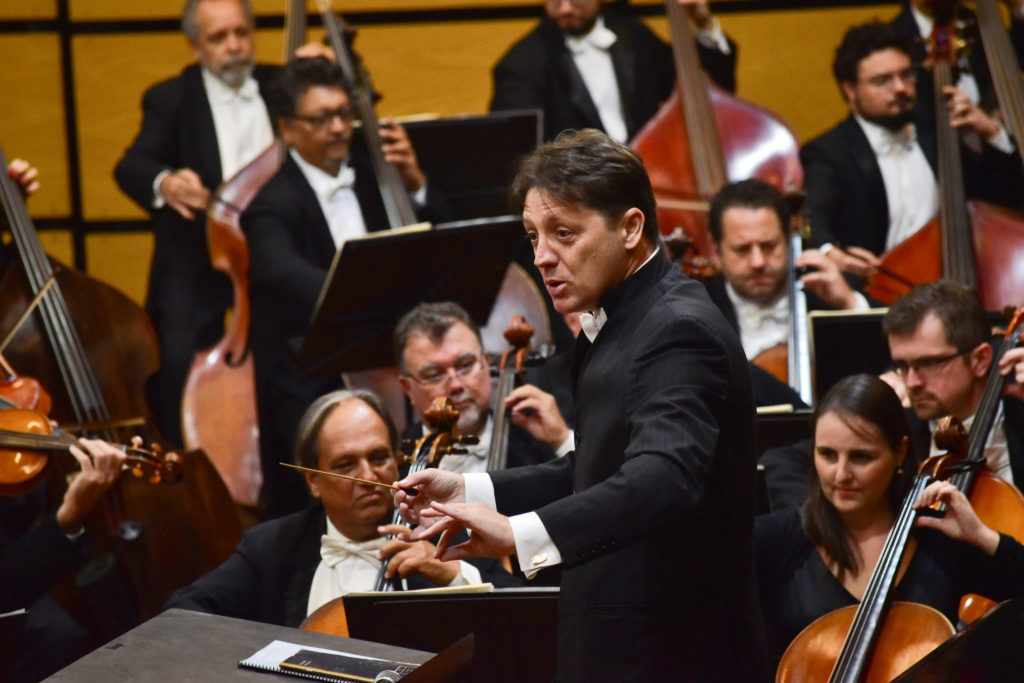
Performing a prominent role in classical music scenario, Evandro Matté holds the title of Artistic Director in the Porto Alegre Symphony Orchestra (OSPA), the SESC’s International Music Festival – Pelotas, the Theatro São Pedro Orchestra (OTSP) and the Zaffari Community Concerts (CCZ).

Recognized for leading projects with innovative results, he’s responsible for renovating orchestras, undertaking tours in Latin America and setting up social and academic programs. The development of the SESC’s International Music Festival – Pelotas and the renovation of the Music School of OSPA are some of these examples.

Furthermore, Evandro Matté has been fruitfully contributing to Brazilian culture for concepting new territories of classical music, including the construction of Teatro Unisinos and the OSPA House – the only one in South of Brazil designed to orchestral repertoire. While in discography production, his initiatives have been spotlighting national composers and performers throughout.

For his contributions, in 2019 was awarded by the Ministère de la Culture for the insignia of Chevalier de l´Ordre des Arts et des Lettres.

He’s frequently invited to collaborate as a guest conductor with orchestras around the world, including recents works in Uruguay, Argentina, Colombia, EUA, Portugal, Italy, Germany, Czech Republic, Croatia and China.


It was through the trumpet, at the age of 7, that Evandro Matté started his studies in music. When he was 15, he joined the professional orchestra of his hometown, the Symphonic Orchestra of Caxias do Sul. Settled in Porto Alegre, he started his studies at the Music School of OSPA. At the age of 19, he got the OSPA trumpeter chair and started his graduation at the Federal University of Rio Grande do Sul (UFRGS). Thereafter, he specialized at the University of Georgia (USA) and the Conservatoire de Bordeaux (FRA).

Attracted by the conducting, he started to perform as a conductor through festivals and masterclasses, being guided by prestigious maestros, such as the iconic Kurt Masur (ALE). In 2007 he took up the artistic director and conductor Unisinos Anchieta Orchestra as the. Along with the orchestra, he recorded albums emphasizing Latin American composers and performances by virtuous Brazilian musicians.

In 2011 he launched SESC’s International Music Festival – Pelotas, a project he designed in partnership with SESC. With Evandro as the artistic director, the festival has become known as one of the largest and most significant in Latin America. Besides its educational aspect, the festival also stands out for its unique role in fostering the culture of the region where it’s based.

After 25 years as a trumpeter, Evandro Matté took up the position of artistic director of OSPA. With tours, discography production, strengthening educational programs and increasing the technical and artistic level of the orchestra, his years in management are celebrated for putting OSPA back to its position of excellence among Latin American orchestras.

Further to his work ahead of OSPA, in 2013 Evandro Matté assumes the position of artistic director and conductor of the Zaffari Community Concerts (CCZ) and, in 2018, of Theatro São Pedro Orchestra (OTSP).

Beauty, California, Christian Baldini, mezzo-soprano, Singer, Soloist

Julie Miller in Conversation with Christian Baldini

On Sunday, March 12, 2023, I will have the great pleasure of conducting Mahler’s Symphony No. 2, with soprano Carrie Hennessey as our soprano soloist, and Julie Miller as our mezzo-soprano soloist at the Mondavi Center. We will include the University Chorus, Alumni Chorus, Chamber Singers, and the UC Davis Symphony Orchestra, including also several UCDSO alumni, for a total of about 300 performers on stage. Here are some questions I asked Julie about the Mahler, and below are her answers:

Christian Baldini: Julie, the Urlicht (fourth movement of the symphony) is probably one of the favorite works in the entire repertoire. All of a sudden, we hear this solitary human voice appear out of nowhere, almost like facing an abyss. How do you approach the Urlicht? What is behind it for you?

Julie Miller: Urlicht, to me represents a moment of simplicity and faith. The beautiful, effortless legato lines, and lush harmonies make this movement one of my favorite pieces to sing. As a vocalist, I have to focus on consistent air flow and a spinning vibrato to create the seemingly endless sound and legato required to successfully present this piece. However, the most import thing for me as an artist is to take the audience on a journey from desparate need to the final destination of hope and eternal rest.

CB: You and I collaborated first many years ago, when we were both a lot younger. Please tell us, how were your beginnings with music? Did you start out as a singer, or by playing an instrument? What has made your musical path so special?

JM: I remember our first collaboration with great fondness. It was Mozart’s Mass in C minor with the UC Davis Symphony. I remember your kindness, clarity and love of the piece guided me through my first performance of the piece with ease and confidence.

My musical beginnings started quite young with my mother teaching me piano and continued through High School and early college with me singing in choirs and playing the violin. I actually didn’t decide to pursue voice in a serious way until my 2nd year of college when I “caught the stage bug” during a performance of Monteverdi’s L’incoronzione di Poppea. From that point on, I was hooked. 

My musical path has had its ups and downs, and like every path, has been different than I initially thought it would be. However, what has made this journey special for me has been the people I have encountered along the way that have supported me during the “growing pains” and inspired me to continue to be the best musician and performer I can be.

CB: Thank you for sharing those wonderful memories, I also very fondly remember our Mozart C minor mass together! Now, what would be your advice for young singers? How do you face auditions, competition, and/or any other frustrations or fears that may come your way?

JM: My advice to young singers would be to know your instrument and be prepared musically. You never know who will be in the audience and when that connection will provide an opportunity down the line. Also, remember that you and your voice are in progress, so be kind to and patient with yourself. You are going to be learning and growing as a vocalist and musician throughout the rest of your career.

CB: Why is symphonic music, and why is opera relevant nowadays?

JM: Symphonic music and opera speak to us at our cores. We connect to the stories that they tell through the music and texts on a deep level and they elicit thought and conversation that lasts long past the ending of the performance. They are art forms that have survived, adapted and thrived for centuries, and their longevity continues to prove their relevance within today’s society.

CB: Thank you for your time Julie, I look forward to making music with you!

JM: Thank you for inviting me to be a part of the tour de force that is bringing this beautiful work to life! It’s always a pleasure to work with you.

Mezzo-soprano Julie Miller recently stepped in last minute on opening night to make her role debut as Ariodante (Ariodante) at Lyric Opera of Chicago. Her performance was hailed as “an extraordinarily composed and possibly career-changing performance” (Chicago Sun Times) and her singing was described as “deeply musical” (Chicago Tribune). 

​Ms. Miller has appeared as a soloist with wonderful organizations such as the Lyric Opera of ChicagoKalamazoo Symphony OrchestraOregon Mozart PlayersGrant Park Music Festival and Ravinia Festival. Recent appearances include Baroness Nica (Charlie Parker’s Yardbird) with Madison OperaLyric Unlimited/Lyric Opera Chicago and English National Opera/Hackney Empire Theatre; Charlotte (Werther) with Opera Idaho; the Mezzo Soloist with the Apollo Chorus of Chicago (Duruflé: Requiem); the Mezzo Soloist with the Sacramento Philharmonic & Opera (Beethoven: Mass in C); and the Mezzo Soloist with the Madison Symphony Orchestra (Janacek: Glagolitic Mass). In the coming months, Ms. Miller looks forward to appearing as Maddalena (Rigoletto) with the Sacramento Philharmonic & Opera and as a Mezzo Soloist in Mahler’s Symphony No. 8 with the Madison Symphony Orchestra.

​Highlights of Ms. Miller’s operatic career include Jo (Little Women) and Ma Joad (The Grapes of Wrath) with Sugar Creek Opera; Emilia (Otello), Ida (Die Fledermaus), Annina (La Traviata) and Krystina (The Passenger) with Lyric Opera of Chicago; Orlofsky (Die Fledermaus) with Vero Beach Opera; Annio (La clemenza di Tito) and Donna Elvira (Don Giovanni) with Ryan Opera Center; Stéphano (Roméo et Juliette) with Townsend Opera; and Flora (La Traviata) with Festival Opera. She has also been heard with orchestra as a Soloist in performances of  Mahler’s Symphony No. 2, Bach’s Magnificat and Cantata No. 6, Handel’s Messiah, Duruflé’s Requiem, Beethoven’s Symphony No. 9, and both Mozart’s Mass in C minor and Requiem.

Ms. Miller is the recipient of the the Jerome and Elaine Nerenberg Foundation Scholarship (Musicians Club of Women), the Rose McGilvray Grundman Award (American Opera Society of Chicago), the Richard F. Gold Career Grant (Shoshana Foundation) and the Edith Newfield Scholarship Award (Musicians Club of Women). She is an alumna of the renowned Patrick G. and Shirley W. Ryan Opera Center at Lyric Opera of Chicago, and a member of the inaugural class of Dawn Upshaw’s Graduate Program in Vocal Arts at the Bard College Conservatory of Music.

Beauty, Buenos Aires, California, Christian Baldini, composer, Music, Singer, Soloist, soprano, Teatro Colón, tenor

Rising Star Tenor Edward Graves in Conversation with Christian Baldini

On February 5, 2023, tenor Edward Graves will sing Rodolfo for our upcoming Barbara K. Jackson Rising Stars of Opera program at the Mondavi Center, in collaboration with the San Francisco Opera Center. Here is a conversation we had with Edward about Puccini, the prestigious Adler Fellowship, auditions, opera in general, and his advice for young singers.

Christian Baldini: Tell us, how did you start singing? When did you first get exposed to the operatic genre, and when did the “bug” first get you about becoming an opera singer?


Edward Graves: I feel like I’ve been singing my whole life. I started singing when I was in church and sang in choirs all throughout elementary, middle, and high school. I also took private piano and voice lessons up until I graduated high school. When I got to college, I intended to be a music education major, but ended up getting cast in Mozart’s “The Goose of Cairo” my freshman year. I didn’t think too much of it at the time, but I realized that the other singers in my class didn’t get cast. After that experience and through the encouragement of my professors, I switched my major to vocal performance and have been on this Opera path ever since. 

CB: What are some of your favorite operas, and why?


EG: That’s such a hard question because I feel don’t know enough operas to have definitive and favorites. I am drawn to operas that have lasting tuneful melodies (or “earworms”) that get stuck in my head. Some operas that come to mind are Don Giovanni, Werther, Manon, Rodelinda,  La Bohème, Tosca, La Fanciulla del West, Rigoletto, La Traviata, and Aida. Sometimes my scope of appreciation is narrowed in on what I’m studying so in addition to La Bohème, I’m studying and preparing the role of Anatol in Samuel Barber’s Vanessa. As I’m getting to know this opera, I’m also gaining a newfound appreciation for its gorgeous melodies as well. 

CB: Have you worked with living composers? If so, how was that experience?

EG: Yes—I’ve had the opportunity to work with two well-known living composers. In 2019, I was a in the premiere of Blue at The Glimmerglass Festival. Jeanine Tesori not only attended many of the rehearsals, she also made revisions during the rehearsal process. At the beginning of one staging rehearsal, she handed the cast sheet music to read through and added it to the show. I remembered thinking how cool it was to be in the room with the composer of the show that I was working on because I normally don’t have that luxury. Last week I performed in a workshop of Jake Heggie’s new opera, Intelligence. I really enjoyed the collaborative process of the workshop and being empowered to speak up if something was written in an awkward way or wasn’t working for me. In the aria that my character sang, Jake encouraged me to use my head voice in the last few bars instead of singing full voice which better helped to convey the character’s vulnerable emotional state. A nice thing about premiering a role or workshopping a piece is that you really get to make it your own. You don’t have other singers to compare yourself to or a standard to live up to.  

CB: You are a part of one of the main young artist program in the world, as an Adler Fellow for the San Francisco Opera Center. What are some of your favorite perks of this position? 

EG: In addition to the resources of the company (in the form of language classes, acting classes, voice lessons, coachings, and steady paycheck,) I have the opportunity to see and go be a part of the process of what it takes to get an opera from the rehearsal room to the stage. It has been really cool to apply what I do in the studio and bring it to the rehearsal room, and then to the stage. It has also been an incredible learning opportunity to watch guest artists throughout a rehearsal process. I feel like I’ve learned so much just by watching!  I’ve gained an appreciation for the process that it takes from learning a role embodying a character. There are so many layers and nuances of characterization and I feel like I’m just beginning to tap into discovering my own artistry.

CB: Tell us about the auditioning process. How was your preparation for it? Is it extremely competitive? How is the atmosphere once you are in the program?

EG: Auditioning is a skill. It can be hard to try and give your all in a ten minute time slot and then prepare yourself for not getting the job that you’re auditioning for. It can also be intimidating to sing for a panel that has never heard you before or isn’t familiar with your work. Prior to an audition, I try and remind myself to just think about communicating the text of whatever aria I’m singing. I know that I’ve done all the technical work so I try just have “fun.” Adler Fellows are chosen from the Merola Opera Program which I think is more competitive to get into because over one thousand singers, pianists, and stage directors apply annually. I haven’t found being in the Merola Opera Program or the Adler Fellowship to be competitive because the only person I’m in competition with is myself. I’m always trying to improve—my vocal technique, my languages, my acting, stage craft, etc. Being in Merola and now the Adler Fellowship has helped me to improve in those areas. Each artist has their own path and it’s hard to not compare yourself to your colleagues, but our paths are different and we are all at different stages of our development.

CB: Why is opera important to you? What does it mean in today’s world?

EG: At its best, opera is the combination of music, spectacle, and incredible singing. When I go to see an opera, I’m looking for those three things. I want to be entertained, moved, and to leave the theater a little better than when I came in. I liken it to going to any other live theater event. 

CB: What would you say about La Bohème, and about Mimì or Rodolfo to someone who does not know the opera? What should people listen for in this kind of music?

EG: La Bohème is a great “first” opera. The music is beautiful and lush and the plot is easy to follow. It is a love story between Mimì and Rodolfo that I  think that a new audience member could relate to. 

CB: Do you have any suggestions or recommendations for young singers?

EG: I think it’s important to always remember why you love to sing and in times of doubt, come back to that. A voice teacher told me once that “this a is marathon, not a sprint” and I began to understand what she meant the more I kept singing. This is a very long journey full of ups and downs—there might be times where you question if you want to pursue singing after facing a setback. Another piece of advice I would offer a young singer is to develop interests outside of singing. Sometimes singing can be all consuming and it can be easy tie your identity and worth to your ability to sing.

CB: Thank you very much for your time, we are delighted to feature you at our Rising Stars of Opera program!

EG: Thank you so much for having me. I hope that folks are able to come and enjoy the performance.


Praised by Opera News as a tenor of “stunningly sweet tone,” Edward Graves is a second-year Adler Fellow at San Francisco Opera. His most recent Bay Area performances include a workshop of Jake Heggie’s upcoming world premiere opera Intelligence with Houston Grand Opera, as well as Stone/Eunuch in Bright Sheng’s Dreams of the Red Chamber and Gastone in La traviata, both on the San Francisco Opera mainstage. At SFO, he also covered the roles of Alfredo in La traviata and Lensky in Eugene Onegin before engaging in a “thrilling who-can-sing-it-higher face-off from Rossini’s Otello” (San Francisco Chronicle) in the Adler Fellowship’s The Future Is Now concert.

Elsewhere, he has recently joined Virginia Symphony for Handel’s Messiah, Detroit Opera as Policeman 2 in Tesori’s Blue, and Berkshire Choral International as the title role in Judas Maccabaeus. His appearance in Merola Opera Program’s What The Heart Desires earned a San Francisco Chronicle rave for his “superbly bright, clarion sound.” Upcoming performances with San Francisco Opera include Rodolfo in Bohème out of the Box, Ruiz in Il trovatore, and Nobleman in Lohengrin. He also covers the title role in Rhiannon Giddens’ Omar at SFOand makes his Spoleto Festival USA debut as Anatol in Vanessa.

Additional credits include Rinuccio in a double bill of Puccini’s Gianni Schicchi and Ching’s Buoso’s Ghost with Michigan Opera Theatre, Robbins in Porgy and Bess with Seattle Opera, and Policeman 2 in the world premiere of Blue at the Glimmerglass Festival, where he also sang Fred in Oklahoma! and Peter in Porgy and Bess. As a Baumgartner Studio Artist at Florentine Opera, he performed roles in The Merry WidowVenus and Adonis / Dido and Aeneas and The Magic Flute.

Graves is a 2022 San Francisco District winner of the Metropolitan Opera’s Laffont Competition. Following his bachelor studies in Voice Performance at Towson University, he received his Performer Diploma and Master of Music in Voice Performance from Indiana University’s Jacobs School of Music.

While at IU, Graves participated in a Game of Thrones-inspired production of Rodelinda and has since been drawn to the virtuosic music of Handel. He strives to create the perfect combination of text, music, and spectacle required to impact audiences emotionally, and he advises that all new works be seen at least twice.

Beauty, Buenos Aires, California, Christian Baldini, Music, Singer, Soloist, soprano, Symphony Orchestra, Teatro Colón, tenor

Rising Star Soprano Mikayla Sager in Conversation with Christian Baldini

On February 5, 2023, soprano Mikayla Sager will sing Mimì for our upcoming Barbara K. Jackson Rising Stars of Opera program at the Mondavi Center, in collaboration with the San Francisco Opera Center. Here is a conversation we had with Mikayla about Puccini, the prestigious Adler Fellowship, auditions, opera in general, and her advice for young singers.

Christian Baldini: What are some of your favorite operas, and why?

Mikayla Sager: Some of my favorite operas are Der Rosenkavalier, La Traviata, Il Trovatore, Adriana Lecouvreur, Don Giovanni, and Eugene Onegin. I am typically drawn to operas with very fleshed out characters with interesting and dynamic relationships to one another. I love fiery, passionate roles, and have found I can either relate the role I sing/would sing from each of those operas listed. 

CB: Have you worked with living composers? If so, how was that experience? If not, what would you hope to gain from such a relationship?

MS: I don’t have extensive experience working with living composers, but I have greatly enjoyed the times that I have. When I have in the past, I found it very fun to watch the creativity of a composer unfold before me, and to see how flexible things can be to suit the particular singer they are writing for. It is much easier to deeply understand the character you are portraying when the composer is in the room, and you can consistently have conversations revolving around the creation of that role. 

CB: You are a part of one of the main young artist programs in the world, as an Adler Fellow for the San Francisco Opera Center. What are some of your favorite perks of this position? 

MS: The Adler fellowship is a particularly unique and special program, because we are given extensive performance experience on one of the largest operatic stages in the world. I think the greatest “perk” would be knowing that you will always be given the support you need to prepare your assigned roles at the highest level, as we have access to some of the greatest coaches and mentors in the world. There are of course other perks, such as having exposure to important people in the industry, but I would say the most important thing for me personally is knowing that I am constantly supported by people with extremely sharp ears!

CB: Tell us about the auditioning process. How was your preparation for it? Is it extremely competitive? How is the atmosphere once you are in the program?

MS: The first step is applying to the Merola opera program, which is a three month long summer festival that operates adjacently to the Adler fellowship. You apply online with audio samples, and from there you are either granted an audition or asked to apply again in the future. They usually receive over a thousand applicants. From there, you audition live, and then they on average accept 25 people. During your time at Merola, you audition for San Francisco opera on the war memorial stage, and that is when they make decisions as to who will be picked for the Adler Fellowship. At the end of the summer, they notify however many people they decide to pick for the coming Adler fellowship year. In my year they picked four singers, and one pianist. It is considered extremely competitive, and you are expected when you are in the program to be always prepared and extremely professional.

CB: Why is opera important to you? What does it mean in today’s world?

MS: Opera is important to me because I think it is an art form that can make us understand each other on a deeper level. Opera evokes big emotions and revolves around subject matter that we don’t typically encounter in everyday life. For me personally, I find it can make us relate to each other beyond surface level or superficial things. I think often we can learn a lot of life lessons through the vehicle that is opera.

CB: What would you say about La Bohème, and about Mimì (or Rodolfo) to someone who does not know the opera? What should people listen for in this kind of music?

MS: La Boheme is an opera full of luscious, gorgeous lines that are extremely pleasing for the listener. Mimi is a very pure character, with a big heart and a lot of love to give. Mimi and Rodolfo’s love story is extremely heartbreaking, and has to be taken in context of the period it was written in. I think it is important for the audience to remember that because of the lack of medicine to cure Mimi’s illness, that she is an extremely selfless character and despite having absolutely nothing and in need of some help. Because we are only doing Act I, this facet of her character won’t necessarily be seen, but I do think it is important should the audience then go and see to the rest of the opera. From a musical standpoint, I think the audience should let this extremely romantic music just wash over them, and leave the hall reminded of the feeling of falling in love.

CB: Do you have any suggestions or recommendations for young singers?

MS: my biggest piece of advice to young singers is to keep your blinders up and focus on your own progress. Try to not waste time thinking about what other people are doing and focus on how you can grow your artistry.

Canadian soprano Mikayla Sager is fascinated by the richly drawn, unapologetically intense characters of the verismo repertoire. Following her recent concert performance with San Francisco Opera, the Chronicle declared her “an extraordinarily gifted young soprano… Sager delivered Desdemona’s arias with a combination of intensity and hushed majesty.” When Sager is onstage, audiences are guaranteed a multidimensional portrayal that balances authentic vulnerability and full-blooded strength.

As a second-year Adler Fellow, Sager performs on stages across California this season. In San Francisco Opera’s centennial, she appears on the War Memorial mainstage as Sister Felicité in Dialogues des Carmélites, Kate Pinkerton in Madama Butterfly, Guardian of the Temple in Die Frau ohne Schatten, and as Image No. 1 in the world premiere of Gabriela Lena Frank’s El ultimo sueño de Frida y Diego. Elsewhere, she brings her Mimì to performances with Bohème out of the Box and the UC Davis Symphony Orchestra. Additional concert appearances include The Future is Now, the Adler Fellowship’s final concert, and Eun Sun Kim Conducts Verdi, under the baton of SFO’s new music director.

Sager has previously appeared as Violetta (La traviata), Fiordiligi (Così fan tutte), Vitellia (La clemenza di Tito), Micäela(Carmen), and Donna Anna (Don Giovanni), as well as Pamina (Die Zauberflöte) and The Fox (The Cunning Little Vixen) during her education at Manhattan School of Music. Following her debut as Norina (Don Pasquale) with Venture Opera, Opera Canada praised her “edgy intensity… she augmented her vocal prowess with enviable acting skills.” Concert highlights include a concert at Festival Napa Valley, conducted by James Conlon, a Hawaii International Music Festival tour, numerous recitals, including an appearance at Carnegie Hall, and a performance at David Geffen Hall with the New York Philharmonic.

Sager has earned recognition and support from the Joan Sutherland and Richard Bonygne Foundation’s Elizabeth Connell Competition, Jensen Foundation Vocal Competition, Metropolitan Opera National Council Auditions (District Winner), Vienna International Music Competition, Festival Napa Valley’s Manetti Shrem Prize, National Opera Association’s Carolyn Bailey and Dominick Argento Competition, and Gran Teatre del Liceu’s Tenor Viñas Competition in Barcelona.

Sager draws inspiration from many other art forms, include architecture and ceramics, as well as an unconventional childhood aboard a sailboat that traveled around the world. These days, her travel companion is her rescue dog Remy, whose fiery personality would suit any operatic stage.

Alejandro Civilotti, Buenos Aires, California, Cello, Christian Baldini, composer, Compositor, Conductor, Eduardo Vassallo, España

Alejandro Civilotti en diálogo con Christian Baldini

Christian Baldini: Conocí a Alejandro Civilotti hace quizás una década, en un concierto que yo estaba dirigiendo en Buenos Aires junto a la Orquesta Sinfónica Nacional. Allí, afortunadamente tuvimos en el programa una pieza de Alejandro (Elegía por Julia Ponce, de Lavapiés). Querido Alejandro, será un placer dirigir el estreno en los Estados Unidos de tu obra para cello y orquesta Auris Concertum, junto al gran Eduardo Vassallo y la UC Davis Symphony Orchestra. Cuéntame por favor, cómo comenzó la génesis de esta pieza? Sé que está relacionada al implante coclear que has recibido, y su dedicación a Su Majestad la Reina Sofía también viene relacionada a su ayuda para garantizar que esta operación sucediera. Me encantaría que nos cuentes el fondo de todo esto.

Alejandro Civilotti: Ante todo gracias por recordar el concierto en que nos conocimos y estrenamos Elegía por Julia Ponce. Es un gran recuerdo para mí también!

Respecto a Auris Concertum: 

Esta obra fue escrita en el lapsus entre el momento en que me llaman de la Fundación García Ibáñes a instancias de la Casa Real, para notificarme que van a realizarme los estudios previos a realizarme el Implante Coclear. Su nombre está relacionado con una publicación que se llamaba “Auris” que pude hojear mientras esperaba a ser atendido, y a modo de comentario he de decir que el ciclo Auris tiene dos obras: la primera es la que ahora se estrena en EEUU, para Violoncello y gran orquesta, y la segunda, escrita luego de haber sido implantado titulada “Auris Resonantiam”, que es para Violín y gran orquesta. las dos obras forman una pareja.

El tiempo previo a la intervención fue de poco más que un mes o mes y medio, fue el tiempo que llevó la composición de la obra. La misma la terminé la mañana en que iba a ingresar al quirófano. Así que gran parte de lo que esa obra cuenta, está teñida de lo que sentí en ese momento, en que oscilaba entre una gran expectativa e ilusión, y a la vez temor, nostalgia, en fin, un sin número de sensaciones. Es como si en esos días -y por lo tanto en esa obra- estuviera sometido a un carrusel de sentimientos e imágenes de una parte importante de mi vida. Por lo tanto, ya que toda obra es un trozo de nuestra biografía, decidí volcar todo eso en una obra dónde a modo de símbolo, un protagonista se enfrentara a todo eso. Y me pareció el Cello el instrumento más adecuado por sus posibilidades expresivas, sus recursos y además porque era conocido que la Reina tenía predilección por el instrumento, y a modo de agradecimiento pensé en escribir la obra, como un gesto de buena educación: más bien soy anti monárquico! La segunda del ciclo está dedicada a los médicos que me intervinieron y a la Fundación García Ibáñez en su conjunto.   

CB: Cómo era tu vida antes del implante, y cómo te ha cambiado desde allí? Musicalmente has sentido que las cosas son diferentes a raíz de estos cambios?

AC: Lo que principalmente ha cambiado es en la comunicación con las personas. Por poner un ejemplo, yo estuve doce años sin poder atender el teléfono…. respecto a la audición musical, ha mejorado mucho, sobre todo en cuanto a lo que escucho en la parcela rítmica, que se escucha perfecto, un poco menos en la cuestión melódica y armónica. El implante coclear es algo que se crea a partir de investigaciones tendientes a intentar que los niños que nacen sordos, no sean a la vez mudos. Así que pone todo su acento en el lenguaje; aunque lógicamente todo ha ido mejorando desde mi intervención. Pero la música abarca frecuencias que difícilmente puedan ser  cubiertas en su totalidad por un implante que en definitiva es un reemplazo del oído. Pero es un gran avance y en mi caso me supuso un disparador motivacional. Pero he de decir que desde hace muchos años, tal vez a causa de este problema, me habitué a atender mi oido interno: escucho internamente, y hasta con los ojos cuando miro una partitura, y eso lo veo una ventaja.

CB: Cómo describirías tu música para alguien que nunca la ha escuchado?

AC: Resulta difícil responder a esa pregunta, ya que a mi entender no escuchamos sólamente con el oído, escuchamos con la cultura, es decir, escuchamos con la que hemos escuchado! Tal vez la mejor descripción posible, que no soy yo el más indicado en hacerla, es que es música que cree en la melodía, aunque ésta sea con una gran carga disonante, con una cierta agresividad… Me atrae mucho la cuestión del timbre y sus posibilidades expresivas, el ritmo. Es una música que no sirve como música de fondo, para poder pensar en otra cosa: intenta activar la complicidad del oyente, atrapar su atención. En todo caso, con errores y aciertos, intento defender la idea de que la música es transversal, su naturaleza es generar ese punto de encuentro sensible entre el que la crea, el que la interpreta y el que la recibe. Su sentido está en esa comunicación, y hasta diría que toda estrategia como forma, es la manera posible que ha encontrado quien la ha creado para llegar al público. Todo lo que escribo está orientada en ese sentido y confieso, hasta imagino la luz y la situación de escena a la hora es escribir una música.

CB: Sé que también te interesa la ópera. ¿Me contarías acerca de proyectos que te gustaría componer? ¿En dónde buscas tu inspiración?

AC: La ópera es una parte muy importante en mi creación. Es un lugar en que confluyen mis ideas, tanto musicales como de otra índole. He escrito bastante, aunque al ser un terreno en que se hace necesaria la inversión de grandes presupuestos, son de difícil salida.

Ahora mismo estoy escribiendo lo que sería mi quinta ópera: sobre la historia de Faetón, un ser perteneciente a la mitología griega que es el creador de la Vía Láctea. será una ópera en tres actos y trabajo sobre un excelente libreto del excelente maestro, que es a la vez experto en literatura y cine, a la vez músico – toca bandoneón – Gustavo Provitina, de Argentina.

También estoy trabajando en un tríptico, una ópera en tres actos con una historia diferente en cada acto, pero que configuren una mirada digamos cosmogónica. De ella hay escrito un acto y la mitad de otro. Sus historias serán un fragmento del cuento de Oscar Wilde “El ruiseñor y la rosa”, el otro será un mito solar de vinculación con el mundo griego, y el tercero será sobre la idea cosmogónica del pueblo Wichi, originario del gran Chaco americano. De esta tercera parte ya hay escrita mucha música, pero aún se está elaborando el libreto.

Después tengo dos óperas de cámara, una se ha llevado a la escena en 2007 en Badalona (Barcelona), dentro del contexto Teatro por la identidad de las Abuelas de Plaza de Mayo, y la segunda titulada “La escala”, ópera de cámara que trata sobre el tema identitario del pueblo catalán. Las historias y sus correspondientes  libretos de estas dos óperas, las realizó mi hijo Diego Civilotti, con el cual llevamos toda una vida de relación creativa, pues él es Filósofo muy vinculado al tema de la creación artística, además es músico y escritor. Con él realizamos tal vez el trabajo de mayor envergadura en ese terreno: la obra escénico musical titulada “Karaí, el héroe”, realizada sobre la novela del gran escritor y antropólogo argentino Adolfo Colombres. Obra de tres horas de duración, en tres actos.

Y hay en proyecto dos óperas más, una será una mirada contemporánea de Las Bacantes.

Además de estas obras, y atendiendo a algo que atraviesa todo lo que hago, que es mi interés por  las causas sociales (diría que más del 80% de lo que he escrito está dentro de esa órbita de “lo social”), estoy preparando la creación de una obra sobre Armenia: será para gran orquesta con Violín concertante.

CB: Qué consejos le darías a jóvenes compositores que están iniciándose en esta carrera?

AC: Lo primera es que ésto no es una carrera…ja.ja. Para mí es una herramienta para narrar lo que vemos y sentimos frente a eso que vemos. Una narrativa posible sobre un trozo de nuestra biografía. Por lo tanto mis consejos van en el sentido que intentar construir su propia narrativa personal. Escuchar mucha música, lo digo siempre, escuchamos con la cultura y aquello que pasa a formar patrimonio de lo que es bello, en realidad es aquello que podemos reconocer, aquello que hemos escuchado, escuchamos con lo escuchado! Leer muchos libros, acercarse a las artes plásticas, en fin, abrirse a todo lo que ocurre para luego, desde la sensibilidad personal, desde una identificación sensible, elegir el camino.

La búsqueda de los elementos técnicos, con ser importantes y que hay que obviamente asumirlos, son simplemente herramientas, tal como dice un poema de estética taoista ” el propósito las palabras es transmitir ideas, una vez transmitidas éstas, las palabras se olvidan…”, las palabras-técnica, es algo que hay “que olvidar” y centrar nuestra atención en la idea. Algo así como no cometer el error de señalar la luna y mirarse el dedo. 

CB: Muchas gracias, desde ya. Será un placer dirigir tu música nuevamente!

AC: El placer es mío! Me hace gran ilusión esta interpretación en calidad de estreno en EEUU, en manos de tu excelente trabajo de dirección, y en la maravillosa interpretación en cello sólo, del gran Maestro Eduardo Vassallo a quien me une una profunda amistad y admiración sin límites. 

Alejandro Civilotti (foto de cortesía)

Alejandro Civilotti (La Plata, Argentina, 1959)

Compositor argentino nacionalizado español, Alejandro Civilotti (1959) es profesor del Conservatorio de Badalona donde imparte desde 1988 armonía, contrapunto y composición y de la Escuela Superior del Taller de Músics, donde imparte orquestación. A partir de 1977 realizó estudios de armonía, contrapunto y composición en su ciudad natal con Enrique Gerardi, discípulo de Alberto Ginastera y de Nadia Boulanger. Al finalizar esa formación a finales de 1984, Civilotti viajó a Barcelona, donde comenzó a estudiar composición e instrumentación con Josep Soler, discípulo de René Leibowitz en París y de Cristòfor Taltabull en Barcelona. Entre otros, ha sido Premio Reina Sofía de Composición, Premio Ciudad de Barcelona, Premio de Composición Casa de las Américas y Premio Internacional Ciutat de Tarragona. Asimismo, ha recibido encargos de instituciones nacionales e internacionales, como el Centro para la Difusión de la Música Contemporánea (CDMC) o el Ministerio de Cultura de Francia.

Su extenso catálogo cuenta con obra vocal, de cámara, para piano, ópera, música para cine, obra para orquesta… y 7 sinfonías que abarcan su etapa de madurez, desde la Sinfonía n.º 1 (1985) hasta la dedicada a sus padres Sinfonía “Requiem” n.º 7 (2018). Entre sus estrenos recientes destaca el de Solitudes en el Ciclo de cámara de la London Symphony Orchestra, Aché para actriz declamando, violonchelo solo y sexteto de percusión el la temporada de cámara de la City of Birmingham Symphony Orchestra, y el de Letanías para violonchelo y piano, por Marc Renau dentro del proyecto catalán “El violoncel desconegut”. En diciembre de 2022, tendrá lugar el estreno de Cosmos para Orquesta Sinfónica, dedicada a Michel Onfray, por la Philharmonisches Staatsorchester de Mainz bajo la dirección de Daniel Montané. 

Alejandro Civilotti (La Plata, Argentina, 1959)

Alejandro Civilotti was born in La Plata in 1959 and has spent most of his professional career in Spain. He has been a professor of harmony, counterpoint and composition since 1988 at the Badalona Conservatory of Music, and he is professor of orchestration at the Taller de Músics Bachelor of Music. From 1977 onwards, he studied harmony, counterpoint and composition for five years in his hometown under Enrique Gerardi, a pupil of Alberto Ginastera and Nadia Boulanger. After finishing his training at the end of 1984, Civilotti travelled to Barcelona, where he began to study composition and instrumentation under Josep Soler, a pupil of René Leibowitz in Paris and Cristòfor Taltabull in Barcelona and one of the most important composers of his generation in Spain. Among others, he won the Queen Sofía Composition Prize, the City of Barcelona Award. He also received some commissions from the Centre for the Dissemination of Contemporary Music (CDMC) for the International Contemporary Music Festival of Alicante, and a commission from the French Ministry of Culture.

His extensive list of works includes many compositions for voice, for piano, for orchestra, music for cinema, opera, etc., as well as seven symphonies that encompass his mature period, from Symphony No. 1 (1985) to the symphony dedicated to his parents Symphony No. 7: Requiem (2018). Among his most recent world premieres are Solitudes in the chamber season of the London Symphony Orchestra, and Aché for actress reciting, solo violoncello and percussion sextet with Eduardo Vasallo as a cello soloist during the chamber season of the City of Birmingham Symphony Orchestra. Next December 2nd will be premiered his work Cosmos for Symphony Orchestra with the Philharmonisches Staatsorchester de Mainz under the direction of Daniel Montané.