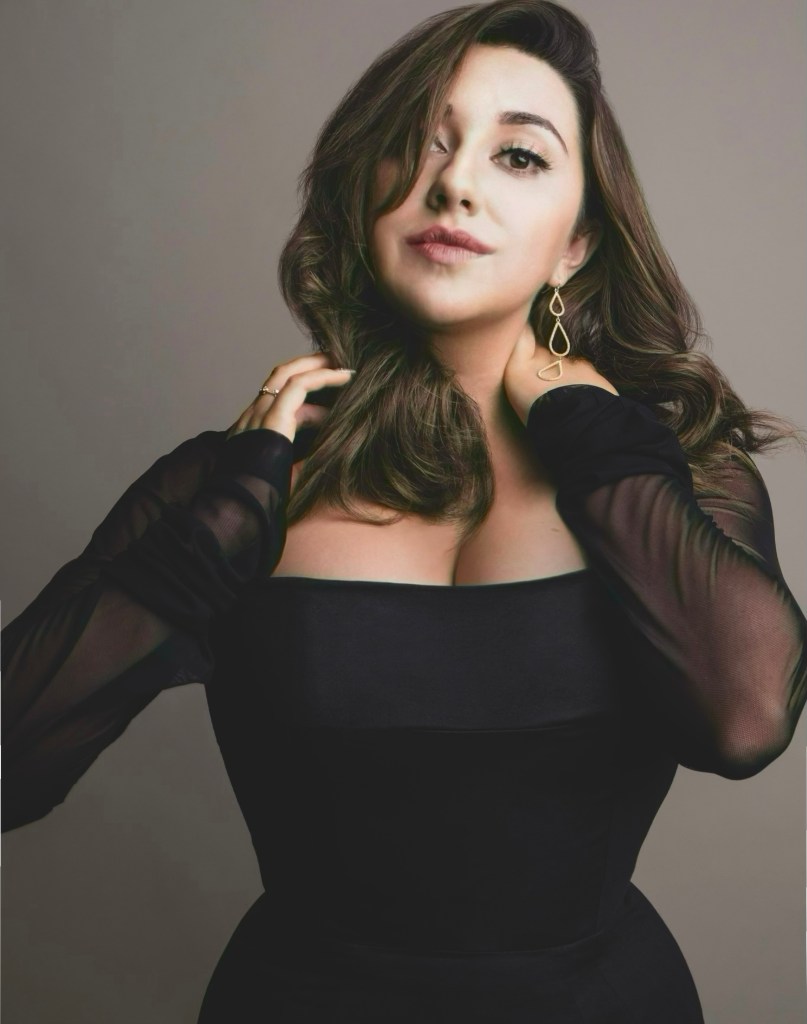
On February 5, 2023, soprano Mikayla Sager will sing Mimì for our upcoming Barbara K. Jackson Rising Stars of Opera program at the Mondavi Center, in collaboration with the San Francisco Opera Center. Here is a conversation we had with Mikayla about Puccini, the prestigious Adler Fellowship, auditions, opera in general, and her advice for young singers.
Mikayla Sager: Some of my favorite operas are Der Rosenkavalier, La Traviata, Il Trovatore, Adriana Lecouvreur, Don Giovanni, and Eugene Onegin. I am typically drawn to operas with very fleshed out characters with interesting and dynamic relationships to one another. I love fiery, passionate roles, and have found I can either relate the role I sing/would sing from each of those operas listed.
CB: Have you worked with living composers? If so, how was that experience? If not, what would you hope to gain from such a relationship?
MS:I don’t have extensive experience working with living composers, but I have greatly enjoyed the times that I have. When I have in the past, I found it very fun to watch the creativity of a composer unfold before me, and to see how flexible things can be to suit the particular singer they are writing for. It is much easier to deeply understand the character you are portraying when the composer is in the room, and you can consistently have conversations revolving around the creation of that role.
CB: You are a part of one of the main young artist programs in the world, as an Adler Fellow for the San Francisco Opera Center. What are some of your favorite perks of this position?
MS:The Adler fellowship is a particularly unique and special program, because we are given extensive performance experience on one of the largest operatic stages in the world. I think the greatest “perk” would be knowing that you will always be given the support you need to prepare your assigned roles at the highest level, as we have access to some of the greatest coaches and mentors in the world. There are of course other perks, such as having exposure to important people in the industry, but I would say the most important thing for me personally is knowing that I am constantly supported by people with extremely sharp ears!
CB: Tell us about the auditioning process. How was your preparation for it? Is it extremely competitive? How is the atmosphere once you are in the program?
MS: The first step is applying to the Merola opera program, which is a three month long summer festival that operates adjacently to the Adler fellowship. You apply online with audio samples, and from there you are either granted an audition or asked to apply again in the future. They usually receive over a thousand applicants. From there, you audition live, and then they on average accept 25 people. During your time at Merola, you audition for San Francisco opera on the war memorial stage, and that is when they make decisions as to who will be picked for the Adler Fellowship. At the end of the summer, they notify however many people they decide to pick for the coming Adler fellowship year. In my year they picked four singers, and one pianist. It is considered extremely competitive, and you are expected when you are in the program to be always prepared and extremely professional.
CB: Why is opera important to you? What does it mean in today’s world?
MS:Opera is important to me because I think it is an art form that can make us understand each other on a deeper level. Opera evokes big emotions and revolves around subject matter that we don’t typically encounter in everyday life. For me personally, I find it can make us relate to each other beyond surface level or superficial things. I think often we can learn a lot of life lessons through the vehicle that is opera.
CB: What would you say about La Bohème, and about Mimì (or Rodolfo) to someone who does not know the opera? What should people listen for in this kind of music?
MS:La Boheme is an opera full of luscious, gorgeous lines that are extremely pleasing for the listener. Mimi is a very pure character, with a big heart and a lot of love to give. Mimi and Rodolfo’s love story is extremely heartbreaking, and has to be taken in context of the period it was written in. I think it is important for the audience to remember that because of the lack of medicine to cure Mimi’s illness, that she is an extremely selfless character and despite having absolutely nothing and in need of some help. Because we are only doing Act I, this facet of her character won’t necessarily be seen, but I do think it is important should the audience then go and see to the rest of the opera. From a musical standpoint, I think the audience should let this extremely romantic music just wash over them, and leave the hall reminded of the feeling of falling in love.
CB: Do you have any suggestions or recommendations for young singers?
MS: my biggest piece of advice to young singers is to keep your blinders up and focus on your own progress. Try to not waste time thinking about what other people are doing and focus on how you can grow your artistry.
Canadian soprano Mikayla Sager is fascinated by the richly drawn, unapologetically intense characters of the verismo repertoire. Following her recent concert performance with San Francisco Opera, the Chronicle declared her “an extraordinarily gifted young soprano… Sager delivered Desdemona’s arias with a combination of intensity and hushed majesty.” When Sager is onstage, audiences are guaranteed a multidimensional portrayal that balances authentic vulnerability and full-blooded strength.
As a second-year Adler Fellow, Sager performs on stages across California this season. In San Francisco Opera’s centennial, she appears on the War Memorial mainstage as Sister Felicité in Dialogues des Carmélites, Kate Pinkerton in Madama Butterfly, Guardian of the Temple in Die Frau ohne Schatten, and as Image No. 1 in the world premiere of Gabriela Lena Frank’s El ultimo sueño de Frida y Diego. Elsewhere, she brings her Mimì to performances with Bohème out of the Box and the UC Davis Symphony Orchestra. Additional concert appearances include The Future is Now, the Adler Fellowship’s final concert, and Eun Sun Kim Conducts Verdi, under the baton of SFO’s new music director.
Sager has previously appeared as Violetta (La traviata), Fiordiligi (Così fan tutte), Vitellia (La clemenza di Tito), Micäela(Carmen), and Donna Anna (Don Giovanni), as well as Pamina (Die Zauberflöte) and The Fox (The Cunning Little Vixen) during her education at Manhattan School of Music. Following her debut as Norina (Don Pasquale) with Venture Opera, Opera Canada praised her “edgy intensity… she augmented her vocal prowess with enviable acting skills.” Concert highlights include a concert at Festival Napa Valley, conducted by James Conlon, a Hawaii International Music Festival tour, numerous recitals, including an appearance at Carnegie Hall, and a performance at David Geffen Hall with the New York Philharmonic.
Sager has earned recognition and support from the Joan Sutherland and Richard Bonygne Foundation’s Elizabeth Connell Competition, Jensen Foundation Vocal Competition, Metropolitan Opera National Council Auditions (District Winner), Vienna International Music Competition, Festival Napa Valley’s Manetti Shrem Prize, National Opera Association’s Carolyn Bailey and Dominick Argento Competition, and Gran Teatre del Liceu’s Tenor Viñas Competition in Barcelona.
Sager draws inspiration from many other art forms, include architecture and ceramics, as well as an unconventional childhood aboard a sailboat that traveled around the world. These days, her travel companion is her rescue dog Remy, whose fiery personality would suit any operatic stage.
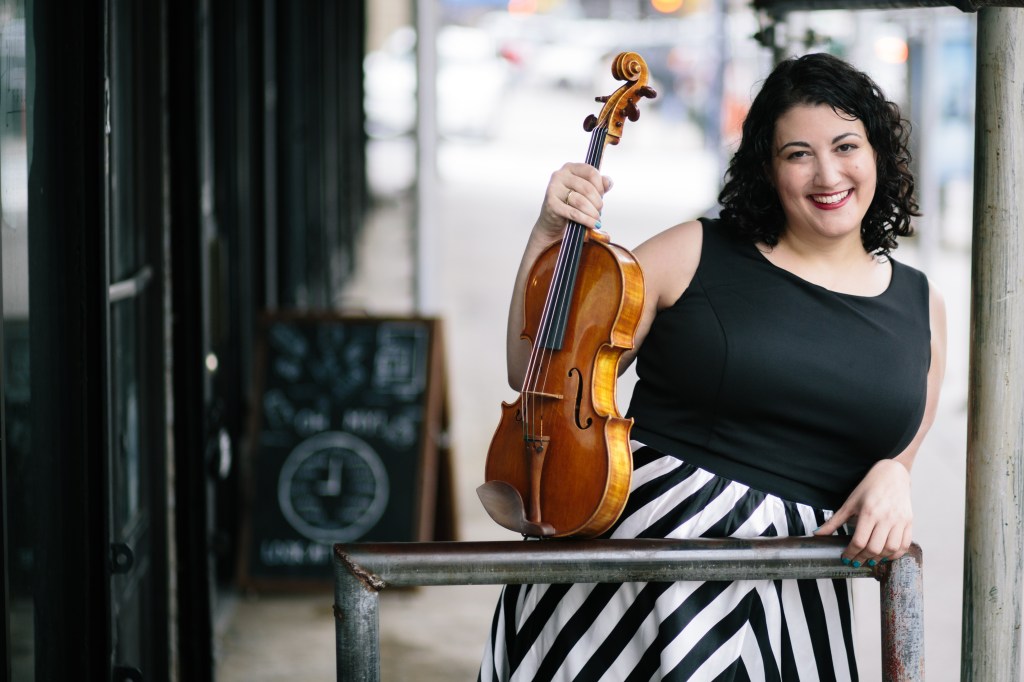
On Friday, October 14, 2022, I will be conducting Harold in Italy, by Hector Berlioz at the Mondavi Center in Davis. Our distinguished soloist with the UC Davis Symphony Orchestra will be Wendy Richman, a highly acclaimed viola player who has been hailed by The New York Times and The Washington Post for her “absorbing,” “fresh and idiomatic” performances with “a brawny vitality,” I had the opportunity to ask Wendy a few questions in preparation for our performance, and below are her responses.
Christian Baldini: Wendy, welcome, I am delighted to have you with us at the Mondavi Center to perform this marvelous music with our orchestra. Tell me, what are some of the features of Harold in Italy that you’d like to share with people in the audience? How do you see Berlioz as a composer? In your view, what makes this music so very special?
Wendy Richman: Thank you so much for having me here and inviting me to share this incredible piece with the students and community! I have always loved Harold in Italy, and it’s been an absolute joy to finally learn and explore it.
In contrast to Paganini’s initial opinion, I love that Harold isn’t a “bona fide” viola concerto. The standard viola concerti are wonderful and should be heard more often, but they’re not all written with the central idea that the viola’s more mellow sound can be in the forefront. It’s not always fun as a soloist to try to project with an acoustically imperfect instrument (more on that later) over a huge orchestra, and I imagine it’s not the most fun for a conductor to constantly implore the orchestra to play pianissimo. Berlioz, though, was one of the greatest orchestrators of all time. He knew what would work best for the viola. Instead of making the violist play in the highest registers that aren’t always our best feature, Berlioz created a viola part that can sing in so many different registers, with huge orchestral tutti sections that allow the ensemble to play fully without constant shushing from the conductor. Harold features all the things I love so much about my instrument: rich, human sound; subtle shadings and major contrasts of character and color; and most of all, its ability to blend and weave into and out of textures in partnership with so many other instruments. That is what viola and violists do best: we are musical chameleons and chamber musicians by nature, so it makes sense that we’d be excited in this piece to play along with English horn, bassoon, the viola section, and even the trombones!
Of all the moments I love in the piece, my favorite movement by far is the second, the “March of the Pilgrims Singing the Evening Prayer.” The “march” aspect is as important as the “prayer”: there is a calm, stately flow to the music, a feeling of timeless inevitability carrying us to the fleeting clarity of the last chord. I imagine that we musicians are quietly sojourning through narrow cobblestone streets, hearing intermittent church bells in the distance (represented by dissonant long notes in the French horns and the harp). My favorite part of my favorite movement is a long middle section with gorgeous, clear orchestration. The woodwinds alternate with the upper strings and cellos to play a hushed chorale, the basses anchor the chorale with a pizzicato (plucked) walking line, and the solo viola outlines the many harmonic changes with arpeggiated chords. These arpeggios are played with a sound that Berlioz only uses in this single section of the entire work. I play sul ponticello, with my bow hair right up against the instrument’s bridge, producing a slightly scratchy, haunting sound with lots of high overtones. I don’t know for sure, but I want to think it’s a linguistic wink from Berlioz: maybe the pilgrims are crossing a long footbridge…since sul ponticello means “on the bridge” in Italian.
CB: You are a distinguished new music performer, having been a member and performed with the International Contemporary Ensemble, and also the Orpheus Chamber Orchestra. Can you tell us how you first became interested in new music? Why is new music important and/or relevant?
WR: When I was a freshman at Oberlin in 1998, I was asked by a friend—a senior who was really into contemporary music—to play with CME (Contemporary Music Ensemble). Unlike a lot of schools that emphasize only the most traditional playing styles and repertoire, Oberlin was and is still known for its advocacy for new music. CME was where the cool kids were, and I felt so cool.
Then I picked up my music. Insert scream emoji here. It was a set of two pieces (Funerailles I and II) by a composer named Brian Ferneyhough, who is known for a style called “New Complexity.” It looks a bit like those joke scores that were meme-ish before memes were a thing. There is a lot of scholarly discussion about the philosophy of this music, about the inherent effort in learning and playing Ferneyhough’s scores. But I didn’t know any of that at the time—I just knew it was about 100 times more difficult than any music I’d ever seen.
The concert was structured so that Funerailles I opened the program and Funerailles II closed it. All I remember is walking onstage with great trepidation, followed by playing a bunch of notes, followed by panic, followed by walking offstage and bursting into tears. Tim Weiss, the incredible CME director, looked at me with wide eyes and an incredulous smile. He gave me a hug.
“What’s WRONG?!?!”
“I…I…I got SO LOST! I’m so sorry. I ruined it.”
Tim threw his head back and laughed, probably rolling his eyes.
“WENNNdy! NO! I mean…that’s what this music is! ……….We were ALL lost!”
I walked back onstage for the last piece and played with a focus and determination I’m not sure I’ve replicated since. I may or may not have played a lot of correct notes, but I did quickly discover that I loved playing challenging music requiring a different skill set to prepare and perform convincingly. I also loved playing with the seemingly fearless musicians on that concert, many of whom later became my fellow founding members of the International Contemporary Ensemble.
In some ways, it makes a lot of sense for a violist to be interested in playing new music: it was kind of a novelty for the viola to be featured in pieces until the mid-19th century, and it wasn’t until after WWII that composers truly figured out how to write for us. I mentioned previously that the viola is “acoustically imperfect,” which is due to the fact that we hold it like a violin. It would be too heavy and awkward to play if violas were the right size for our pitch range—half the size of a cello, as our strings are an octave higher than a cello’s. When we started holding it like a violin, luthiers “cut down” instrument like Amati and Stradivarius violas and made the necks thinner, eventually making slightly smaller violas the norm. (That’s the short explanation—that the viola should actually be almost twice as big as it is! I don’t really know WHY we hold it like a violin, but I’ll let someone else lead the resistance for that.)
So in the middle of the 20th century, more composers were compelled to write for the viola as a solo instrument, and they experimented with chamber instrumentations that didn’t force the viola to compete with its acoustically superior (read: louder) counterparts, the violin and cello. That’s not to say there isn’t a ton of incredible repertoire for us prior to that time. I love playing string quartets, which were my first musical love. I also play Baroque/historical viola and live for a Monteverdi suspension. And I’m thrilled to play Schumann’s Märchenbilder when I have the chance. We don’t have to stop playing and listening to all the older stuff! I’ll admit that I went through a long phase of that, but I’ve come around to feeling more fulfilled by programs that are simply good music, from a variety of times and places, with a satisfying connecting thread. When composers started thinking more outside the box with the viola, there was simply much more repertoire for us to choose from.
CB: You recently released your debut solo album on New Focus Recordings, including nine works in which you play, and also sing. Can you tell us about this project? How did it all fall into place? How did you choose the composers that you would include in it?
WR: Thank you for asking about my album. It was a long, intense journey: I started working with the composers around 2010, recorded in 2016, and spent several years editing on and off (and crowdfunding!). It is a scary and vulnerable process, made more so because I was listening to myself sing. I’d had plenty of experience listening to recordings of myself playing, and I had come to terms with generally despising that activity but dealing with it. But I was unprepared for the emotional weight I’d feel with my voice being part of the picture, because it had been a long time since I had been a semi-serious singer. So it took a lot to get myself to listen to each round of edits. I think the hardest part of the whole experience was that it was released just two months before the beginning of the pandemic. It didn’t get as much attention as I had hoped, and I didn’t get to tour with it. I still could, but the world is different from March 2020, and I think in some ways I’m a different musician from March 2020, too. That’s all to say that there’s a lot I would do differently if I could do it again, but ultimately I’m proud of what I created.
I was sort of equally committed to viola and voice when I was in high school. In college, I focused on viola but was very lucky to study voice with Marlene Ralis Rosen during my time at Oberlin. When I moved to Boston to pursue my master’s degree, singing kind of fell by the wayside—I didn’t have a teacher, and I felt like I needed to solely focus on viola. From time to time, I sang something short on a recital, mostly the Brahms op. 91 songs with viola. (I wasn’t performing both parts on those, though!) I also learned a piece by Giacinto Scelsi called Manto, of which the third movement is written for “singing female violist.” The piece is difficult for performer and audience alike; it’s not conventional and is frankly very strange! But I just loved everything about it. I began performing Manto III often, and audiences’ positive responses to it taught me that any piece of music can be “accessible” if the performer believes in it.
I missed singing, and I started to think I’d been a better violist when I was also singing regularly. The positive response to Manto III got me thinking about whether there were other pieces written for singing violist. When my now-husband and I moved to Ithaca, NY, in 2007, I started taking voice lessons with the wonderful late soprano Judith Kellock. Judy was excited by the idea of my commissioning pieces to play and sing, and the project started to take shape thanks to her encouragement.
At the time, I was very active on Twitter, and through that platform I met and/or reconnected with a lot of composers. I decided that I wanted to work with people whose music I liked, of course, but also people who I really loved personally. That aspect of the project ended up being even more important than I realized early in the process, as becoming close friends with each composer helped our communication and understanding when the album took longer than I’d originally hoped.
CB: What would you say to people who don’t like new music, or who say they don’t understand it, or that they simply prefer their usual music by Bach, or Beethoven or Brahms?
WR: Listening to certain things can be challenging, and sometimes we equate “challenging” with “work.” It’s a bit like reading something like a Haruki Murakami novel, or watching a Jim Jarmusch film, or looking at a sculpture by Louise Bourgeois. The abstract stuff is not always for everyone, and it’s not for every moment of every day. I also don’t want to feel like I’m forcing it upon people. I just ask everyone to approach it with an open mind and open ears, not trying to understand but rather simply experience. Once you get used to the language, the aesthetic, it can be enormously rewarding. Sometimes it doesn’t speak to you, and that’s totally fine! But it does feel more approachable with more time and more contact.
As those references may tell you, I also find it helpful and enriching to explore other avant-garde and experimental art forms, both historical and contemporary, as well as music from other cultures, like Indonesian gamelan ensembles or Tuvan throat singing. That music has been around much longer than some of the Western European musical tradition we think of as “classical.” If we consider the entire history and breadth of music as a spectrum—but one with multiple dimensions—it becomes easier to keep ourselves open to unfamiliar things. All music, all art, was “new” at some point, and Berlioz was certainly ahead of his 19th century contemporaries in many aspects of his composing.
CB: Lastly, what is your advice for young performers? How should one get ready for the profession? I also ask this because we have all faced challenges, failures and sometimes even (or especially) extremely gifted people end up giving up and quitting. What is a healthy mindset to fight this, and to keep going?
WR: It’s completely normal to feel discouraged sometimes, and even to go through long periods of questioning the profession. I wish it weren’t such a normal thing, but musicians and artists are a bit cursed in the overthinking department. Don’t worry if your career doesn’t look exactly like your teacher’s, or your friend’s or the way you thought it would look. No matter how many hours a day you might spend doing something different like working in an office environment or teaching fourth grade, if you’re still doing the thing, you’re still doing the thing. Allow your present self to define yourself, not other people or abstract, years-old goals.
My advice to young performers is to remain flexible. Develop and maintain “chops” for a variety of musical styles and jobs. My goal as a teenager was to play in a string quartet and perform with Orpheus Chamber Orchestra. When I began to focus on contemporary music, I still played as much “conventional” chamber music as I could, but I turned my attention pretty fully to the contemporary rep. I still took orchestra repertoire classes but never imagined I’d take orchestra auditions. I ignored my parents’ advice to take a pedagogy class because I thought I hated teaching.
But along the way, I’ve done every single one of those things. I’ve taken orchestra auditions and won jobs, allowing me to have a steady source of income and travel to New York to play with International Contemporary Ensemble, as well as giving me enough credibility as an orchestra player to sub with some of the country’s best orchestras. When I finished my master’s degree and was faced with the reality of trying to make ends meet, I discovered that I love teaching. Again, this provided a steady source of income, and the love of teaching led me to return to school for my doctorate. The full-circle moment came when I moved to New York in 2017 and started subbing with Orpheus—still a dream come true. And when I moved to Los Angeles in 2020, my varied experiences and skill sets allowed me to reach out to people who might be interested in hiring me. It’s hard work and takes some mental juggling to piece together a career that way, but I love the variety and challenges. Be open to serendipity, and don’t knock something until you’ve tried it again ten years later.
Wendy Richman (courtesy photo)
Wendy Richman has been celebrated internationally for her compelling sound and imaginative interpretations. As a soloist and chamber musician, she has performed at Carnegie Hall, Lincoln Center Festival, Metropolitan Museum of Art, Miller Theater, Mostly Mozart Festival, Park Avenue Armory, Phillips Collection, and international festivals in Berlin, Darmstadt, Helsinki, Hong Kong, Karlsruhe, Morelia, and Vienna. Former violist of The Rhythm Method string quartet, Wendy is a founding member of the New York-based International Contemporary Ensemble (ICE).
Hailed by The New York Times and The Washington Post for her “absorbing,” “fresh and idiomatic” performances with “a brawny vitality,” Wendy collaborates closely with a wide range of composers. She presented the U.S. premieres of Kaija Saariaho’s Vent nocturne, Roberto Sierra’s Viola Concerto, and a fully- staged version of Luciano Berio’s Naturale. Upon hearing her interpretation of Berio’s Sequenza VI, The Baltimore Sun commented that she made “something at once dramatic and poetic out of the aggressive tremolo-like motif of the piece.”
Though best known for her interpretations of contemporary music, Wendy enjoys performing a diverse range of repertoire. She regularly performs with NYC’s Orpheus Chamber Orchestra and has collaborated with fortepianist Malcolm Bilson, the Claremont and Prometheus Trios, and members of the Cleveland, Juilliard, and Takács Quartets. She has also been a frequent guest with the viola sections of the Atlanta Symphony, Minnesota Orchestra, and St. Louis Symphony.
From 2017 to 2021, Wendy served on the string faculty of New York University (NYU Steinhardt), where she taught viola, chamber music, and a class on extended string techniques. She has also held teaching positions at the University of Tennessee, University of Alabama, and Cornell University, as well as NYU Summer Strings, Walden School Summer Young Musicians Program, Sewanee Summer Music Festival, and Music in the Mountains Conservatory.
Wendy earned degrees from Oberlin Conservatory (BM), New England Conservatory (MM), and Eastman School of Music (DMA). She studied viola with Carol Rodland, Kim Kashkashian, Peter Slowik, Jeffrey Irvine, and Sara Harmelink, and voice with Marlene Ralis Rosen, Judith Kellock, and Mary Galbraith.
Her debut solo album, vox/viola, was released in 2019 on New Focus Recording’s TUNDRA imprint.
On April 21, 2022, I will have the pleasure of conducting the US Première of Oscar Strasnoy’s Piano Concerto Kuleshov with Ryan McCullough as our soloist, together with the phenomenal UC Davis Symphony Orchestra at the Mondavi Center for the Performing Arts in Davis, California. Below is a very engaging interview with Ryan talking about Strasnoy, and other interesting topics:
Christian Baldini: Ryan, it will be a pleasure to have you with us for this US première of a composer that I admire and like so much, and which requires a soloist just like you. What can you share with people about Oscar Strasnoy’s Piano Concerto Kuleshov? What is unusual, different and/or attractive about it?
Ryan McCullough: Thank you so much for having me here, Christian, and for your kind words. What I find so interesting about concerti written in this century (and the end of the last) is how much they operate like musical jukeboxes. John Adams’ Century Rolls (1996) is a perfect example of this, a kind of musical survey of piano music in the 20th century, but from the perspective of listening to recordings: of contemporary jazz, stride, bebop, Stravinsky, Satie heard through Art Tatum… the piano is a kind of distant object, a fixture of the past filtered through the intimacy of listening to old recordings in the present. Adams’ more recent piano concerto Must the Devil Have All the Good Tunes (2018) is another stylistic grab bag (specifically taking a foray into funk), and there are many other recent pieces I can think of that do this—Julian Anderson’s The Imaginary Museum (2017, also a stylistic grab bag), George Benjamin’s Duet (2008, even more of a throwback to the concerto pre-Beethoven), and Jonathan Harvey’s Bird Concerto with Pianosong (2001, a reimagining of Olivier Messiaen’s birdsong piano music, almost comically from the perspective birds imitating human music). More broadly, the idea of the piano concerto has been ‘broken’ for a while now. Luciano Berio said in 1973 that the concerto, with its 19th-century notions of competition and super-human strength on the part of the pianist, had no meaning anymore, especially in a society where recording technology had effectively replaced the piano as the central hub of domestic music-making. This is even more so the case today—one could easily argue that the true descendant of the piano is a streaming service like Spotify!
Oscar Strasnoy’s Kuleshov definitely explores this idea. It’s almost like a playlist of six or seven songs on random shuffle, where the piano and ensemble snap in and out of different points in each song. Similarly to the Benjamin I mentioned earlier, this isn’t a concerto in the Lisztian sense, where I’m fighting with the orchestra to see who’s faster, louder, better… we’re inseparable. The ensemble floats in and out of the resonance of the piano, and the piano imitates instruments in the ensemble. If you can’t really tell who’s who, then we’re doing a good job! Virtuosity in this case is like a magician performing sleight of hand—“where’d my card go?!”
CB: Who are some other composers you admire, and why?
RMC: There are so many, this is such a hard question. There are many incredible composers doing really wonderful work today, and I feel very lucky to have many friends who are such composers. One is Christopher Stark, who has been writing really powerful, metaphysical works that address climate change head-on. On the opposite end of the spectrum is Tonia Ko, who has a tremendous talent for enlarging the very smallest, most intimate sounds we experience in casual everyday life. Elizabeth Ogonek, who I’m co-teaching a course with on instrument building at Cornell this semester, has an ear that can bend reality (e.g., “there is no spoon”), her music is full of sounds that are truly unreal. Jesse Jones is another friend whose music is just so freaking honest, you feel like you’ve had an unbelievably engaging conversation with an old friend. Dante De Silva is a very close friend who has been exploring alternative tuning systems recently, and writes music that is so personal, almost auto-biographical, but in a way that’s light-hearted and often self-effacing. I could go on… these folks are all in their 30s and 40s, it’s really inspiring, the future of new music feels secure.
In terms of old music, I’ve really fallen in love with the music of William Grant Still recently, there is so much clarity in the writing balancing his rich, resplendent use of harmony and texture. Also the British composer Adela Maddison, a woman known primarily (and erroneously) as Fauré’s lover, who wrote some absolutely magical song cycles and chamber music. Like many women composers in the late 19th century, she has disappeared into the patriarchal fabric of history.
On the other hand, I was just practicing a Mozart concerto for a run of concerts this summer, and ****, how could one person have been so inventive…
CB: You’ve also been composing lately, especially for yourself and your wife (the wonderful soprano Lucy Fitz Gibbon). What do you look for in your own compositions? What defines your aesthetics, your choices, your imagery?
I haven’t really had any time to compose this semester, which has been a real shame, and something I plan to rectify this summer. Composing as a performer is (I imagine) a bit like cooking when you’re a professional chef—you spend all this time making incredible dishes for someone else, but when you get home and only have a few hours left to sleep, you barely manage to throw some instant ramen in the microwave and wash it down with a shot of bourbon. Composing is almost like satisfying a craving—you need certain sounds, and aren’t getting them anywhere else, so you go searching for them.
Most of what I’ve written recently has been vocal music. I began setting some poetry by Emily Dickinson (Indeterminate Inflorescence) in March 2020, born from a need for spiritual peace by exploring the reassurance of eternity. Most of the songs play games with infinite loops, where (like the flower structures they’re named for) beginnings and ends are effectively mirror images and can be repeated ad infinitum. Perhaps appropriately, there are still a couple of songs in that cycle that need to be finished and engraved so Lucy and I can finally perform it as a set…
The second set (Argumentum e Silentio), based on the French-German-Jewish poet Paul Celan, is considerably darker, and has renewed meaning to me now. The poetry, which I set in German, is also thinking about eternity, but from a more cynical perspective, a sense that history constantly repeats and everything that is beautiful must be balanced by something that is ugly. One line in particular—from the second song in this cycle, Espenbaum (“Aspen Tree”)—has been on repeat in my head recently: “Löwenzahn, so grün ist die Ukraine. / Meine blonde Mutter kam nicht heim.” [Dandelion, so green is the Ukraine. / My blonde mother never came home.] Celan was born in what is now Ukraine, and both of Celan’s parents perished in the Holocaust in what is now the Russian-backed breakaway state of Transnistria, between Ukraine and Moldova. Historically, Ukraine as a nation has always been more of an ideal than a reality, and so the double-edged imagery of birth and death from the same soil is uncomfortably poignant today. This cycle was hard to write, because such pungent poetry doesn’t need “help”, more a platform to express itself.
The last set (Mister In-Between)was a different kind of coping mechanism, all arrangements of jazz standards by the American lyricist Johnny Mercer, written for and performed with mezzo-soprano Stephanie Blythe. If you don’t know who Mercer is, then the titles “Jeepers Creepers” and “Ac-cent-tchu-ate the positive” will help. This ended up being an exercise in “creative nostalgia”—since these songs are so well-known, it’s easy to mindlessly fall into clichés, or completely drown them in sauce and obscure the extraordinarily creative structures. Stephanie is a force of nature, and composing these arrangements for her was unbelievably inspiring. We’ll be recording the whole set this summer.
CB: How were your beginnings with music? How did it all start for you?
RMC: It was bit by bit. My mom and grandmother both played piano, my grandfather (who was a master woodworker) had stripped the black paint off their Grinnell Brothers baby grand piano and refinished it to reveal its gorgeous mahogany veneer. I started piano when I was 5, but around the time I was 11 there was a confluence of forces—I started composing, I started playing clarinet in various ensembles, was singing in a children’s choir (then subsequently a jazz ensemble and barbershop choir). Suddenly music was everything, and everything was music, and that’s hard to undo. I guess it was a bit like that old piano—there was something underneath that just needed a little time to reveal, then it was off to the races.
CB: What would be your advice for your musicians starting out and/or struggling to find their path? How does one deal with adversity, bad days or rather, what can help find more hope to keep working hard?
RMC: I’m not gonna lie, if I was unsure about encouraging students to pursue a professional career in music before the pandemic, I am even less sure now. This is not an implication of the art itself, which will survive anything, but a testament to the reality that so much of our professional development is non-linear. You give what feels like an amazing performance in a big venue as part of a major festival… nothing comes of it, straight into the void. You phone in a concert at a school… suddenly people are asking you to play that piece again and again. This is even more pronounced with digital content production, which is now a significant part of the job. You spend hours and hours carefully crafting a video recording, edits and color grading and audio mastering… 27 people watch it. Or you make an audition video for someone in an afternoon and… 40k views. It makes no sense. You spend so much time as an admin, leveraging what you’re doing or about to do in order to get more work, it feels like the work itself is secondary.
On some fundamental level we are all conditioned to seek positive feedback—you want to know that what you’re doing is good, and we learn to rely on that external input from the time we’re little. This is useful for training and education, but you eventually must shut it down. You can only learn to develop a specific voice by listening to your inner ear and trusting your own instincts. As a teacher, I know half of what I’m advising students to do is ********, or at least not 100% perfectly suited to every person, and so I work to get them thinking about their own wishes and desires as soon as humanly possible, and to learn to be curious problem solvers.
If you know that music is your life, and there are no other paths that will satisfy you as much, then you will find a place for yourself, but only if you listen honestly to your inner ear and match those genuine desires with external expectations. If you only focus on what other people tell you is good, you might get somewhere in the short term, but in the long term you will cease to exist, and at that point you are eminently disposable. Know thyself, as the ancient maxim goes…
CB: Thank you so much for your wise words, beautiful musicality and time, and I can’t wait to make music with you!
RMC: It has been such a pleasure, the ensemble sounds great, the piece is amazing, California in the springtime is gorgeous… Looking forward to the concert!
Ryan McCullough
Born in Boston and raised behind the Redwood Curtain of northern California, pianist Ryan MacEvoy McCullough has developed a diverse career as soloist, vocal and instrumental collaborator, composer, recording artist, and pedagogue. Ryan’s music-making encompasses work with historical keyboards, electro-acoustic tools and instruments, and close collaborations with some of today’s foremost composers. In a performance of Chopin “his virtuosity was evident and understated, his playing projected a warmth… that conjured the humanity of Arthur Rubinstein,” (Eli Newberger, The Boston Musical Intelligencer) and in a performance of contemporary music, his playing “found a perfect balance between the gently shimmering and the more brittle, extroverted strands… and left you eager to hear the rest.” (Allan Kozinn, NY Times).
Ryan’s growing discography features many world premiere recordings, including solo piano works of Milosz Magin (Acte Prealable), Andrew McPherson (Secrets of Antikythera, Innova), John Liberatore (Line Drawings, Albany), Nicholas Vines (Hipster Zombies from Mars, Navona), art song and solo piano music of John Harbison and James Primosch with soprano Lucy Fitz Gibbon (Descent/Return, Albany), and art song by Sheila Silver (Beauty Intolerable, Albany, also with Ms. Fitz Gibbon). He has also appeared on PBS’s Great Performances (Now Hear This, “The Schubert Generation”) and is an alumnus of NPR’s From the Top.
As concerto soloist Ryan has appeared frequently with orchestra, including the Los Angeles Philharmonic, Toronto Symphony Orchestra, Sarasota Festival Orchestra, Colburn Conservatory Orchestra, Orange County Wind Symphony, and World Festival Orchestra, with such conductors as George Benjamin, Gisele Ben-Dur, Fabien Gabel, Leonid Grin, Anthony Parnther, Larry Rachleff, Mischa Santora, and Joshua Weilerstein. Mr. McCullough has collaborated with the Mark Morris Dance Group, contemporary ensembles eighth blackbird and yarn/wire, and has performed at festivals including the Tanglewood Music Center, Token Creek Chamber Music Festival, Sarasota Festival, Nohant International Chopin Festival, and Methow Valley Chamber Music Festival. Highlights of the ‘21-‘22 season include an original cabaret collaboration with mezzo-soprano Stephanie Blythe, three separate tours with the Mark Morris Dance Group, a residency with the UC Davis Symphony Orchestra, Brahms’ Die Schöne Magelone at the Harvard Musical Association with soprano Lucy Fitz Gibbon, and performances of Stockhausen’s MANTRA at Notre Dame and Syracuse Universities as part of ensemble HereNowHear.
Ryan lives in Kingston, NY, with his wife, soprano Lucy Fitz Gibbon, and in his time off can be found brewing beer, building and modifying audio equipment, or photographing the sublime Hudson Valley. For additional information and curios, visit www.RyanMMcCullough.com.
On April 21, 2022, I will have the pleasure of conducting the US Première of Oscar Strasnoy’s Piano Concerto Kuleshov with Ryan McCullough as our soloist, together with the phenomenal UC Davis Symphony Orchestra at the Mondavi Center for the Performing Arts in Davis, California. Below is a brief interview with Oscar talking about his music:
Christian Baldini: Dear Oscar, it will be so wonderful to conduct the US Premiere of your Piano Concerto Kuleshov with the excellent pianist Ryan McCullough as our soloist. Tell me, how did the genesis of this piece start? And how did you come up with the concept of Kuleshov as a source of inspiration?
Oscar Strasnoy: As is almost always the case, the piece was born out of a soloist’s desire to receive a piece by a specific composer. In this case, Alexandre Tharaud was the generator of the project. Mauricio Kagel had promised him a piano concerto, but he died before finishing it. So Alexandre asked me. I am a sort of post-mortem-ghost-writer for Kagel, a position I enjoy very much assuming.
The idea of relating the work to the first film editing techniques of the Soviet cinema of the 1920s-1930s comes from further back, it is something that has always interested me. The name Lev Kuleshov came up at the end of the composition, when it occurred to me to close a very heterogeneous form, made mostly of fragments, using his concept of alternating still and moving images, a kind of big rondo around a more abstract central movement.
CB: Your music is surprising, refreshing, it probably cannot be easily labeled or contained. What is your goal with each new piece? What do you try to “communicate”, and/or what are some priorities to you in your music?
OS: For years, my activity as a composer was principally around opera and musical theater. And the fact of frequently working with texts created in me a quasi Pavlovian reflex for generating musical images, something like ideograms that could be associated to concepts. A kind of program music without a program. I feel very close, not necessarily in style, but in the way of approaching the heterogeneous formal assembly of the works, to the thought of Eisenstein or to Liszt, Wagner, Pierre Schaeffer and Messiaen. My interest is not focused on the so called “musical material” (new sounds) but on how acoustic ideas are associated with each other and form a kind of story board or, perhaps better, a Japanese kind of emakimono scrolls. That Japanese art is the one that fascinates me the most among all types of art. A kind of cinematography avant la lettre, still cinema, frozen time.
CB: You have worked with many of the world’s greatest artists. You’ve written concertos for Isabelle Faust and Alexander Tharaud. Does this make your life easier when writing a concerto with a performer in mind? How do you approach the process, is it very collaborative or do you deliver the piece once it’s done?
OS: I like working with friends, first of all, spending time with them exchanging food, jokes and ideas. That’s how I learned the most. I send them my ideas in sketch form, sometimes I tell them over the phone, and I complete them with their technical advice.
CB: What would you recommend to someone who has never heard your music before? What should they listen for?
OS: I would recommend looking at emakimonos in a museum or on the internet. I would also recommend to look at a wonderful eighty-meters long work that David Hockney painted with an iPad during the pandemic, “A Year in Normandy” is its title. And I would recommend watching Soviet cinema from the 1920s.
CB: Kuleshov seems to make some references to piano music of the past. I hear a lot of (even possible quotations) Rachmaninov, Debussy and Ravel. How did you approach these connections or recollections? How do you manage to make all these voices fit into your own language?
OS: My main source for this work was silent film accompaniment music from the 1920s. Surely those musics were influenced by certain features of those composers, so my references are surely second hand.
CB: Do you have any advice for young composers?
OS: Forget about the so called “musical material”. Music is immaterial, it consists of heterogeneous sounds disposed on a given time. Any sonorous thing can fill that time with whatever you can think of. I would recommend them also to forget the obligation of artistic homogeneity that we inherited from the Enlightenment. The world we live in is heterogeneous and the art of our time has to reflect the world we live in. I would also recommend them to avoid as much as possible emulating the contemporary musical currents taught in universities, which turn almost all students into epigones. Being an artist means being free to do whatever you want with whatever ideas, material or media you want. If you don’t achieve that degree of independence, you will not be an artist, you will be a craftsman, which is not bad in itself but was probably not your initial plan. But one has to be patient, it’s a process that can take some time, probably the whole life.
CB: Thank you very much for your time, I very much look forward to once more conducting your beautiful music.
OS: Thank you, dear Christian. It’s a big pleasure and an honor for me to be here in Davis.
Oscar Strasnoy, Photo by Heidi Specker
Biography
Oscar Strasnoy was born in Buenos Aires and studied piano, conducting and composition there at the Conservatorio Nacional Superior de Música (with Aldo Antognazzi and Guillermo Scarabino), at the Conservatoire de Paris (with Guy Reibel, Michaël Levinas and Gérard Grisey), where he won in 1996 a Premier Prix à l’Unanimité (first prize) and the Hochschule für Musik, Frankfurt (with Hans Zender). He was the Music Director of the Orchestre du Crous de Paris (1996–1998). He was one of the founding recipients of the Grüneisen Foundation (Mozarteum Argentino) conducting scholarship, and of the French Government Scholarship. In 1999 he was invited by Peter Eötvös to Herrenhaus-Edenkoben in Germany.
Luciano Berio awarded him the 2000 Orpheus Prize for his chamber opera Midea produced at the Teatro Caio Melisso in Spoleto in 2000 and at the Rome Opera in 2001.He was also artist in residence at the Akademie Schloss Solitude in Stuttgart, in 2003 at the Villa Kujoyama in Kyoto (Institut français), and in 2006 at the Civitella Ranieri Foundation in Umbria, Italy. In 2007 he received a John Simon Guggenheim Memorial Foundation Fellowship for Music Composition. Radio France, in association with the Parisian Théâtre du Châtelet, featured Strasnoy as the main composer of the Festival Présences 2012, a retrospective of most of his works in 14 concerts in January 2012.
Compositions
Oscar Strasnoy has composed twelve stage works, including operas performed at Spoleto, Rome, Paris (Opéra Comique, Théâtre du Châtelet), Hamburg, Bordeaux, Aix-en-Provence Festival, Teatro Colón of Buenos Aires), Berlin State Opera; a live-accompanied silent film score for Anthony Asquith’s Underground which premiered at the Louvre in 2004 and was subsequently played at the Cine Doré in Madrid, the Mozarteum Argentino, Kyoto, and Tokyo) and a secular cantata, Hochzeitsvorbereitungen (mit B und K). He also composed several pieces of chamber, vocal and orchestral music, including his song cycle Six Songs for the Unquiet Traveller which premiered in 2004 performed by the Nash Ensemble and Ann Murray in a concert to inaugurate the newly refurbished Wigmore Hall in London.
In January 2012 a retrospective of his work in 14 concerts has been presented at the Théâtre du Châtelet in Paris as part of the Festival Présences of Radio France. Strasnoy’s works are primarily published by Universal Edition (Vienna) Chant du Monde (Paris) and Billaudot (Paris). His opera Midea is published by Ricordi (Milan).
Christian Baldini:On March 5 I will have the pleasure of conducting the world première of the Violin Concerto “Kuyén” by Chilean composer Miguel Farías, featuring the wonderful violinist Rachel Lee Priday.Miguel Farías is a superb Chilean composer, and we have been colleagues and friends for about fifteen years, when we met in France at a festival where we both had our works for orchestra performed by the excellent Orchestra National de Lorraine. I was immediately captivated by his music because of his great use of the orchestral palette, his imagination and his expressiveness, and his great ability to write motifs that are very memorable without trying to be. It is a pleasure to present this world premiere that was our commission and that received the prestigious support of Ibermúsicas. Miguel, tell us, how was the genesis of this piece? What could you share with us about how you started writing it, what plan you originally had and what changed in the process (if that did happen)? Are you happy with the final results?
Miguel Farías: First of all, thank you very much dear Christian for your words, and I would also like to tell you that it is a great pleasure to be able to collaborate with UCDSO and with you, especially after fifteen years of friendship!
Composing Kuyén was somehow quite intuitive. I like to write narrative (fiction), and during the last year I wrote a book that contains stories that speak of the night, from different perspectives. One of these is one that has to do with mythology. Perhaps that is why I had in mind some sonorities that were related not only to the night, but also to beings that inhabit it. This is how it occurred to me to “ground” this sound speech that was haunting my head, basing it on the narrative of the Kuyén myth. The idea, in addition to having a soloist and an orchestra, reinforced the discourse based on dialogue, which ended up being essential to give shape to the piece.
CB: How were your beginnings with music?
MF: Initially, when I was about 10 years old, I taught myself to play the piano. Then I really liked rock and jazz and I studied electric guitar. I quickly realized that more than playing other people’s music, I liked inventing music on the guitar. So at fourteen I went to find out how to study composition at the conservatory, and at fifteen I was already in my first formal year.
CB: Who were some of the people in your life that have most positively influenced you to be the composer you are today?
MF: It may sound cliché, but first of all my family. In general, I am interested in a type of music that does not question itself, but dialogues with its surroundings. In my family there are no musicians, so they have been an influence not only emotionally, but also creatively and thoughtfully. In the art world, I have generally been much more influenced by literary narratives than by composers. The speech and thought of Raul Ruiz has been important in my way of thinking about the discourse and the musical form. In the construction (or attempted construction) of my own musical discourse, I believe that several writers have influenced me, some examples are the Cubans Guillermo Cabrera Infante and Pedro Juan Gutierrez, the Chileans Christian Geisse and Hernán Rivera Letelier, or the Mexican Juan Rulfo, among several others. Honestly, without literature in my life, it would be difficult for me to continue growing artistically.
CB: Being a young composer is not easy. Opportunities for your works to be commissioned by or performed by an orchestra don’t come very often (or at all). What advice would you give to young composers who are looking for opportunities?
MF: Go forward with a lot of work and confidence. It is difficult to have commissions or works performed by orchestras these days, but my experience has shown me that if one is capable of presenting artistically interesting ideas and projects, there is interest from the institutions.
First of all, in order to present interesting projects, I think you have to work hard to develop a correct and personal way of orchestral writing. You have to understand the sonorities of the orchestra as well as its relationship with musical time. Then, the exercise of the trade itself provides the tools to bring ideas to the score.
On the other hand, composition contests and courses are very useful, not only to have visibility, but also to be able to hear what is written above all. In competitions, the most common thing is not to win, but to keep trying; on the one hand, it serves to develop a high-level orchestral writing, tolerance to frustration, and above all a handling of writing and ease in bringing abstract ideas to life on the music sheet. Contests serve as a kind of exercise in this.
CB: You are also an opera composer. In your opinion, are there any (or many) differences between writing chamber music, symphonic music, vocal music, and dramatic music for the stage, such as opera?
MF: Very much so, in my opinion. The starting point in dramatic and instrumental music is very different. In the first we start from quite tangible and literary narrative resources. In the second, at least in my case, one starts from a blank sheet of paper, where we have to build the sound objects with which the ideas we have in mind will be represented. Both worlds are exciting, and difficult to master.
On the other hand, in dramatic music for the stage, at the time of writing there are many factors to consider that influence each note we write. The narrative, the visual, the temporal; and other more complex factors that have to do with the context of the text being worked on. I’m not saying that instrumental music doesn’t contain these riches and difficulties, but I do say that opera, for example, begins from a space heavily charged by a tradition that has these factors as its starting point. In the opera, our blank page at the beginning is quite lined.
CB: For someone who has never heard your music before, what advice would you give them? What is important in your music? What should they try to hear in your works? (and in this Concerto for violin and orchestra, specifically?)
MF: I find it difficult to answer something like that, since I would like to say that they can hear what they want and how they want when listening to my music. But if we think specifically about Kuyén, I would like them to try to feel the colors and nuances of light with which I tried to impregnate the sonorities, both of the solo violin and of the orchestra. Kuyén for me is a dialogue between colors, lights, brightness and darkness, and I would like to suggest that in this work, they start by letting themselves be carried away by intuition to hear it as an abstract conversation between these elements.
CB: Thank you very much for writing this beautiful work for the UC Davis Symphony Orchestra and Rachel Lee Priday. I am very happy to be able to share your music with our public and our community.
MF: Thanks to you dear Christian, to the UCDSO and to Rachel. It has been amazing working with you and Rachel. I have learned a lot, and I have enjoyed it even more. Rachel has given an impressive voice to each of the notes I wrote. I am very excited and grateful. And of course, I hope that this first collaboration after fifteen years of friendship is not the last.
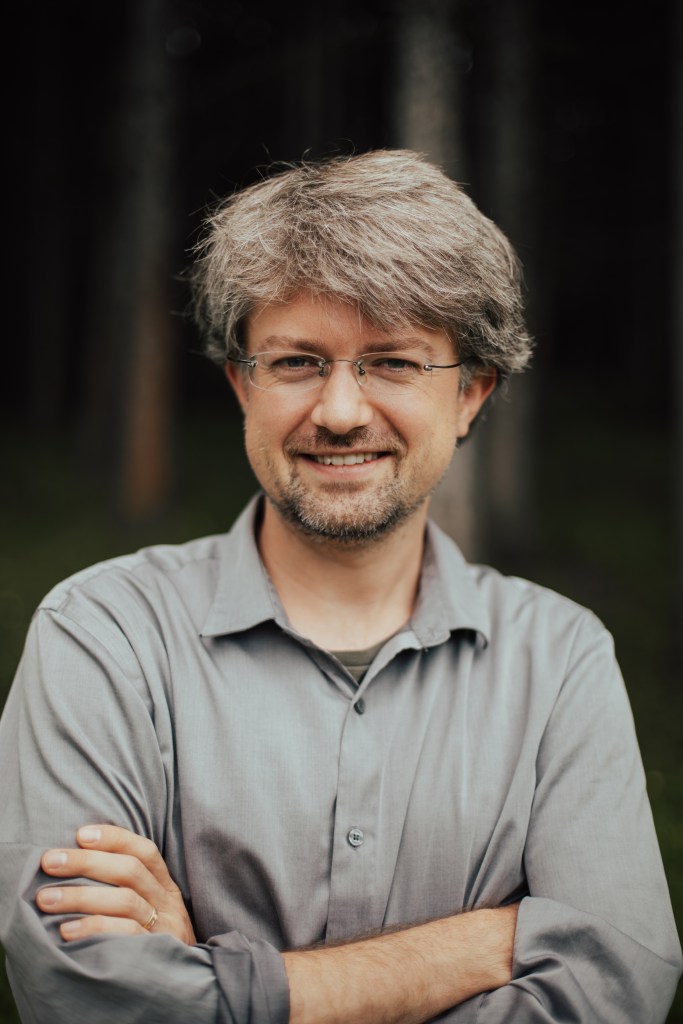
Miguel Farías (Photo by Max Sotomayor)
Composer and PhD in Latin American Studies, Miguel Farías (b. 1983) studied in Chile, Switzerland, and France.
He is the winner of several international prizes and beneficiary of commissions and residences in Chile and Europe, including Injuve, 2007 (Spain); Luis Advis, 2007 (Chile); Frederic Mompou (Barcelona, Spain); Joan Guinjoan, 2013 (Barcelona, Spain); Manuel Valcarcel, 2013 (Santander, Spain); the sponsorship prize at the BMW Musica Viva competition of the Bavarian Radio (Munich, Germany); and he was a laureate of the Isang Yun Music Prize, 2007 (Korea); Tactus, 2008 (Belgium); the prestigious Queen Elisabeth Competition, 2009 (Belgium); and the Reina Sofía (Spain), among others. He was a finalist in the “Composer Project” and “Roche Commissions” programs of the Lucerne Festival, with Pierre Boulez as a member of the jury.
In June 2012, Farías won the 2012 “Art Critics” Prize in the National Opera category and the National Arts Prize “Altazor” in 2013, for his opera Renca, París y Liendres, premiered by the Chilean Symphony Orchestra. In 2018, his second opera, El Cristo de Elqui, was premiered by the Chilean National Opera at the Municipal de Santiago, directed for the stage by Jorge Lavelli. In 2019, he won the Beaux-Arts Chilean Academy prize for the premiere of this opera.






 Christian Baldini's Interviews