Conductor, Music, Singer, Soloist, Symphony Orchestra, tenor, Uncategorized

Kyle Stegall in Conversation with Christian Baldini

On Friday, March 6, I will conduct Beethoven’s only oratorio, ”Christus am Ölberge” (”Christ on the Mount of Olives”) at the Mondavi Center with the UC Davis Symphony Orchestra and University Chorus, on a program that will also include Beethoven’s Piano Concerto No. 4, with Andrei Baumann, and the world première of “what remains” by composer Laurie San Martin. Below is a brief Q&A session with one of our three vocal soloists, tenor Kyle Stegall. Click on these links for interviews with Ms. Piccolino and Mr. Yoder.

Christian Baldini: Please tell us about your education and training. How did you start with music, and when did you decide to become a singer?

Kyle Stegall: I’ve been interested in professional singing and in teaching singing since my senior year of high school.  All three of my degrees are in Vocal Performance, and were granted by the Universities of Missouri, Michigan, and Yale.  My passion for communication is what has driven my studies, and the development of my performance and teaching career.

CB: What do you find remarkable about this work by Beethoven? What are your favorite moments in it?

KS: I am so looking forward to performing this dramatic and heroic work with Maestro Baldini and the musical forces at UC-Davis.  I am particularly fond of the moment in which the clarinet introduces the prayer theme in Christ’s opening aria.

CB: What are some of your favorite pieces of music, whether in the operatic realm, chamber music, or on the concert platform? Which works would you like to be singing next?

KS: I am lucky to have a career engaged with a great breadth of the classical repertoire.  I sing opera, recital, and concert work in equal proportions, which is actually quite rare.  I value the opportunity to communicate in such varied stylistic-idioms and performance environments.  Everything from the haute-contre repertoire of the French Baroque to world premieres of new repertoire for the solo voice, to staples of the recital canon, to large orchestrated works such as Christus am Oelberge hold consistent spots in my performance seasons.  I am particularly fond of the Bach evangelists, the cycles of Benjamin Britten, and orchestrated masses/oratorios of the classical and bel canto repertoire.  I’d like to find a spot for Britten’s War Requiem and Berlioz’ Les Nuits d’ete in coming seasons.

CB: What does art, and music in particular, mean to you? Is it relevant in our society today?

KS: Art and music are and will forever be relevant.  Art is an intensely potent force for awakening in large numbers of people a dormant respect for our shared, vulnerable humanity. What our world needs is community. What our world needs is emotional honesty.  Music is the crystallized sonic manifestation of these things.  The question isn’t whether or not art is relevant.  The question is whether or not we will make room in our hearts, budgets, schedules, and priorities for it.


Kyle Stegall2
tenor Kyle Stegall (courtesy photo)


Kyle Stegall’s performances around the world have been met with accolade for his “blemish-free production” (Sydney Morning Herald), and his “dramatic vividness” (St. Louis Post-Dispatch). A career spanning concert, opera, and recital stages has grown out of successful collaborations with many of the world’s most celebrated artistic directors including Manfred Honeck, Joseph Flummerfelt, Masaaki Suzuki, William Christie, and Stephen Stubbs.

In demand as an opera and concert soloist, Mr. Stegall is a celebrated interpreter of the Bach evangelists, and is often heard in the great oratorios of Handel and Haydn.  His operatic repertoire spans the haute-contre heroes of the French Baroque to modern premieres.

Mr. Stegall  is a proud alumnus of the universities of Missouri, Michigan, and Yale.

@stegalltenor http://kylestegall.com

Christian Baldini, Concert Hall, Conductor, Singer, Uncategorized

Daniel Yoder in Conversation with Christian Baldini

On Friday, March 6, I will conduct Beethoven’s only oratorio, ”Christus am Ölberge” (”Christ on the Mount of Olives”) at the Mondavi Center with the UC Davis Symphony Orchestra and University Chorus, on a program that will also include Beethoven’s Piano Concerto No. 4, with Andrei Baumann, and the world première of “what remains” by composer Laurie San Martin. Below is a brief Q&A session with one of our three vocal soloists, bass-baritone Daniel Yoder. Click on these links for interviews with Ms. Piccolino and Mr. Stegall.

Christian Baldini: Please tell us about your education and training. How did you start with music, and when did you decide to become a singer?

Daniel Yoder: My musical training started in 5th grade when I first held my trumpet and began assailing my family with the unavoidable tones of the beginning trumpet player.  Thankfully, I became proficient and learned the French horn, piano, and drums.  Music was always in the house, and I basked in all genres of music.  I began singing in the chairs and less of my church and then began singing in the choir.

CB: What do you find remarkable about this work by Beethoven? What are your favorite moments in it?
DY: What I find most appealing about this work is the operatic quality of the music, which serves to convey the gravity and value of the libretto and Messianic message.  As a Christian, I feel the textures and strength of the composition help the listener and performer alike understand the highs and lows of the drama preceding the coming Crucifixion and Resurrection.

CB: What does art, and music in particular, mean to you? Is it relevant in our society today?
DY:  Art, and the free expression of it in its many forms, is indispensable to me.  Society only benefits from the ability to sing, paint, sculpt, and it is a blessing to have the opportunity, as artists, to share what is inside us with the world.  While math and the sciences have their intrinsic value in society, art has its relevance in its ability to transform, edify, calm, encourage, and challenge us as humans.

Daniel Yoder HR


Native-American bass-baritone Daniel Yoder is delighted to be singing again with the UCDavis family!  He is a member of the San Francisco Opera Chorus, and has performed recently with companies including West Edge Opera, Pocket Opera, Diablo Symphony, Fresno Grand Opera, Sacramento Choral Society, Music in the Mountains, Sacramento Opera, Sinfonia Spirituosa, and Capella Antiqua of Sacramento.
Mr. Yoder has performed the bass solos of Handel’s Messiah, as well as the Requiems of Mozart, Fauré, Duruflé, and Malcolm Archer.  He has also recently performed the Mozart Mass in C.
Favorite operatic roles include Zurga in Bizet’s The Pearl Fishers, Gugliermo in Mozart’s Cosi fan tutti, Figaro in Mozart’s The Marriage of Figaro, Silvio in Leoncavallo’s Pagliacci, Leporello and Masetto in Mozart’s Don Giovanni, Achilla in Handel’s Giulio Cesare, Betto in Puccini’s Gianni Schicchi, and Claudius in Handel’s Agrippina.
California, Christian Baldini, Concert Hall, Concerto, Germany, Jean-Paul Gasparian, Music, piano, Soloist, Symphony Orchestra

Jean-Paul Gasparian in Conversation with Christian Baldini

On December 18, Jean-Paul Gasparian will be our soloist for Rachmaninov’s Piano Concerto No. 2, with the Nordwestdeutsche Philharmonie in a concert that I will conduct in Bad Salzuflen (Germany). I had the opportunity of asking Jean-Paul some questions, and below are the answers:

Christian Baldini: First of all, it is a pleasure to be collaborating with you on this wonderful concerto by Rachmaninov. Tell me, since you have played this concerto before, what is so special about it? Would you consider it to be one of the main pieces of the repertoire for you? What are some of the features in this concerto that you find particularly attractive?
Jean-Paul Gasparian: First of all I would like to say that I am extremely happy to play this concert with you and the Nordwestdeutsche Philharmonie. Rachmaninov’s Concerto n.2 is actually one of the concerti that I play most often and it is one of the very first that I learned when I was a child. So this concerto accompanies me since many years – almost since the beginning, in a way. And I totally agree with you : it is definitely one of the most glorious and emblematic works of the repertoire. My former professor Michel Beroff told me an interesting anecdote about Stephen Kovacevich: someone asked him “what is your favorite concerto ?”, and instead of answering Mozart, Beethoven or Brahms (as expected), he said “Rachmaninov n.2!”. Which is quite surprising as it is not a repertoire that we often associate with him. But this little anecdote proves that this work produces an incredibly powerful effect on the audience. On any audience I think – even on people that are not familiar with classical music by the way. This concerto is a sort of quintessence of romanticism. It has memorable melodies at every corner, it has epic breath from the beginning to the end, but also very melancholic and elegiac character. Of course this is a work that has been played and recorded thousands of times. So we will do our best to propose an interpretation that is fresh and authentic.
CB: What are other composers that inspire you, and that you enjoy performing? (and which works?)

JPG: There are of course composers that are particularly close to my heart and that I play very often: Rachmaninov is definitely one of them, but there is also Chopin (to whom I dedicated my second CD, with the 4 Ballades, among other pieces), Scriabin, Debussy, Beethoven…

Concerning Beethoven by the way, I will participate in an integrale of his sonatas next year at the Maison de la Radio in Paris, for the 250th anniversary, playing 4 of his sonatas. For the moment I try to keep a large spectrum of repertoire: I also play more modern or contemporary music from time to time (this year I played pieces by Messiaen and Boulez for example).
CB: What corners of the repertoire, or which pieces have you not played yet, but you would like to have the opportunity to perform (either a concerto with orchestra or a solo piece)?

JPG: Yes there are pieces and composers that I adore but I didn’t have the occasion to play a lot for the moment : for example I would very much like to play more Brahms in the coming years, especially the 2 concerti, the Ballades, the 3rd Sonata…

Talking about concerti I would love to have the opportunity to perform Schumann’s concerto, Prokofiev’s N.3, as well as Rachmaninov’s N.1, among others.
CB: How did you get started with music, and who have been some important people in your musical upbringing? What and who has inspired you? 

JPG: I began to play the piano at the age of 6, first with my parents, who are both pianists themselves. They played a very important role, by giving me the basics of the art of piano playing, by making me discover the repertoire (including the symphonic repertoire, the operas, the chamber music etc.). They still continue to give advice, to come to my concerts when they can…

Then I also studied with different teachers that had strong influence on me. I could say that my background is a mix of French and Russian school. Because on the one hand I studied during 8 years at Paris National Conservatoire, with teachers such as Jacques Rouvier, Michel Beroff, Michel Dalberto, Claire Désert, and on the other hand I participated regularly in masterclasses with teachers from the Russian school, such as Tatiana Zelikman (the teacher of Daniil Trifonov) and Elisso Virsaladze who is herself a great soloist. And I think that one can feel this combination of influences in my playing, in my sensibility and also in my repertoire.
CB: Besides music, what do you enjoy doing in your daily life?

JPG: I read quite a lot since many years : especially philosophy, but also literature and poetry. I am very fond of cinema and have quite an important collection of movies at home, especially European cinema of the 60s and 70s, as well as American cinema of course. I am also doing sport quite regularly and love to follow football and tennis events. And as everyone I enjoy going out with friends!

CB: Thank you for your time. I very much look forward to our Rachmaninov collaboration in a few weeks in Germany.
JPG: Thank you, I am very much looking forward to our collaboration, see you in Bad Salzuflen!
Jean-Paul Gasparian
Jean-Paul Gasparian (Biography)

Born in Paris in 1995, he studied at Paris’ National Conservatoire with Olivier Gardon, Jacques Rouvier, Michel Béroff, Laurent Cabasso, Claire Désert and Michel Dalberto. Jean-Paul has been member of international piano masterclasses with Pavel Gililov, Elisso Virsaladze and Tatiana Zelikman, selected for the Verbier Academy 2014 and Prize Winner of the Salzburg Academy 2010. From September 2017, he started an Artist Diploma at the Royal College of Music in London, with Professor Vanessa Latarche.

He is the winner of the Bremen European Competition 2014, and has been a laureate at many other international competitions including the José Iturbi Competition 2015 (4th Prize and special prize for the best performance of a contemporary piece), the Lyon International Competition 2013 (3rd Prize), the Hastings International Concerto Competition 2013, the Tel-Haï Concerto Competition 2012, and semi-finalist of the Geza Anda Competition in 2015. He is also the piano laureate of the Cziffra Foundation Prize 2014 and the l’Or du Rhin Foundation Prize 2016.
Moreover, he received the 1st Prize in Philosophy at the Concours Général des Lycéens de France in 2013.

Jean-Paul has played with orchestras such as the Orchestre National d’Ile-de-France, the Bremen Philarmonic Orchestra, Musikkollegium Winterthur, the Robert-Schumann Philharmonie, Orchestre de l’Opéra de Rouen, Orchestre Régional de Normandie, Orchestre de la Garde Républicaine, the Serbian Radio-Television Orchestra, the Montenegro Symphonic Orchestra, Toulouse Chamber Orchestra the Murcia Symphonic Orchestra, the Valencia Symphonic Orchestra, Orchestre Symphonique de Caen, the Alliance Orchestra, the Ostinato Orchestra, performing Mozart, Beethoven, Chopin, Liszt, Mendelssohn, Saint-Saëns, Tchaïkovski, Rachmaninov and Gershwin concertos.

He has given recitals at important festivals, among them : Festival Chopin de Bagatelle, Flâneries de Reims (broadcasted live on Medici.tv), La Roque d’Anthéron, Lisztomanias, Printemps des Arts de Monte-Carlo, Nohant Festival Chopin, Touquet Piano Folies, Août Musical de Deauville, Festival Radio-France de Montpellier, Liszt en Provence, and has played in important venues such as the Salzburg Mozarteum, Zürich’s Tonhalle, Bremen’s Die Glocke, London’s Royal Albert Hall, Belgrade’s Kolarac, the Tel-Aviv Museum of Art, the Louis Vuitton Foundation (broadcasted live on Radio Classique), the Maison de la Radio, the Salle Cortot and the Salle Gaveau in Paris.

Upcoming concerts include recitals in Holland, United Kingdom, Colombia, Germany, Spain, as well as in France at the Radio-France Festival Montpellier, Piano aux Jacobins in Toulouse, Festival de l’Épau and many others. He began 2018 by replacing at last minute famous pianist Christian Zacharias in Chemnitz, Germany, and playing two times Mozart’s 24th Concerto under Leopold Hager.

His Schumann G Minor Sonata Live in Nohant 2015 has been released last year, together with Aldo Ciccolini’s last recital, as the first album of the Nohant Chopin Festival Archives. Moreover, the “Classica” Magazine has ranked Jean-Paul among the 10 most promising young pianists of his generation. The “Pianiste” Magazine also dedicated a large portrait to him this year.

His first studio CD was released in 2018 for the Évidence Classics label, with a Russian program : Rachmaninov, Scriabin, Prokofiev, and was highly praised by the press.

Since September 2016, Jean-Paul is artist-in-residence at the Singer Polignac Foundation, together with Shuichi Okada and Gauthier Broutin, with whom he founded the Cantor Trio.

Jean-Paul is supported by the Safran Foundation for Music. He is also, since this summer, a Steinway Artist.

Concerto, Music, piano, Symphony Orchestra, Uncategorized

Soloist Profile: Erica Mineo in Conversation with Christian Baldini

Erica Mineo will perform Schumann’s Piano Concerto as our soloist with the UC Davis Symphony Orchestra on June 1 in a program that will also include Shostakovich’s Symphony No. 9, and a new piece by Daniel Godsil. Click here for more details.

Christian Baldini: Erica, first of all congratulations on winning the UC Davis Symphony Orchestra Concerto Competition. There was a competitive pool of applicants, and the jury’s decision was unanimously in your favor. At your age, you have already quite a few important accomplishments behind you. Please tell us how you started with the piano. How and when did you first become interested in music? I understand you also play the violin. Please tell us about it too.

Erica Mineo: Thank you! This opportunity to perform with the symphony is a great honor and a dream come true, and I must give credit to Marilyn Swan, my wonderful piano teacher, and Claire Zheng, an excellent accompanist and an even better friend. I am indebted to them both for all their support and guidance through these months of learning and interpreting the Schumann.

I started piano when I was seven, rather late compared to most of my contemporaries. But I’m thankful I wasn’t ever forced to play an instrument. Cultivating my love for music has been a very organic process. When I was very young, I listened to plenty of Classical music—my parents still have the Mozart CD’s they played when I was a baby! I suppose you could say I’m from a musical family, too. On my father’s side, my grandmother is a jazz singer, and my great-uncle Paul Peek was a rockabilly musician and a Rock and Roll Hall of Fame inductee! On my mother’s side, my uncle is a classical music aficionado, and so was my grandfather.

I’ve got a funny story about how I ended up playing the violin. My elementary school had an orchestra program in which students chose any instrument they liked. When I was nine, I arbitrarily picked the violin, and it’s stuck with me ever since. With both instruments, I’ve been lucky to have teachers who instill a solid foundation in technique, artistry, and theory while still making music meaningful and ultimately, fun. And ever since my early days with those Mozart CD’s, Classical music has remained an integral part of my life and identity.

CB: Which other activities do you enjoy outside music?

EM: Just like music, I’ve been very passionate about animals, especially cats and horses, ever since I was young. I always knew I wanted to be a veterinarian. Currently, I enjoy volunteering with Yolo County Animal Services (YCAS) and Therapeutic Riding and Off-Track Rehabilitation (TROTR), both in Woodland. I’m also a member of Foal Team—we help take care of the baby equines (and the occasional alpaca) that come through the UCD vet school’s large animal neonatal ICU. I’m an undergraduate volunteer with the Knights Landing One Health Veterinary Clinic as well—our monthly clinic provides in-town veterinary services to the rural community of Knights Landing.

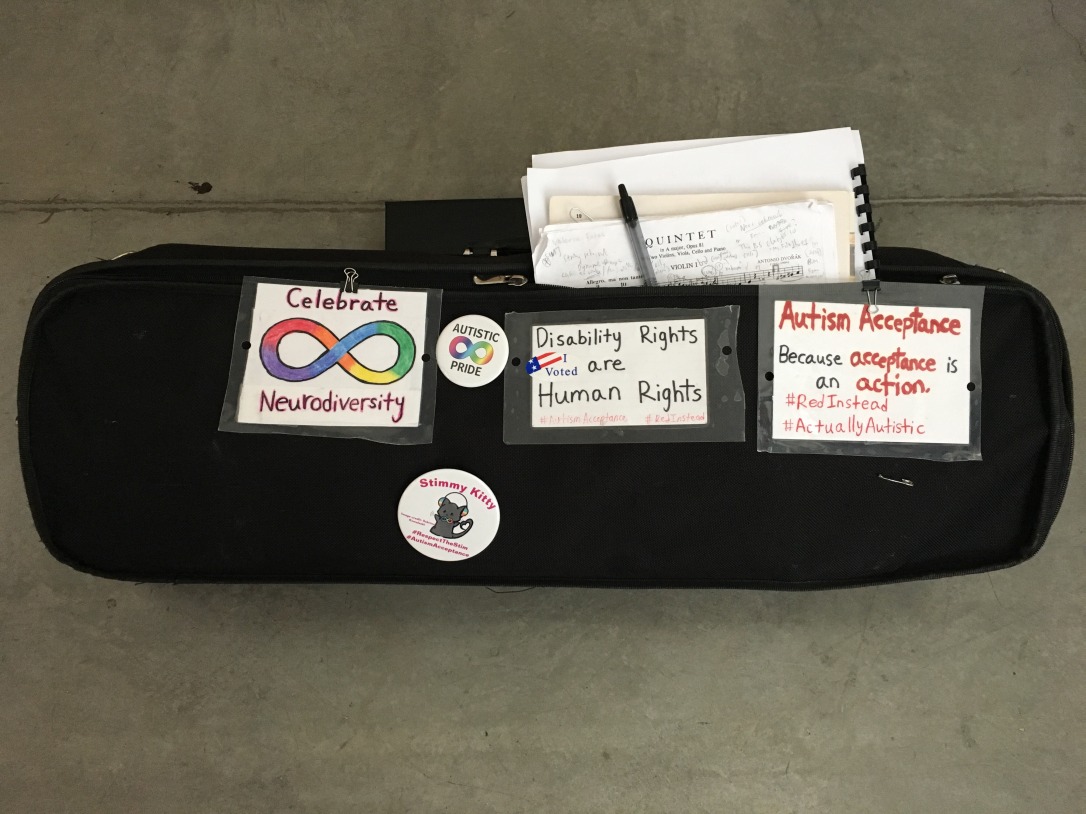
I very much enjoy reading literary classics, especially Shakespeare, and writing poetry. Running and nature photography illustrate my ever-present affinity with the great outdoors. And ever since finding out I’m autistic, I’ve become keenly interested in disability rights and neurodiversity, why we need this variation of brains and minds more than ever in today’s world. As the buttons and pins on my violin case illustrate, I hope to channel this deep passion into promoting disability awareness and acceptance and empowering other autistic people. I’m the co-founder and Vice President of the Autism and Neurodiversity Community at UC Davis, a peer-support group for autistic students.
IMG_5383.jpg

CB: We look forward to featuring you as our soloist for the first movement of Schumann’s Piano Concerto. In your opinion, what is so beautiful and remarkable about this piece? Why did you choose to perform it?

EM: The Schumann is such a sensitive, intimate, and yet fiercely determined work, with so many mischievous moments and little conversations with the orchestra. I especially love the back-and-forth parts between the piano and the oboe solo. Here’s a fun fact: the oboist playing these solos, Rose—I mean Professor Baunach—is actually my Physics instructor this quarter! And Claire’s on timpani, and I’ve got several other friends in the strings, winds, and brass. Schumann really fosters collaboration in this concerto. I’ve never really believed the soloist is inherently “better” than the orchestra anyway—one musician does not make a concerto, after all—but here, the piano and orchestra make a true team.

I also can definitely relate to Schumann as a person. While he likely wasn’t autistic, the historical evidence shows he definitely was neurodivergent in some respect. I wonder if his music was like a different kind of language for him, much as it is for me. Music communicates so much more than mere words!

Ms. Swan suggested learning the Schumann about a year ago, since I performed Grieg’s Piano Concerto in high school. I understand Grieg composed his piano concerto after hearing the Schumann, and it’s quite fascinating to see the similarities between the two. Not only the key, A Minor, but also minutiae such as those mischievous oboe solos! These two pieces are quite like siblings, and I’m humbled to have had the opportunity to learn them both.

CB: What is a typical routine for you? How much do you practice your piano and your violin, and how do you balance your music with school activities, and everything else?

EM: You’re absolutely right—fitting music, schoolwork, and pre-vet activities all together is a delicate balancing act. A consistent routine is essential. I usually get up very early in the morning and try to go to bed at a decent hour if I’ve not got a late-night Foal Team shift. Social media does not exist in my vocabulary. Ironically, the academic rigor is not the most difficult aspect of the school day—it’s pacing myself through all the sensory stimuli that accumulates when I’m walking to class and interacting with others. The music building and the Pitzer center are two of my refuges when it gets overwhelming—the little red bench on the second floor of the music building is one of my favorite spots.

As a busy pre-vet, I do admit I ought to practice music more than I do—usually I snatch an hour or two in between classes, or—as Claire is apt to tell you—occasionally even before lessons. But with such limited time, one learns to make the most of every minute, to focus on those key measures while not losing sight of the entire work. And when I’m not practicing, I’ll get creative—perhaps think about interpretation and intent while walking to class, play some pieces I’m working on to the cats in the YCAS shelter, or have a playlist of passages running (excuse the pun) in my head while I’m on a run.

CB: Is music very important to you? (I imagine it is, when I hear you play!) And why?

EM: The eminent French piano teacher Nadia Boulanger once said, “Do not take up music unless you would rather die than not do so.” This sentiment resonates deeply with me. Classical music is the oxygen for my soul. It’s been the portal to forming meaningful, long-lasting friendships—virtually all my close friends play an instrument or sing. Ultimately, it’s allowed me to feel such profound emotion and expression I never previously thought possible.

And while being autistic does have its challenges as an invisible disability, you can especially see its great strengths in music. My sensitivity to sound becomes an asset in noting the little details, in pieces from my chamber group’s piano quintet to Bach fugues. When I play or hear a piece, I see and feel sparks, waves, and ripples of color in addition to the notes themselves. Thanks to this intersection of autism and musical perception, I not only hear but also experience music as a living, tangible entity.

CB: What are your dreams? Where would you like to see yourself in ten years?

EM: After finishing my undergraduate studies, I plan to attend veterinary school, most likely along the companion animal/equine track. I hope to keep advocating for acceptance of autism and neurodiversity in society, including in music and the veterinary field. And I very much hope to keep playing the piano and violin and sharing these musical masterpieces with others—both humans and non-humans—throughout these years and beyond.  

CB: Thank you very much for your time, and for your very inspiring answers. We look forward to sharing your beautiful musicality with our audience soon!

EM: You’re very welcome! I very much look forward to rehearsing and performing with you and the symphony!

thumb_IMG_7233_1024

Erica Mineo, a second-year undergraduate majoring in Biological Sciences and minoring in Music and Animal Science (Equine), currently studies piano with Marilyn Swan at UC Davis. Erica began her piano studies at age seven with Soh-Ra Kim and Dr. Linda Mazich-Govel in Rancho Palos Verdes. In high school, she studied with Hans Boepple, music professor and former department chair at Santa Clara University. She has enjoyed master classes and sessions with composer Dr. David Ward-Steinman, Bernadene Blaha, Lucille Straub, Nina Scolnik, and Dr. Louise Earhart. Erica performed Mozart’s 9th Piano Concerto as a soloist with the Southwestern Music Festival and Beach Cities Symphony orchestras, and the Grieg Piano Concerto with the Monta Vista High School Chamber Orchestra and the Winchester Orchestra of San Jose. She was a three-time state finalist in the Celia Mendez Beethoven Competition at San Jose State University, and has also earned recognition for performances of Mozart, Bach, Chopin, and Grieg. In 2017, Erica was a Music Teachers’ Association of California (MTAC) Young Artist Guild finalist, and in 2015 earned MTAC Panel Honors for piano and violin. She began studying violin from age nine with Gail Gerding-Mellert, and in high school with Julliard faculty member Li Lin as well as Robin Sharp, SF Chamber Orchestra concertmaster and Stanford faculty member. Erica was the Monta Vista High School Chamber Orchestra concertmaster, and now studies violin with Jolán Friedhoff at UC Davis. As a violinist, Erica enjoys performing chamber music in a piano quintet.

A passionate pre-vet, Erica is keenly interested in pursuing the companion animal/equine track. She is a member of the UC Davis vet school’s Foal Team and the Knights Landing One Health Veterinary Clinic. She also volunteers with Yolo County Animal Services (YCAS) and Therapeutic Riding and Off-Track Rehabilitation (TROTR), both in Woodland. Her other passions include classic literature (especially Shakespeare), writing poetry, running, nature photography, and disability studies.

Erica is also a proudly autistic disability rights advocate, and the co-founder and Vice President of the Autism and Neurodiversity Community at UC Davis, a peer-support group for autistic students. She was invited as a panelist to speak about her experiences as an autistic university student at the UC Davis MIND Institute’s May 31st Neurodiversity Summit.



Concert Hall, Dance, Experimental, folklore, Music, Nature, Symphony Orchestra, Uncategorized

Composer Profile: Daniel Godsil in Conversation with Christian Baldini

Christian Baldini: Daniel, congratulations on having your work Cathedral Grove selected to be performed by the UC Davis Symphony Orchestra at our upcoming concert on June 1, as part of the UCDSO Composition Award/Readings. Tell us about your piece, its title, its genesis, and anything else that you’d like to add.

Daniel Godsil: Thank you, Christian! It’s an honor to have been chosen for this, and to get the opportunity to work with you and the UC Davis Symphony!

For me, an orchestra is a very special thing: I love the beautiful concert halls, I love the rituals, I love the great masterworks that have been written for it. I especially love how so many people assemble together, both onstage and off, to present and hear this music. As I was deciding what to do with this piece, I thought about how much an orchestra, and all its accompanying social structure, is similar to “America’s Best Idea”: its national parks. We take time out of our busy days to go experience something out of the ordinary; we’ve decided as a culture how much certain extraordinary places mean to us, and how important it is to preserve them for future generations. The Muir Woods–of which the “Cathedral Grove” is a part– is one such place for me. And there’s immediate beauty, yes, but these ancient trees have been around long before us and will hopefully still be there long after we’re gone: this evokes a very sublime feeling. John Steinbeck said in his book Travels With Charley that “No one has ever successfully painted or photographed a redwood tree;” this piece is my humble attempt to, instead, make a painting in sound. I tried to capture some of that sublime feeling, and also vitality, majesty, tenderness, silence, light or color filtering through the tops of trees, etc.  

CB: What do you try to achieve with every new piece that you write? What are your main goals?

DG: After finishing my undergraduate work in composition, I spent a long time working as a composer for film and other visual media. When I returned to composing art music, it took me a long time to come to terms with why I was doing it; it didn’t feel like there was a tangible end product like a movie or a video game. What has really helped me is the idea of making music as a community. With so much music out there nowadays, I think it’s important to cultivate music groups or communities–people that you work with, live with, study with, meet at a festival, have coffee with. I’m always most excited to hear music that my friends make or perform. I try as much as I can to write music that will be appropriate for the performer or event I’m composing for, and I love collaborating with performers while I compose. Hopefully, this all helps to communicate with the audience, too.

CB: You’ve now lived in California for quite a few years. Has being a UC Davis graduate student influenced you much professionally and/or personally, and if so, in which ways?

DG: California is a very special place for me: for one, my wife Sara grew up here, and has deep ties to the Bay Area, and her family lives here. And now, my daughter Betsy (who is already 18 months old!) was born here. I grew up in Illinois, in the hometown of poet Carl Sandburg. Illinois has its own kind of beauty, but I have to admit that it’s nothing quite like what I experience in California on a daily basis. A lot of this comes out in my recent music, too. I’ve been influenced profoundly by the natural beauty of my new home state. As an added bonus, the music department at UC Davis is fantastic! We grad students get to compose for and collaborate with world-class performers, and study with musicians and scholars at the tops of their field. What more could you ask for? I’ve also become a very avid cyclist, and I absolutely love that I can bicycle all year round in California. Living in Davis has taught me that time on the bike is almost as important as studying or composing!

CB: Is there anything that you’d like to see change in the usual concert platform, or in the way that symphony concerts are presented?

DG: As I mentioned earlier, I’m someone who really loves the modern orchestra and how it’s presented now. Even though it may seem stuffy, there’s a reverence built into the ritual that I think should be preserved. Just like you wouldn’t go into the Muir Woods with a boombox (hopefully), there’s a level of respect that goes with an orchestral performance. That said, I really think that orchestras need to have a significant “laboratory” component, where new music is given equal standing with established repertoire. When you go to a good museum, the contemporary works aren’t presented in some back room…they’re in a fantastic, new, climate-controlled space, right next door to the masterworks of the past. I’m not a fan of having new orchestral works presented as filler, or blamed for lost ticket sales. The audiences should be given more credit! Look at what the Gustavo Dudamel and the LA Phil are doing, for instance, and thriving, at that! Championing new music should be a major part of preserving our beautiful orchestral tradition; like the slogan says for the American Composers Forum, “all music was once new.” And by taking chances on new local music! I love going to the Crocker Art Museum in Sacramento, for instance: they have a great collection of local California art, and it’s fantastically diverse. I love it when orchestras do the same kind of thing, it strengthens community bonds very simply and effectively.

CB: What would be your advice for anyone trying to become a composer? (and/or for anyone applying for graduate school in composition)?

DG: Again, I think it’s really important to cultivate musical community. If you’re not a skilled instrumentalist or performer, start by working on that! Get out and start playing music with other people. Write something for a cellist friend, for instance, and see what works. You can learn so much more in one rehearsal than by reading books for that same amount of time. That’s not to say that reading or studying is a bad thing: it’s important to learn your craft through whatever means possible, and doubly important if you want to pursue composition at the graduate level. But I think it’s good to frame everything by actually doing music.

CB: Thank you for your time, Daniel, we look forward to performing your piece and sharing it with our audience soon!

DG: Thank you, Christian, I’m really excited to work with you and the orchestra, and I hope people who hear it will let me know what they think!


Godsil_headshot

Daniel Godsil‘s music, which has been described by the San Francisco Classical Voice as having an “intense dramatic narrative”, draws from such eclectic influences as rock and heavy metal, science-fiction, and Brutalist architecture.

Winner of the 2017 Earplay Donald Aird Composition Competition (for his quartet Aeropittura), Godsil’s music has been played by Ensemble Dal Niente, Talujon Percussion, the Lydian String Quartet, the Empyrean Ensemble, the Metropolitan Orchestra of Saint Louis, the University Symphony Orchestra at California State University, Fullerton, the Knox-Galesburg Symphony, the Daedalus String Quartet, and the Nova Singers, among many others. Recent film scores include the PBS documentary Boxcar People, Man Ray’s 1926 silent film Emak-Bakia and the feature film H.G. Welles’ The First Men In The Moon. Godsil was a finalist in the 2018 Lake George Music Festival chamber composition competition, the 2018 Reno Pops Orchestra competition, as well as the 2014 & 2018 Red Note New Music Festival Composition Competitions. His choral works are published by Alliance Music Publishing and NoteNova Publishing.

Born and raised in central Illinois, Godsil (b.1982) is currently pursuing his PhD. in Composition and Theory at the University of California, Davis, studying with Mika Pelo, Laurie San Martin, and Sam Nichols. He holds an MFA in Music Composition from the Vermont College of Fine Arts, where he studied with John Fitz Rogers, John Mallia, and Jonathan Bailey Holland. He also holds a BM in Music Composition from Webster University.

Godsil was selected to participate in the 2017 Summer Institute for Contemporary Performance Practice (SICPP) in Boston, where he had master classes with composers Nicholas Vines and Georg Friedrich Haas.

Godsil has also been active as an educator, conductor, and performer in the central Illinois area, Knox College, Monmouth College, and Carl Sandburg College. At Knox College, he directed the New Music Ensemble, Wind Ensemble, Chamber Ensemble, and Men’s Chorus. He has also held posts as choral accompanist and collaborative pianist, and served as Music Director and Organist at Grace Episcopal Church in Galesburg, IL.