Beauty, Christian Baldini, composer, Concerto, Conductor, piano, Soloist, Uncategorized

Oscar Strasnoy in Conversation with Christian Baldini

On April 21, 2022, I will have the pleasure of conducting the US Première of Oscar Strasnoy’s Piano Concerto Kuleshov with Ryan McCullough as our soloist, together with the phenomenal UC Davis Symphony Orchestra at the Mondavi Center for the Performing Arts in Davis, California. Below is a brief interview with Oscar talking about his music:

Christian Baldini: Dear Oscar, it will be so wonderful to conduct the US Premiere of your Piano Concerto Kuleshov with the excellent pianist Ryan McCullough as our soloist. Tell me, how did the genesis of this piece start? And how did you come up with the concept of Kuleshov as a source of inspiration?

Oscar Strasnoy: As is almost always the case, the piece was born out of a soloist’s desire to receive a piece by a specific composer. In this case, Alexandre Tharaud was the generator of the project. Mauricio Kagel had promised him a piano concerto, but he died before finishing it. So Alexandre asked me. I am a sort of post-mortem-ghost-writer for Kagel, a position I enjoy very much assuming.

The idea of relating the work to the first film editing techniques of the Soviet cinema of the 1920s-1930s comes from further back, it is something that has always interested me. The name Lev Kuleshov came up at the end of the composition, when it occurred to me to close a very heterogeneous form, made mostly of fragments, using his concept of alternating still and moving images, a kind of big rondo around a more abstract central movement.

CB: Your music is surprising, refreshing, it probably cannot be easily labeled or contained. What is your goal with each new piece? What do you try to “communicate”, and/or what are some priorities to you in your music?

OS: For years, my activity as a composer was principally around opera and musical theater. And the fact of frequently working with texts created in me a quasi Pavlovian reflex for generating musical images, something like ideograms that could be associated to concepts. A kind of program music without a program. I feel very close, not necessarily in style, but in the way of approaching the heterogeneous formal assembly of the works, to the thought of Eisenstein or to Liszt, Wagner, Pierre Schaeffer and Messiaen. My interest is not focused on the so called “musical material” (new sounds) but on how acoustic ideas are associated with each other and form a kind of story board or, perhaps better, a Japanese kind of emakimono scrolls. That Japanese art is the one that fascinates me the most among all types of art. A kind of cinematography avant la lettre, still cinema, frozen time.

CB: You have worked with many of the world’s greatest artists. You’ve written concertos for Isabelle Faust and Alexander Tharaud. Does this make your life easier when writing a concerto with a performer in mind? How do you approach the process, is it very collaborative or do you deliver the piece once it’s done?

OS: I like working with friends, first of all, spending time with them exchanging food, jokes and ideas. That’s how I learned the most. I send them my ideas in sketch form, sometimes I tell them over the phone, and I complete them with their technical advice.

CB: What would you recommend to someone who has never heard your music before? What should they listen for?

OS: I would recommend looking at emakimonos in a museum or on the internet. I would also recommend to look at a wonderful eighty-meters long work that David Hockney painted with an iPad during the pandemic, “A Year in Normandy” is its title. And I would recommend watching Soviet cinema from the 1920s.

CB: Kuleshov seems to make some references to piano music of the past. I hear a lot of (even possible quotations) Rachmaninov, Debussy and Ravel. How did you approach these connections or recollections? How do you manage to make all these voices fit into your own language?

OS: My main source for this work was silent film accompaniment music from the 1920s. Surely those musics were influenced by certain features of those composers, so my references are surely second hand.  

CB: Do you have any advice for young composers?

OS: Forget about the so called “musical material”. Music is immaterial, it consists of heterogeneous sounds disposed on a given time. Any sonorous thing can fill that time with whatever you can think of. I would recommend them also to forget the obligation of artistic homogeneity that we inherited from the Enlightenment. The world we live in is heterogeneous and the art of our time has to reflect the world we live in. I would also recommend them to avoid as much as possible emulating the contemporary musical currents taught in universities, which turn almost all students into epigones. Being an artist means being free to do whatever you want with whatever ideas, material or media you want. If you don’t achieve that degree of independence, you will not be an artist, you will be a craftsman, which is not bad in itself but was probably not your initial plan. But one has to be patient, it’s a process that can take some time, probably the whole life.

CB: Thank you very much for your time, I very much look forward to once more conducting your beautiful music.

OS: Thank you, dear Christian. It’s a big pleasure and an honor for me to be here in Davis.

Oscar Strasnoy, Photo by Heidi Specker

Biography

Oscar Strasnoy was born in Buenos Aires and studied piano, conducting and composition there at the Conservatorio Nacional Superior de Música (with Aldo Antognazzi and Guillermo Scarabino), at the Conservatoire de Paris (with Guy Reibel, Michaël Levinas and Gérard Grisey), where he won in 1996 a Premier Prix à l’Unanimité (first prize) and the Hochschule für Musik, Frankfurt (with Hans Zender). He was the Music Director of the Orchestre du Crous de Paris (1996–1998). He was one of the founding recipients of the Grüneisen Foundation (Mozarteum Argentino) conducting scholarship, and of the French Government Scholarship. In 1999 he was invited by Peter Eötvös to Herrenhaus-Edenkoben in Germany.

Luciano Berio awarded him the 2000 Orpheus Prize for his chamber opera Midea produced at the Teatro Caio Melisso in Spoleto in 2000 and at the Rome Opera in 2001.He was also artist in residence at the Akademie Schloss Solitude in Stuttgart, in 2003 at the Villa Kujoyama in Kyoto (Institut français), and in 2006 at the Civitella Ranieri Foundation in Umbria, Italy. In 2007 he received a John Simon Guggenheim Memorial Foundation Fellowship for Music Composition. Radio France, in association with the Parisian Théâtre du Châtelet, featured Strasnoy as the main composer of the Festival Présences 2012, a retrospective of most of his works in 14 concerts in January 2012.

Compositions

Oscar Strasnoy has composed twelve stage works, including operas performed at Spoleto, Rome, Paris (Opéra Comique, Théâtre du Châtelet), Hamburg, Bordeaux, Aix-en-Provence Festival, Teatro Colón of Buenos Aires), Berlin State Opera; a live-accompanied silent film score for Anthony Asquith’s Underground which premiered at the Louvre in 2004 and was subsequently played at the Cine Doré in Madrid, the Mozarteum Argentino, Kyoto, and Tokyo) and a secular cantata, Hochzeitsvorbereitungen (mit B und K). He also composed several pieces of chamber, vocal and orchestral music, including his song cycle Six Songs for the Unquiet Traveller which premiered in 2004 performed by the Nash Ensemble and Ann Murray in a concert to inaugurate the newly refurbished Wigmore Hall in London.

In January 2012 a retrospective of his work in 14 concerts has been presented at the Théâtre du Châtelet in Paris as part of the Festival Présences of Radio France. Strasnoy’s works are primarily published by Universal Edition (Vienna) Chant du Monde (Paris) and Billaudot (Paris). His opera Midea is published by Ricordi (Milan).

Concerto, Conductor, Experimental, Music, Soloist, Symphony Orchestra, violin

Miguel Farías in Conversation with Christian Baldini

[to read the original version of this interview, in Spanish, click here]

Christian Baldini: On March 5 I will have the pleasure of conducting the world première of the Violin Concerto “Kuyén” by Chilean composer Miguel Farías, featuring the wonderful violinist Rachel Lee Priday. Miguel Farías is a superb Chilean composer, and we have been colleagues and friends for about fifteen years, when we met in France at a festival where we both had our works for orchestra performed by the excellent Orchestra National de Lorraine. I was immediately captivated by his music because of his great use of the orchestral palette, his imagination and his expressiveness, and his great ability to write motifs that are very memorable without trying to be. It is a pleasure to present this world premiere that was our commission and that received the prestigious support of Ibermúsicas. Miguel, tell us, how was the genesis of this piece? What could you share with us about how you started writing it, what plan you originally had and what changed in the process (if that did happen)? Are you happy with the final results?

Miguel Farías: First of all, thank you very much dear Christian for your words, and I would also like to tell you that it is a great pleasure to be able to collaborate with UCDSO and with you, especially after fifteen years of friendship!

Composing Kuyén was somehow quite intuitive. I like to write narrative (fiction), and during the last year I wrote a book that contains stories that speak of the night, from different perspectives. One of these is one that has to do with mythology. Perhaps that is why I had in mind some sonorities that were related not only to the night, but also to beings that inhabit it. This is how it occurred to me to “ground” this sound speech that was haunting my head, basing it on the narrative of the Kuyén myth. The idea, in addition to having a soloist and an orchestra, reinforced the discourse based on dialogue, which ended up being essential to give shape to the piece.

CB: How were your beginnings with music?

MF: Initially, when I was about 10 years old, I taught myself to play the piano. Then I really liked rock and jazz and I studied electric guitar. I quickly realized that more than playing other people’s music, I liked inventing music on the guitar. So at fourteen I went to find out how to study composition at the conservatory, and at fifteen I was already in my first formal year.

CB: Who were some of the people in your life that have most positively influenced you to be the composer you are today?

MF: It may sound cliché, but first of all my family. In general, I am interested in a type of music that does not question itself, but dialogues with its surroundings. In my family there are no musicians, so they have been an influence not only emotionally, but also creatively and thoughtfully. In the art world, I have generally been much more influenced by literary narratives than by composers. The speech and thought of Raul Ruiz has been important in my way of thinking about the discourse and the musical form. In the construction (or attempted construction) of my own musical discourse, I believe that several writers have influenced me, some examples are the Cubans Guillermo Cabrera Infante and Pedro Juan Gutierrez, the Chileans Christian Geisse and Hernán Rivera Letelier, or the Mexican Juan Rulfo, among several others. Honestly, without literature in my life, it would be difficult for me to continue growing artistically.

CB: Being a young composer is not easy. Opportunities for your works to be commissioned by or performed by an orchestra don’t come very often (or at all). What advice would you give to young composers who are looking for opportunities?

MF: Go forward with a lot of work and confidence. It is difficult to have commissions or works performed by orchestras these days, but my experience has shown me that if one is capable of presenting artistically interesting ideas and projects, there is interest from the institutions.

First of all, in order to present interesting projects, I think you have to work hard to develop a correct and personal way of orchestral writing. You have to understand the sonorities of the orchestra as well as its relationship with musical time. Then, the exercise of the trade itself provides the tools to bring ideas to the score.

On the other hand, composition contests and courses are very useful, not only to have visibility, but also to be able to hear what is written above all. In competitions, the most common thing is not to win, but to keep trying; on the one hand, it serves to develop a high-level orchestral writing, tolerance to frustration, and above all a handling of writing and ease in bringing abstract ideas to life on the music sheet. Contests serve as a kind of exercise in this.

CB: You are also an opera composer. In your opinion, are there any (or many) differences between writing chamber music, symphonic music, vocal music, and dramatic music for the stage, such as opera?

MF: Very much so, in my opinion. The starting point in dramatic and instrumental music is very different. In the first we start from quite tangible and literary narrative resources. In the second, at least in my case, one starts from a blank sheet of paper, where we have to build the sound objects with which the ideas we have in mind will be represented. Both worlds are exciting, and difficult to master.

On the other hand, in dramatic music for the stage, at the time of writing there are many factors to consider that influence each note we write. The narrative, the visual, the temporal; and other more complex factors that have to do with the context of the text being worked on. I’m not saying that instrumental music doesn’t contain these riches and difficulties, but I do say that opera, for example, begins from a space heavily charged by a tradition that has these factors as its starting point. In the opera, our blank page at the beginning is quite lined.

CB: For someone who has never heard your music before, what advice would you give them? What is important in your music? What should they try to hear in your works? (and in this Concerto for violin and orchestra, specifically?)

MF: I find it difficult to answer something like that, since I would like to say that they can hear what they want and how they want when listening to my music. But if we think specifically about Kuyén, I would like them to try to feel the colors and nuances of light with which I tried to impregnate the sonorities, both of the solo violin and of the orchestra. Kuyén for me is a dialogue between colors, lights, brightness and darkness, and I would like to suggest that in this work, they start by letting themselves be carried away by intuition to hear it as an abstract conversation between these elements.

CB: Thank you very much for writing this beautiful work for the UC Davis Symphony Orchestra and Rachel Lee Priday. I am very happy to be able to share your music with our public and our community.

MF: Thanks to you dear Christian, to the UCDSO and to Rachel. It has been amazing working with you and Rachel. I have learned a lot, and I have enjoyed it even more. Rachel has given an impressive voice to each of the notes I wrote. I am very excited and grateful. And of course, I hope that this first collaboration after fifteen years of friendship is not the last.

Miguel Farías (Photo by Max Sotomayor)

Composer and PhD in Latin American Studies, Miguel Farías (b. 1983) studied in Chile, Switzerland, and France.

He is the winner of several international prizes and beneficiary of commissions and residences in Chile and Europe, including Injuve, 2007 (Spain); Luis Advis, 2007 (Chile); Frederic Mompou (Barcelona, Spain); Joan Guinjoan, 2013 (Barcelona, Spain); Manuel Valcarcel, 2013 (Santander, Spain); the sponsorship prize at the BMW Musica Viva competition of the Bavarian Radio (Munich, Germany); and he was a laureate of the Isang Yun Music Prize, 2007 (Korea); Tactus, 2008 (Belgium); the prestigious Queen Elisabeth Competition, 2009 (Belgium); and the Reina Sofía (Spain), among others. He was a finalist in the “Composer Project” and “Roche Commissions” programs of the Lucerne Festival, with Pierre Boulez as a member of the jury.

In June 2012, Farías won the 2012 “Art Critics” Prize in the National Opera category and the National Arts Prize “Altazor” in 2013, for his opera Renca, París y Liendres, premiered by the Chilean Symphony Orchestra. In 2018, his second opera, El Cristo de Elqui, was premiered by the Chilean National Opera at the Municipal de Santiago, directed for the stage by Jorge Lavelli. In 2019, he won the Beaux-Arts Chilean Academy prize for the premiere of this opera.

Beauty, California, Christian Baldini, composer, Concerto, Conductor, Experimental, folklore, Music, violin

Miguel Farías en diálogo con Christian Baldini

[to read this interview translated into English, click here]

Christian Baldini: El 5 de Marzo tendré el placer de dirigir el estreno mundial del Concierto para Violín y Orquesta de Miguel Farías, que lleva el título “Kuyén” junto a la gran violinista Rachel Lee Priday. Miguel es un gran compositor chileno, y hemos sido colegas y amigos por unos 15 años, cuando nos conocimos en Francia en un festival donde ambos teníamos nuestras obras para orquesta interpretadas por la excelente Orchestre National de Lorraine. Inmediatamente su música me cautivó por su gran manejo de la paleta orquestal, su imaginación y su expresividad, y por su gran habilidad de escribir motivos que resultan muy memorables sin intentar serlo. Es un placer presentar este estreno mundial que fue nuestro encargo y que recibió el prestigioso apoyo de Ibermúsicas. Miguel, contanos, ¿cómo fue la génesis de esta pieza? Que podrías compartir con nosotros acerca de cómo comenzaste a escribirla, que plan tuviste originalmente y que cambió en el proceso (si eso pasó)? ¿Estás feliz con los resultados finales?

Miguel Farías: Primero que todo, muchas gracias querido Christian por tus palabras, y también me gustaría decirte que es un enorme placer poder colaborar con la UCDSO y contigo, sobre todo después de 15 años de amistad!

Componer Kuyén fue de alguna manera bastante intuitivo. Me gusta escribir narrativa, y durante el último año escribí un libro que contiene cuentos que hablan de la noche, desde distintas miradas. Una de estas es la que tiene que ver con lo mitológico. Quizás por eso es que tenía en la mente algunas sonoridades que se relacionaban no solo con la noche, si que con seres que la habitan. Es así que se me ocurrió aterrizar este discurso sonoro que rondaba mi cabeza, basándolo en lo narrativo del mito de Kuyén. La idea además de tener un solista y una orquesta, reforzaron el discurso basado en el diálogo, lo que terminó siendo esencial para darle forma a la pieza.

CB: ¿Cómo fueron tus comienzos con la música?

MF: En un comienzo, cuando tenía unos 10 años, aprendí a tocar piano de manera autodidacta. Luego me gustó mucho el rock y el jazz y estudié guitarra eléctrica. Me di cuenta rápidamente que más que tocar música de otros, me gustaba inventar música en la guitarra. Así que a los 14 años fui a averiguar como estudiar composición en el conservatorio, y a los 15 años ya estaba en mi primer año formal.

CB: ¿Quienes fueron algunas de las personalidades en tu vida que más te han influido de manera positiva para ser el compositor que sos hoy en día?

MF: Puede sonar cliché, pero en primer lugar mi familia. En general me interesa una música que no se cuestiona a sí misma, sino que dialogue con su entorno. En mi familia no hay músicos, así que han sido una influencia no solo desde lo emotivo, sino que también desde lo creativo y reflexivo. En el mundo del arte, en general me he influenciado mucho más por narrativas literarias que por compositores. El discurso y pensamiento de Raul Ruiz ha sido importante en mi manera de pensar lo discursivo y la forma musical. En la construcción, o intento de construcción, de mi propio discurso musical, creo que me han influenciado varios escritores, algunos ejemplos son los cubanos Guillermo Cabrera Infante y Pedro Juan Gutierrez, los chilenos Christian Geisse y Hernán Rivera Letelier, o el mexicano Juan Rulfo, entre varios otros. Sinceramente sin la literatura en mi vida, me costaría seguir creciendo artísticamente.

CB: Ser un joven compositor no es fácil. Las oportunidades de que una orquesta te encarguen o toquen tus obras no llegan siempre ni muy frecuentemente. ¿Qué consejos le darías a jóvenes compositores que están buscando oportunidades?

MF: Seguir adelante con mucho trabajo y confianza. Es difícil tener encargos u obras interpretadas por orquestas actualmente, pero mi experiencia me ha mostrado que si uno es capaz de presentar ideas y proyectos artísticamente interesantes, hay interés de parte de las instituciones.

Antes que todo, para presentar proyectos interesantes, creo que hay que trabajar mucho en desarrollar una escritura orquestal correcta y personal. Hay que entender las sonoridades de la orquesta así como la relación de esta con el tiempo musical. Luego, el ejercicio del oficio mismo entrega las herramientas para llevar ideas a partitura.

Por otro lado, los concursos y cursos de composición sirven mucho, no solo para tener visibilización, si no que para poder oír lo que se escribe por sobre todo. En los concursos lo más común es no ganar, pero seguir intentándolo, por un lado, sirve para desarrollar una escritura orquestal de alto nivel, la tolerancia a la frustración, y sobre todo un manejo de la escritura y la soltura en llevar ideas abstractas a partitura. Los concursos sirven como una especie de ejercitación de esto.  

CB: Sos también un compositor de ópera. En tu opinión, hay alguna (o muchas) diferencias entre escribir música de cámara, sinfónica, vocal, y música dramática para el escenario, como la ópera? 

MF: Muchísima para mí. El punto de partida discursivo en la música dramática y en la instrumental es muy diferente. En la primera partimos de recursos narrativos bastante tangibles y literarios. En el segundo, al menos en mi caso, uno parte desde una hoja en blanco, en que hay que construir los objetos sonoros con los que se representarán las ideas que tengamos en mente. Ambos mundos son apasionantes, y difíciles de dominar.

Por otro lado, en la música dramática para escenario, al momento de escribir hay que considerar muchos factores que influyen en cada nota que escribamos. Lo narrativo, lo visual, lo temporal; y otros factores más complejos que tienen que ver con lo contextual del texto que se trabaja. No digo que la música instrumental no contenga estas riquezas y dificultades, pero sí que, la ópera por ejemplo, comienza desde un espacio muy cargado por una tradición que tiene estos factores como punto de partida. En la ópera nuestra hoja en blanco del inicio viene bastante rayada.

CB: Para alguien que nunca ha escuchado tu música antes, que consejo les darías? ¿Qué es lo importante en tu música? Que deberían intentar oír en tus obras? (y en este Concierto para violín y orquesta, puntualmente?)

MF: Me cuesta responder algo así, ya que me gustaría decir que oigan lo que quieran y como quieran al escuchar mi música. Pero si pensamos específicamente en Kuyén, me gustaría que intentaran sentir los colores y los matices de luz con los que intenté impregnar las sonoridades, tanto del violín solista como de la orquesta. Kuyén para mi es un diálogo entre colores, luces, brillos y oscuridades, y me gustaría sugerir que en esta obra, partan por dejarse llevar por la intuición para oírla como una conversación, abstracta, entre estos elementos.

CB: Muchas gracias por haber escrito esta hermosa obra para la UC Davis Symphony Orchestra y Rachel Lee Priday. Estoy muy feliz de poder compartir tu música con nuestro público y nuestra comunidad.

MF: Gracias a ti querido Christian, a la UCDSO y a Rachel. Ha sido increíble el trabajo contigo y con Rachel. He aprendido muchísimo, y lo he disfrutado más aún. Rachel ha dado una voz impresionante a cada una de las notas que escribí. Estoy muy emocionado y agradecido. Y claro, espero que esta primera colaboración después de 15 años de amistad, no sea la última.

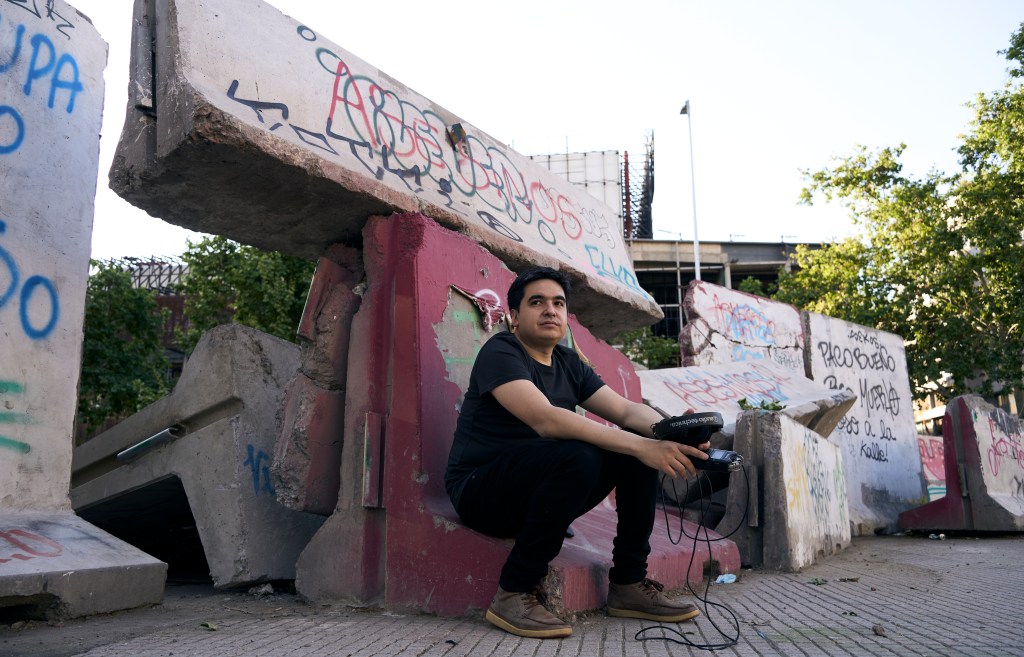
Miguel Farías – Foto por Max Sotomayor

Miguel Farías, compositor y Doctor en Estudios Latinoamericanos, chileno, nacido en  Venezuela en 1983.

Es ganador de varios premios internacionales y beneficiario de encargos y residencias en Chile y el extranjero. El 2011 y 2013 fue finalista en los programas “Composer Project” y “Roche Commissions” del Festival de Lucerne, con Pierre Boulez como jurado.

En junio de 2012, fue ganador del premio del círculo de críticos de arte 2012, en categoría ópera nacional y del Premio a las Artes Nacionales “Altazor” 2013, gracias a su ópera “Renca, París y Liendres”. En 2019 recibió el premio «Domingo Santa Cruz» de la Academia Chilena de Bellas Artes.

En 2018 estrenó su segunda ópera, «El Cristo de Elqui», encargo del Municipal de Santiago, Ópera Nacional de Chile. Y en 2021 estrenó su monodrama «La Compuerta nº12, con libreto propio sobre el cuento homónimo de Baldomero Lillo.

Es profesor asociado de la Pontificia Universidad Católica de Chile. Sus obras son editadas y publicadas por Universal Edition.

California, Christian Baldini, composer, Concerto, Conductor, Experimental, Jean Ahn, Korea, Music, Symphony Orchestra, Uncategorized

Composer Jean Ahn in Conversation with Christian Baldini

On February 1, Jean Ahn’s work “Woven Silk”, for haegeum and orchestra will be performed by Korean haegeum virtuoso Soo-yeon Lyuh and the UC Davis Symphony Orchestra as part of the Taproot New Music Festival. I had the chance of asking Jean some questions about her music and training. Her answers are below.
Christian Baldini: Dear Jean, many years have gone by since you were selected as a participating fellow in the first edition of our New Music Festival at UC Davis (nowadays called Taproot New Music Festival). It is wonderful to welcome you back, and to perform one of your compositions, in this case, a Concerto for Haegeum and Orchestra, titled “Woven Silk”, and written for the astonishing Soo-yeon Lyuh, who will be our soloist at our upcoming concert. Could you tell us what it feels like for you to be back, and could you provide some background about your piece?
Jean Ahn: I had my orchesta piece “Lulu, Lulu” played by Maestro Baldini and the UCD Symphony Orchestra. It was a wonderful performance and it definitely helped me get more performance opportunities. The best thing about the UC Davis music festival was the community it built during few days. The whole department, UCD faculty and graduate students were all together with the fellow composers. The discussions were always interesting, to the point, still very comfortable and open. I remember talking a lot more than usual, and we all did!I am so excited to be part of the festival again by sharing “Woven Silk”.
Woven Silk is a tribute to the TWO strings of haeguem. Haeguem is one of the oldest fiddles from Korea. With only two strings, the versatility and the intensity of haegeum is limitless.
After many collaborations with haegeum master Sooyeon Lyuh, I decided to make an orchestra piece, featuring what these strings can do. The motive of the piece is Perfect 5th interval (the usual tuning of the two strings) and string crossing method (explicitly showing the difference of the two strings, a cliche technique in western music, but not in Korean music).

CB: Tell us, where did you grow up, and how did you first become involved with music? When did you decide to become a composer?

JA: I was born in Seoul Korea. My mother was a piano teacher so I started playing the piano at a very young age. However, I hated reading notes, so I memorized everything. Having perfect pitch and learning how to write music boosted my confidence so I was determined to be a composer at age 6 and never changed my mind.CB: What are some of the most important influences to you as a performer, and as a composer?

JA: Up to my Ph.D. degree, I was only interested in being a composer, not a musician. I would write something, give it to a performer, often argue and have unpleasant outcome. After graduation, I became much more involved as a conductor, performer, singer or page turner! That truly changed by writing. Today, I can call myself a musician and I feel so much less insecure about my composition.CB: You have founded Ensemble Ari, a group of Korean musicians in the Bay Area. Could you tell us about the mission and importance of such an ensemble?

JA: I had been organizing many concerts here and there already. In 2014, my friends and I decided to make it more formalized and start an ensemble. It happened naturally. The musicians are all Korean American, so we often collaborate with Korean composers or Korean traditional musicians. Most of our repertoire is western music and our focus is to bridge different culture and different audience. We have collaborated with many different groups, including a children’s choir, an adult choir, an early music ensemble and a poetry group. On January 25th and 26th, we are collaborating with Soprano Rhoslyn Jones and two young singers from the Bay Area Vocal Academy. We are doing all female composers work. Our audience always learn something new through our concerts. It is fun to continuously surprise them.

CB: Thank you for your time, Jean. We look forward to performing your piece at our upcoming concert.

JA: Thank you for this invitation, I very much look forward to the performance!

Jean Ahn


Born in Korea, Jean Ahn began to study piano and composition at a very early age.

Her creative output includes works ranging from solo instruments to full orchestra, as well as choral, dance and electroacoustic music. Jean’s music was featured at Aspen Music Festival, June in Buffalo, New Music Miami, IAWM Beijing Congress, SEAMUS, Spark Festival, Women Composers Conference in Australia, New York City Electronic Music Festival, among others. Commissions include works for the SF Bach Choir, Leftcoast Chamber Ensemble, Volti Chamber Choir, SF Choral Artists, Gayaguem Soloist JUL, Locrian Chamber Players, and Pianissimo, among others. Her works have been performed by Oakland Symphony, Earplay, Enhake, Untwelve, Berkeley Symphony, Diablo Valley Symphony, Ensemble Sur Plus, pianist Lisa Moore (Bang on a can), Contemporaneous Ensemble, Invoke String Quartet and others.

Jean’s ongoing research  “Folksong Revisited” has been presented at many conferences.  This collection shows her vision to introduce Korean songs and techniques to professional performers in the US. Jean has also studied electronic music at CNMAT and has been working on hyper-koto series that exaggerate gestures from Asian traditional music.

She finished her B.A. and M.M. at Seoul National University and Ph.D at UC Berkeley where her teachers included Edmund Campion, Cindy Cox, David Wessel, Jorge Liederman and Richard Felciano.

She is the director of Ensemble ARI and Lecturer at UC Berkeley. www.jeanahn.com

Concert Hall, Dance, Experimental, folklore, Music, Nature, Symphony Orchestra, Uncategorized

Composer Profile: Daniel Godsil in Conversation with Christian Baldini

Christian Baldini: Daniel, congratulations on having your work Cathedral Grove selected to be performed by the UC Davis Symphony Orchestra at our upcoming concert on June 1, as part of the UCDSO Composition Award/Readings. Tell us about your piece, its title, its genesis, and anything else that you’d like to add.

Daniel Godsil: Thank you, Christian! It’s an honor to have been chosen for this, and to get the opportunity to work with you and the UC Davis Symphony!

For me, an orchestra is a very special thing: I love the beautiful concert halls, I love the rituals, I love the great masterworks that have been written for it. I especially love how so many people assemble together, both onstage and off, to present and hear this music. As I was deciding what to do with this piece, I thought about how much an orchestra, and all its accompanying social structure, is similar to “America’s Best Idea”: its national parks. We take time out of our busy days to go experience something out of the ordinary; we’ve decided as a culture how much certain extraordinary places mean to us, and how important it is to preserve them for future generations. The Muir Woods–of which the “Cathedral Grove” is a part– is one such place for me. And there’s immediate beauty, yes, but these ancient trees have been around long before us and will hopefully still be there long after we’re gone: this evokes a very sublime feeling. John Steinbeck said in his book Travels With Charley that “No one has ever successfully painted or photographed a redwood tree;” this piece is my humble attempt to, instead, make a painting in sound. I tried to capture some of that sublime feeling, and also vitality, majesty, tenderness, silence, light or color filtering through the tops of trees, etc.  

CB: What do you try to achieve with every new piece that you write? What are your main goals?

DG: After finishing my undergraduate work in composition, I spent a long time working as a composer for film and other visual media. When I returned to composing art music, it took me a long time to come to terms with why I was doing it; it didn’t feel like there was a tangible end product like a movie or a video game. What has really helped me is the idea of making music as a community. With so much music out there nowadays, I think it’s important to cultivate music groups or communities–people that you work with, live with, study with, meet at a festival, have coffee with. I’m always most excited to hear music that my friends make or perform. I try as much as I can to write music that will be appropriate for the performer or event I’m composing for, and I love collaborating with performers while I compose. Hopefully, this all helps to communicate with the audience, too.

CB: You’ve now lived in California for quite a few years. Has being a UC Davis graduate student influenced you much professionally and/or personally, and if so, in which ways?

DG: California is a very special place for me: for one, my wife Sara grew up here, and has deep ties to the Bay Area, and her family lives here. And now, my daughter Betsy (who is already 18 months old!) was born here. I grew up in Illinois, in the hometown of poet Carl Sandburg. Illinois has its own kind of beauty, but I have to admit that it’s nothing quite like what I experience in California on a daily basis. A lot of this comes out in my recent music, too. I’ve been influenced profoundly by the natural beauty of my new home state. As an added bonus, the music department at UC Davis is fantastic! We grad students get to compose for and collaborate with world-class performers, and study with musicians and scholars at the tops of their field. What more could you ask for? I’ve also become a very avid cyclist, and I absolutely love that I can bicycle all year round in California. Living in Davis has taught me that time on the bike is almost as important as studying or composing!

CB: Is there anything that you’d like to see change in the usual concert platform, or in the way that symphony concerts are presented?

DG: As I mentioned earlier, I’m someone who really loves the modern orchestra and how it’s presented now. Even though it may seem stuffy, there’s a reverence built into the ritual that I think should be preserved. Just like you wouldn’t go into the Muir Woods with a boombox (hopefully), there’s a level of respect that goes with an orchestral performance. That said, I really think that orchestras need to have a significant “laboratory” component, where new music is given equal standing with established repertoire. When you go to a good museum, the contemporary works aren’t presented in some back room…they’re in a fantastic, new, climate-controlled space, right next door to the masterworks of the past. I’m not a fan of having new orchestral works presented as filler, or blamed for lost ticket sales. The audiences should be given more credit! Look at what the Gustavo Dudamel and the LA Phil are doing, for instance, and thriving, at that! Championing new music should be a major part of preserving our beautiful orchestral tradition; like the slogan says for the American Composers Forum, “all music was once new.” And by taking chances on new local music! I love going to the Crocker Art Museum in Sacramento, for instance: they have a great collection of local California art, and it’s fantastically diverse. I love it when orchestras do the same kind of thing, it strengthens community bonds very simply and effectively.

CB: What would be your advice for anyone trying to become a composer? (and/or for anyone applying for graduate school in composition)?

DG: Again, I think it’s really important to cultivate musical community. If you’re not a skilled instrumentalist or performer, start by working on that! Get out and start playing music with other people. Write something for a cellist friend, for instance, and see what works. You can learn so much more in one rehearsal than by reading books for that same amount of time. That’s not to say that reading or studying is a bad thing: it’s important to learn your craft through whatever means possible, and doubly important if you want to pursue composition at the graduate level. But I think it’s good to frame everything by actually doing music.

CB: Thank you for your time, Daniel, we look forward to performing your piece and sharing it with our audience soon!

DG: Thank you, Christian, I’m really excited to work with you and the orchestra, and I hope people who hear it will let me know what they think!


Godsil_headshot

Daniel Godsil‘s music, which has been described by the San Francisco Classical Voice as having an “intense dramatic narrative”, draws from such eclectic influences as rock and heavy metal, science-fiction, and Brutalist architecture.

Winner of the 2017 Earplay Donald Aird Composition Competition (for his quartet Aeropittura), Godsil’s music has been played by Ensemble Dal Niente, Talujon Percussion, the Lydian String Quartet, the Empyrean Ensemble, the Metropolitan Orchestra of Saint Louis, the University Symphony Orchestra at California State University, Fullerton, the Knox-Galesburg Symphony, the Daedalus String Quartet, and the Nova Singers, among many others. Recent film scores include the PBS documentary Boxcar People, Man Ray’s 1926 silent film Emak-Bakia and the feature film H.G. Welles’ The First Men In The Moon. Godsil was a finalist in the 2018 Lake George Music Festival chamber composition competition, the 2018 Reno Pops Orchestra competition, as well as the 2014 & 2018 Red Note New Music Festival Composition Competitions. His choral works are published by Alliance Music Publishing and NoteNova Publishing.

Born and raised in central Illinois, Godsil (b.1982) is currently pursuing his PhD. in Composition and Theory at the University of California, Davis, studying with Mika Pelo, Laurie San Martin, and Sam Nichols. He holds an MFA in Music Composition from the Vermont College of Fine Arts, where he studied with John Fitz Rogers, John Mallia, and Jonathan Bailey Holland. He also holds a BM in Music Composition from Webster University.

Godsil was selected to participate in the 2017 Summer Institute for Contemporary Performance Practice (SICPP) in Boston, where he had master classes with composers Nicholas Vines and Georg Friedrich Haas.

Godsil has also been active as an educator, conductor, and performer in the central Illinois area, Knox College, Monmouth College, and Carl Sandburg College. At Knox College, he directed the New Music Ensemble, Wind Ensemble, Chamber Ensemble, and Men’s Chorus. He has also held posts as choral accompanist and collaborative pianist, and served as Music Director and Organist at Grace Episcopal Church in Galesburg, IL.