Christian Baldini, composer, Compositora, Concert Hall, Eliza Brown, Symphony Orchestra

Eliza Brown in Conversation with Christian Baldini

I’m thrilled to be conducting Eliza Brown’s a toy boat on the serpentine at the Mondavi Center in Davis on June 1, alongside Gershwin’s Rhapsody in Blue, with Erina Saito, and Daniel Brewbaker’s Playing and Being Played, with Rachel Lee Priday. Eliza is a composer whose work moves seamlessly between disciplines, drawing on literature, sound ecology, and collaborative creation with other artists and thinkers. Their music invites deep listening—not just to the sounds themselves, but to the questions those sounds ask about memory, space, and meaning.

Eliza’s pieces have been performed around the world by top new music ensembles, and their recent projects have included everything from music-theater inspired by a year of field recordings in Indiana to collaborations with sculptors and video artists. They are also a thoughtful scholar and passionate educator, currently serving as Associate Professor of Music at DePauw University.

It was a joy to speak with Eliza about the ideas that fuel their music, the power of listening, and some of the unexpected surprises that shape their creative life.

Christian Baldini: Your work “a toy boat on the serpentine” will be performed alongside Gershwin’s Rhapsody in Blue—two pieces that inhabit very different worlds. Could you tell us about the origins of a toy boat and what kind of space or imagery you hope it evokes for the listener?

Eliza Brown: This piece was commissioned by my former youth orchestra, Philadelphia Sinfonia, in honor of my mother, who served as the president of their board for many years after I graduated from the organization. I asked for her input while composing the piece, and incorporated musical elements that we extrapolated from the Classical music she finds most moving. She and I are both fans of Virginia Woolf, and the title is a reference to Woolf’s novel Orlando. Orlando, the main character, sees a toy boat bobbing on the calm Serpentine river in London’s Hyde Park, and takes it as a sign that her sea-captain husband is safe after sailing through a storm. Orlando experiences a surge of ecstasy from this simple everyday sight, thanks to her vivid imaginative inference. So the piece moves from very small musical fragments bobbing on a glittery surface to big, Romantic musical phrases and gestures at its peak. I hope listeners feel free to imagine their own imagery along with this, and to layer their own personal significance onto the piece, just as Orlando does with the toy boat.

CB: You’ve described your music as being driven by sound’s “potential for meaning.” What does that mean in practice—how do you begin shaping a piece when there’s no narrative, only sonic intention?

EB: I think there’s a lot of space, and a complex spectrum of different kinds of musical meaning, between the 19th-century poles of “programmatic” – i.e. based on an extra-musical narrative – and “absolute music” – i.e. the “purely” musical. I don’t think sound is ever completely devoid of referential meaning, because human brains are wired to interpret sensory inputs. We are always hearing sounds in reference to other sounds we have experienced, and this is deeply ingrained in our survival instincts – sounds indicate safety, danger, sources of food and water, etc. In a less life-or-death example, if we hear the sound of a cello, we’re subconsciously referencing that against other examples of cello we’ve heard in the past. Every experience we have with sound contributes to the way we listen and understand what we hear. The meanings of sound and music are of course very complex and layered and culturally and personally contingent, so we can’t use sound to sort of paint meaning by numbers and have it translate exactly the same way to every listener. But we can create combinations of sonic and musical references that come from a place of awareness about their potential meanings in cultural context, and there’s a richness there, and fun to be had in combining all these different signifiers, just as there is when writing text. So as I’m developing material, I’m often asking myself questions like, what does this remind me of? Where have I heard sounds like this before, in music or from any other source? Do I want to make compositional choices that bring the material closer to or further from those origins, references, influences? If the answer is, “further,” then in what direction? How will we get there? It’s a way to kind of map my way between recognizable landmarks or reference points, or play in the space between them.

CB: In The Listening Year, you integrated field recordings, scientific insights, and community stories from a single creek in Indiana. How did that immersive process change the way you compose—or even perceive music itself?

EB: I think that The Listening Year was an outlet to deepen and confirm approaches I was already exploring, rather than a catalyst for unexpected turns in my work or listening. As someone who has done a lot of outdoor soundwalks, and spent many hours listening in silence in Quaker meeting as a child, environmental listening feels like second nature. And I often start a piece by paying close attention to something outside of myself –  an existing piece of music, conversations with collaborators, recordings of the performers I’m writing for. My ideas come from that attentive, relational process. The Listening Year amplified that process, as I spent about 16 months making and studying fifty-two weekly field recordings and seeking many perspectives on the creek before writing any music. I thought of this as an ecological process, in which my composing was inextricable from the web of inputs and relationships created during that time. There’s also something attractive to me about this kind of devotional practice of attention: my creativity stems from being devoted to this place, these people. 

CB: Your work sussurra grew out of a kinetic sculpture and became a cross-disciplinary collaboration. How does your creative process shift when working alongside artists in other media, especially in film or visual art?

EB: This question follows well from my previous answer, in the sense that I don’t think my process is fundamentally different when working with artists from other fields. It starts with this process of exploration, listening, attention, and seeing what emerges and following those threads. In interdisciplinary collaborations there’s also an element of translation, where we gain an understanding of each other’s thinking in the terms of both disciplines, which usually leads to really delightful moments of discovery and recognition: oh, you think about this too with different words; oh, yes, we understand each other. We’re also figuring out the intersections and spaces between our disciplines and our specific practices that we want to spend time in, that expand our thinking about what we do as individual creators. That process takes time and iteration, so I think the biggest difference is in the development timeline rather than the way I’m thinking about composing or collaborating. In some ways the biggest difference between my interdisciplinary projects and my more traditional music projects is the production infrastructure. Interdisciplinary projects are less likely to fit into traditional producing models like “concert,” “play,” “gallery exhibition,” etc., so they often involve more administrative and production work on the part of the artists to get the project off the ground.

CB: Many of your compositions have an intertextual layer—responding to earlier music, texts, or traditions. What draws you to engage with the past, and how do you balance homage with innovation?

EB: I think what has drawn me to engage with the past – particularly early in my career as I was finding my voice – is my simultaneous sense of resonance with and appreciation for it, but also alienation and distance from it. I love so much music from the Western canon, and find it fascinating and moving, but I am not of the eras and cultures that found it necessary to make that music. And I would not want to be – in those eras and cultures, I likely would not have had access to a music education or career due to sexism! So I look at these historical objects with both attraction and wariness, and have written a number of pieces that pass historical musical artifacts – style elements, forms, fragments, whole pieces – through a kind of compositional filter that reflects this duality. In these pieces one might hear echoes of the past, but they’re echoes, removed from the source – veiled, re-contextualized, reverberations rather than re-creations. I don’t think they are homages, though there is affection there – they are more the product of passing these objects through the filter of my complex relationship with them.   

CB: Your academic research focuses on narratology in music—particularly in Czernowin’s Pnima…ins innere. Does that analytical lens ever influence how you compose your own music?

EB: Yes, absolutely! I have always been a very interdisciplinary thinker, and I really resonate with notions of storytelling across media. Pnima is an opera that has no textual libretto – the singers sing phonemes rather than words. Yet it is based on a novel and tells that novel’s story through what the composer calls “an internal theater,” or a sonification of the characters’ psychological journeys. My research was about the theoretical frameworks one could use to understand how this kind of storytelling works, and it drew on theories of narrative from literature and screen media as well as music theory and aesthetic philosophy. Without giving a full dissertation here, I will say that that research has been so influential to me that it would be almost impossible to excavate all of the ways it is ingrained in my thinking and practice. But perhaps the most significant thing has been understanding musical gesture, sound, and time as metaphors for embodied experience – understanding musical activity in terms of human behavior, or the ways that we experience psychological and emotional states in our bodies. 

CB: As a professor and mentor to young composers, what are some values or skills you most hope your students carry forward into their careers?

EB: One of the biggest things I hope students take with them is a sense of permission to explore whatever it is that excites them artistically. I find that many students enter a music degree with a lot of assumptions about what music is, what composition is, what counts as composing. These assumptions can really limit them from exploring avenues of creation that they might love. So I hope students encounter a broad range of practices presented without judgment, and feel a sense of permission to pursue their instincts and passions into any of these directions, whether they fit their initial assumptions or not. I also hope that students shed the need for anyone else’s approval to be an artist – what makes you a composer is the fact of composing, not external recognition. Everyone needs technical skills, too, but those vary depending on individual practices and goals. It’s so difficult to make a career in the arts, so I think it’s fundamentally important that young artists develop a sense of internal permission and agency, and a personalized technical skillset, that no one can take away from them, regardless of the challenges of funding, finding opportunities, and all of the practical considerations that come along with artistic careers.

CB: Looking ahead, are there any upcoming projects—musical, theatrical, environmental, or otherwise—that you’re particularly excited about right now?

EB: Yes, I’m kind of at a turning point between projects so there’s a lot to look forward to right now! In June I’ll finish a piece for Duo della Luna (Susan Botti, voice and Airi Yoshioka, violin) setting poetry by Elizabeth Bradfield, and I’ll also be working on two small-scale interdisciplinary projects this summer, each a collaboration with another artist who is a composer-performer. In the fall I’ll start working on an opera based on a Renaissance painting that I’ve been thinking about for almost 15 years! That’s going to be a long-term project, but I’m excited to finally start getting it out of my head and into the world.

CB: Finally, for a fun one: What’s something personal or unexpected that you’d be willing to share—perhaps a favorite sound, a ritual in your composing process, or a surprising influence?

EB: I couldn’t choose a favorite sound (every sound that exists could be my favorite in the right context!) but I do enjoy “unexpected soundtrack moments” in daily life – when the music in a public space, or looping in my head, isn’t what I would first think to pair with the activity or scene around me, but somehow goes with it perfectly or adds a subversive layer to it. The most recent one I can think of was on May 4, when some nerdy DJ at my climbing gym had a playlist that was about 90% John Williams – not what one typically hears in a gym! It was pretty delightful. Three strangers and I had been working on the same bouldering route for a bit, and as soon as the Indiana Jones theme came on we all topped it out like a quartet of Williams-activated climbing sleeper agents. I don’t know if the music helped or not, but it was a fun coincidence!

Eliza Brown’s music is motivated by sound and its potential for meaning; questions about the nature of human existence, social relationships, and responsibilities; and vivid sensory experiences. Their compositions have been performed by leading interpreters of new music, including Ensemble Dal Niente, Spektral Quartet, ensemble recherche, International Contemporary Ensemble, Network for New Music, Ensemble SurPlus, Quince Contemporary Vocal Ensemble, and Wild Rumpus New Music Collective; heard on stages throughout the USA and in Mexico, Colombia, Germany, Hungary, Spain, Canada, and the UAE; and recorded on multiple labels. Eliza’s work has been supported by grants from the Illinois Council on the Arts and the Paul R. Judy Center for Applied Research, among others, as well as residencies at the Ragdale Foundation (IL) and A Position on Retreat (BC).

Eliza’s work is frequently intertextual, opening dialogues with existing pieces of music, historical styles, field recordings, and other artifacts. It is also frequently interdisciplinary, with a particular focus on music-theater and opera. Recent projects include The Listening Year (2024), an hour-long music-theater work for cello-percussion duo New Morse Code and fixed media that incorporates and responds to a year of field recordings made along Big Walnut Creek in Greencastle, Indiana. Eliza consulted with scientists, conservationists, local residents, fellow artists, and students to interpret the recordings; the form and content of the piece reflect the site’s ecology and annual cycles, human uses and understandings of the site, and the transformative experience of a year-long environmental listening practice. This work was awarded the 2023-24 DePauw University Fisher Fellowship. The chamber work sussurra (2023), commissioned by Classical Music Indy for the Micro Composition Project, was inspired by visual artist Antonia Contro’s kinetic sculpture foglia, and in turn became the sonic layer of a film featuring the sculpture that Eliza co-created with Contro and video artist Jon Satrom of studiothread. 
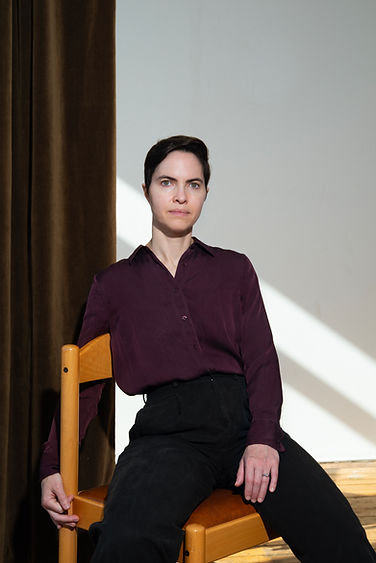
Eliza Brown_030.jpg

Eliza’s artistic interests give rise to questions about the interpretation and meaning of music and words that drive their scholarship, creation, and teaching. Their dissertation, A Narratological Analysis of ‘Pnima…ins innere’ by Chaya Czernowin, used methods drawn from the interdisciplinary field of narratology (the study of narrative) to examine how Czernowin’s opera tells its story by means of music alone, as singers in Pnima sing phonemes and wordless vocal sounds. Eliza writes original and co-created texts and libretti, drawing upon a wide range of influences including scholarship, contemporary poetry, and a childhood steeped in protest, folk, parody, and camp songs. 

Eliza is a dedicated teacher who enjoys helping students develop as creators and engage complex ideas with rigor and enthusiasm. They are currently Associate Professor of Music at DePauw University, where they teach composition, music theory, and career development courses. Eliza has enjoyed a long-term affiliation with the Walden School Young Musicians Program, where they spent many summers in various roles including faculty and Academic Dean. Eliza holds a B.Mus. summa cum laude in composition from the University of Michigan and a D.M.A. in composition with program honors from Northwestern Universit

Concerto, Conductor, Experimental, Music, Soloist, Symphony Orchestra, violin

Miguel Farías in Conversation with Christian Baldini

[to read the original version of this interview, in Spanish, click here]

Christian Baldini: On March 5 I will have the pleasure of conducting the world première of the Violin Concerto “Kuyén” by Chilean composer Miguel Farías, featuring the wonderful violinist Rachel Lee Priday. Miguel Farías is a superb Chilean composer, and we have been colleagues and friends for about fifteen years, when we met in France at a festival where we both had our works for orchestra performed by the excellent Orchestra National de Lorraine. I was immediately captivated by his music because of his great use of the orchestral palette, his imagination and his expressiveness, and his great ability to write motifs that are very memorable without trying to be. It is a pleasure to present this world premiere that was our commission and that received the prestigious support of Ibermúsicas. Miguel, tell us, how was the genesis of this piece? What could you share with us about how you started writing it, what plan you originally had and what changed in the process (if that did happen)? Are you happy with the final results?

Miguel Farías: First of all, thank you very much dear Christian for your words, and I would also like to tell you that it is a great pleasure to be able to collaborate with UCDSO and with you, especially after fifteen years of friendship!

Composing Kuyén was somehow quite intuitive. I like to write narrative (fiction), and during the last year I wrote a book that contains stories that speak of the night, from different perspectives. One of these is one that has to do with mythology. Perhaps that is why I had in mind some sonorities that were related not only to the night, but also to beings that inhabit it. This is how it occurred to me to “ground” this sound speech that was haunting my head, basing it on the narrative of the Kuyén myth. The idea, in addition to having a soloist and an orchestra, reinforced the discourse based on dialogue, which ended up being essential to give shape to the piece.

CB: How were your beginnings with music?

MF: Initially, when I was about 10 years old, I taught myself to play the piano. Then I really liked rock and jazz and I studied electric guitar. I quickly realized that more than playing other people’s music, I liked inventing music on the guitar. So at fourteen I went to find out how to study composition at the conservatory, and at fifteen I was already in my first formal year.

CB: Who were some of the people in your life that have most positively influenced you to be the composer you are today?

MF: It may sound cliché, but first of all my family. In general, I am interested in a type of music that does not question itself, but dialogues with its surroundings. In my family there are no musicians, so they have been an influence not only emotionally, but also creatively and thoughtfully. In the art world, I have generally been much more influenced by literary narratives than by composers. The speech and thought of Raul Ruiz has been important in my way of thinking about the discourse and the musical form. In the construction (or attempted construction) of my own musical discourse, I believe that several writers have influenced me, some examples are the Cubans Guillermo Cabrera Infante and Pedro Juan Gutierrez, the Chileans Christian Geisse and Hernán Rivera Letelier, or the Mexican Juan Rulfo, among several others. Honestly, without literature in my life, it would be difficult for me to continue growing artistically.

CB: Being a young composer is not easy. Opportunities for your works to be commissioned by or performed by an orchestra don’t come very often (or at all). What advice would you give to young composers who are looking for opportunities?

MF: Go forward with a lot of work and confidence. It is difficult to have commissions or works performed by orchestras these days, but my experience has shown me that if one is capable of presenting artistically interesting ideas and projects, there is interest from the institutions.

First of all, in order to present interesting projects, I think you have to work hard to develop a correct and personal way of orchestral writing. You have to understand the sonorities of the orchestra as well as its relationship with musical time. Then, the exercise of the trade itself provides the tools to bring ideas to the score.

On the other hand, composition contests and courses are very useful, not only to have visibility, but also to be able to hear what is written above all. In competitions, the most common thing is not to win, but to keep trying; on the one hand, it serves to develop a high-level orchestral writing, tolerance to frustration, and above all a handling of writing and ease in bringing abstract ideas to life on the music sheet. Contests serve as a kind of exercise in this.

CB: You are also an opera composer. In your opinion, are there any (or many) differences between writing chamber music, symphonic music, vocal music, and dramatic music for the stage, such as opera?

MF: Very much so, in my opinion. The starting point in dramatic and instrumental music is very different. In the first we start from quite tangible and literary narrative resources. In the second, at least in my case, one starts from a blank sheet of paper, where we have to build the sound objects with which the ideas we have in mind will be represented. Both worlds are exciting, and difficult to master.

On the other hand, in dramatic music for the stage, at the time of writing there are many factors to consider that influence each note we write. The narrative, the visual, the temporal; and other more complex factors that have to do with the context of the text being worked on. I’m not saying that instrumental music doesn’t contain these riches and difficulties, but I do say that opera, for example, begins from a space heavily charged by a tradition that has these factors as its starting point. In the opera, our blank page at the beginning is quite lined.

CB: For someone who has never heard your music before, what advice would you give them? What is important in your music? What should they try to hear in your works? (and in this Concerto for violin and orchestra, specifically?)

MF: I find it difficult to answer something like that, since I would like to say that they can hear what they want and how they want when listening to my music. But if we think specifically about Kuyén, I would like them to try to feel the colors and nuances of light with which I tried to impregnate the sonorities, both of the solo violin and of the orchestra. Kuyén for me is a dialogue between colors, lights, brightness and darkness, and I would like to suggest that in this work, they start by letting themselves be carried away by intuition to hear it as an abstract conversation between these elements.

CB: Thank you very much for writing this beautiful work for the UC Davis Symphony Orchestra and Rachel Lee Priday. I am very happy to be able to share your music with our public and our community.

MF: Thanks to you dear Christian, to the UCDSO and to Rachel. It has been amazing working with you and Rachel. I have learned a lot, and I have enjoyed it even more. Rachel has given an impressive voice to each of the notes I wrote. I am very excited and grateful. And of course, I hope that this first collaboration after fifteen years of friendship is not the last.

Miguel Farías (Photo by Max Sotomayor)

Composer and PhD in Latin American Studies, Miguel Farías (b. 1983) studied in Chile, Switzerland, and France.

He is the winner of several international prizes and beneficiary of commissions and residences in Chile and Europe, including Injuve, 2007 (Spain); Luis Advis, 2007 (Chile); Frederic Mompou (Barcelona, Spain); Joan Guinjoan, 2013 (Barcelona, Spain); Manuel Valcarcel, 2013 (Santander, Spain); the sponsorship prize at the BMW Musica Viva competition of the Bavarian Radio (Munich, Germany); and he was a laureate of the Isang Yun Music Prize, 2007 (Korea); Tactus, 2008 (Belgium); the prestigious Queen Elisabeth Competition, 2009 (Belgium); and the Reina Sofía (Spain), among others. He was a finalist in the “Composer Project” and “Roche Commissions” programs of the Lucerne Festival, with Pierre Boulez as a member of the jury.

In June 2012, Farías won the 2012 “Art Critics” Prize in the National Opera category and the National Arts Prize “Altazor” in 2013, for his opera Renca, París y Liendres, premiered by the Chilean Symphony Orchestra. In 2018, his second opera, El Cristo de Elqui, was premiered by the Chilean National Opera at the Municipal de Santiago, directed for the stage by Jorge Lavelli. In 2019, he won the Beaux-Arts Chilean Academy prize for the premiere of this opera.

Beauty, California, Christian Baldini, composer, Concert Hall, Conductor, Experimental

Composer Mathilde Wantenaar in Conversation with Christian Baldini

Shortly before the world stopped turning around as usual, in December 2019, I had the pleasure of conducting again at the beautiful Concertgebouw in Amsterdam, one of my favorite concert halls in the world. While I was there, I reached out to Carine Alders, who coordinates the Leo Smit Stichting. Whenever I travel for work somewhere I like to immerse myself with the local culture, and to recognize gems that I could do research about share with audiences back home. The purpose for me was simple: to become acquainted with some of the most important (forgotten, neglected and also new) voices of female composers in the Netherlands. Our meeting was very helpful, and Carine shared with me recordings, scores, and much information. Mathilde Wantenaar‘s name came up, and when I researched on it a little bit I found her music fascinating, refreshing and very original. This is how I decided to program it for our upcoming concert with the UC Davis Symphony Orchestra, on November 20, 2021.

Christian Baldini: Mathilde, it will be a pleasure to conduct the US premiere of your orchestral work “Prélude à une nuit américaine”. I find this work extremely fascinating, beautiful, with very subtle orchestration and also particularly reminiscent of Bartók and Debussy. Tell me, what is the genesis of this piece? How did you approach writing it? How would you explain your compositional process, and does it change much from piece to piece? 

Mathilde Wantenaar: I improvise a lot on the piano, this is also how I started composing as a child – I was supposed to be studying pieces for my piano lessons, but would wander off in my imagination and start playing around with the notes, inventing little melodies and pieces. As I improvise, or play an existing piece, I might find something which draws me in, a chord or a melody or a little motive and I start playing around with it. Once I have some material I might look for some more contrasting material perhaps and also think about the form. Sometimes the form comes first, though, or I have an atmosphere in mind while I start improvising or if the starting point is a text, everything changes and I start by reciting the text, learning it by heart and trying to hear the music that is hidden in it. So it does change from piece to piece.

CB: What would you say to someone who has not listened to your music yet? What should they listen for? Ultimately, what do you hope listeners will take with them home after experiencing one of your pieces?

MW: For me music is about beauty, but I mean this in the broadest sense (so not just pleasant music, although there is nothing wrong with pleasant music either in my opinion). I think that artists all over the world are making a collective effort to look for and bring forth beauty just like scientists all over the world are making a collective effort to discover truth. But every artist has their own approach and highlights different aspects, which makes the musical landscape so rich and diverse. I try to capture and present the musical aspects that I myself find thrilling or touching and offer them to the musicians and listeners in the hope that it might touch them the same way that the music I love touches me. Some of my favourite musical aspects are lyricism, I love it when the music sings, long lines and a sense of direction, the building of tension, unabashed dramatic gestures, playing with different textures and atmospheres which can be far-away, misty and magical or golden, shimmering and triumphant and anything in between. 


CB: What are some of the things you care about the most when it comes to music (both new and old)?

MW: You are asking some pretty intense questions haha. Let me think… I think I should refer back to my previous answer. Music is about beauty and communicating beauty, first with the performer who is to interpret and add their own musicality to the piece, and via the performer the piece is communicated to the listener, whose imagination is also unleashed, hopefully.  


CB: You are still very young, and you’ve developed a remarkable career already. Can you tell us about some of the most important or inspiring experiences and/or people that you’ve had so far? What has helped you or inspired you to continue growing and excelling as an artist?

MW: When I was still in high school, there was a project with the renowned ASKO|Schönberg ensemble, for whom we got to write a piece which was then performed in the beautiful small hall of the Concertgebouw in Amsterdam. This was such a great experience that I decided to go for it and study composition at the Conservatory of Amsterdam. I have had many more inspiring experiences after that, because writing a new piece and working all kinds of musicians is always an adventure, but one of my most recent important experiences was the première of my second orchestral piece ‘Meander’, performed by the Rotterdam Philharmonic Orchestra and conducted by Lahav Shani. Lahav is a brilliant conductor and I was quite nervous to be working with him to be honest, because I looked up to him so much, but he was so kind and warmhearted and also gave me some very useful feedback to further improve my orchestral writing. I greatly appreciate it when the people who perform my work, not just the conductor but also individual musicians, share their experience and thoughts with me. It means they find it worthwhile and it allows me to grow.

CB: Is there anything that you would change in the so called “classical music” world? Are you at all interested in other genres, in crossover, or other variants of possible collaborations? (Are you also interested in composing an opera, perhaps?)

MW: I really like the classical music world. It is such a wonderful tradition with immense beauty to offer. Of course a bit more new music on the program never hurts, but perhaps I am not completely unbiased on that front haha. But seriously, I do think it is important to focus also on programming new works so that the classical music tradition really stays alive, instead of a beautiful but ancient piece of art in a museum. And as for ‘other genres’, I think new music is new music, you never know what it will sound like and what it will sound like is up to the composer. It can be crossover like you mentioned, if the composer feels that is an interesting path to explore, but in any case it is good to give many different people the opportunity to write and be performed, so we musicians, listeners and composers alike can be inspired and the music continues to grow and live on.


CB: I’d like to ask you to dream of a music festival for which you’d be the artistic director. What would you program? Which guests would you invite? Which orchestras and/or ensembles would be featured? (to make it even more difficult: you’d have unlimited funds!) – if possible, please provide two or three sample programs.

MW: Christian, what a question! I feel like my head might explode, I would need weeks or months even to think about that question! And I am still trying occasionally to write some notes also… I am sorry I cannot come up with something right on the spot. In any case, referring to your previous question, I think it is always nice to combine ‘old’ and ‘new’ music in a program. When I go to a concert I want to hear the treasures form the past as well as experience something new and fresh and anything in between. It’s no revolutionary stance I think, but I strongly believe in it. 


CB: Thank you very much for your time Mathilde, I look forward to performing your music and to sharing it with our audiences!

MW: Thank you and all the musicians for performing my piece! And the audience for listening of course. I wish I could be there, but Davis is a little far from home (Amsterdam, the Netherlands) for me. I just looked it up and read it is the most popular city in Yolo county, which sounds like a place worth visiting, so who knows one day… In any case good luck and fun with the performance! I hope you and the listeners will enjoy it 🙂

Mathilde Wantenaar (Photo by Karen van Gilst)

Amsterdam born composer Mathilde Wantenaar (1993) started her studies at  the Amsterdam Conservatory, where she studied classical composition with Willem Jeths and Wim Henderickx and subsidiary subjects including piano, cello, classical voice and advanced rhythm. 

   Wantenaar’s music has been described as lyrical, enchanting and eclectic yet authentic. The combination of her craftsmanship and openness to a broad array of genres make Wantenaar a very versatile composer. She works with individual musicians, both vocalists and instrumentalists, as well as small ensembles, large orchestras and everything in between, and is especially interested in creating opera. 

   After her first chamber opera premiered during the Opera Forward Festival 2016 of the Dutch National Opera Wantenaar completed her composition studies and was admitted to the Royal Conservatory of The Hague to study classical voice with Rita Dams and Noa Frenkel where the goal was to further develop her musicality, explore the art of singing in depth and learn more about drama. This proved to be an invaluable experience with regards to her vocal writing in particular, but also her compositional approach in general.

   For three years Wantenaar divided her time between her composition practice and vocal studies, until she got her first orchestral commission (Prélude à une nuit américaine for the Rotterdam Philharmonic Orchestra) as well as an opera commission (Een lied voor de maan for the Dutch National Opera) in 2019 and decided it was time to focus solely on composition from now on. 

   Wantenaar has written for, and collaborated with, the Dutch National Opera, the Rotterdam Philharmonic Orchestra, the Netherlands Philharmonic Orchestra, the Netherlands Radio Choir, the Dutch Wind EnsembleAmsterdam SinfoniettaWishful Singing, Liza Ferschtman, Ralph van Raat, Johannette Zomer and many others.

Conductor, Music, Singer, Soloist, Symphony Orchestra, tenor, Uncategorized

Kyle Stegall in Conversation with Christian Baldini

On Friday, March 6, I will conduct Beethoven’s only oratorio, ”Christus am Ölberge” (”Christ on the Mount of Olives”) at the Mondavi Center with the UC Davis Symphony Orchestra and University Chorus, on a program that will also include Beethoven’s Piano Concerto No. 4, with Andrei Baumann, and the world première of “what remains” by composer Laurie San Martin. Below is a brief Q&A session with one of our three vocal soloists, tenor Kyle Stegall. Click on these links for interviews with Ms. Piccolino and Mr. Yoder.

Christian Baldini: Please tell us about your education and training. How did you start with music, and when did you decide to become a singer?

Kyle Stegall: I’ve been interested in professional singing and in teaching singing since my senior year of high school.  All three of my degrees are in Vocal Performance, and were granted by the Universities of Missouri, Michigan, and Yale.  My passion for communication is what has driven my studies, and the development of my performance and teaching career.

CB: What do you find remarkable about this work by Beethoven? What are your favorite moments in it?

KS: I am so looking forward to performing this dramatic and heroic work with Maestro Baldini and the musical forces at UC-Davis.  I am particularly fond of the moment in which the clarinet introduces the prayer theme in Christ’s opening aria.

CB: What are some of your favorite pieces of music, whether in the operatic realm, chamber music, or on the concert platform? Which works would you like to be singing next?

KS: I am lucky to have a career engaged with a great breadth of the classical repertoire.  I sing opera, recital, and concert work in equal proportions, which is actually quite rare.  I value the opportunity to communicate in such varied stylistic-idioms and performance environments.  Everything from the haute-contre repertoire of the French Baroque to world premieres of new repertoire for the solo voice, to staples of the recital canon, to large orchestrated works such as Christus am Oelberge hold consistent spots in my performance seasons.  I am particularly fond of the Bach evangelists, the cycles of Benjamin Britten, and orchestrated masses/oratorios of the classical and bel canto repertoire.  I’d like to find a spot for Britten’s War Requiem and Berlioz’ Les Nuits d’ete in coming seasons.

CB: What does art, and music in particular, mean to you? Is it relevant in our society today?

KS: Art and music are and will forever be relevant.  Art is an intensely potent force for awakening in large numbers of people a dormant respect for our shared, vulnerable humanity. What our world needs is community. What our world needs is emotional honesty.  Music is the crystallized sonic manifestation of these things.  The question isn’t whether or not art is relevant.  The question is whether or not we will make room in our hearts, budgets, schedules, and priorities for it.


Kyle Stegall2
tenor Kyle Stegall (courtesy photo)


Kyle Stegall’s performances around the world have been met with accolade for his “blemish-free production” (Sydney Morning Herald), and his “dramatic vividness” (St. Louis Post-Dispatch). A career spanning concert, opera, and recital stages has grown out of successful collaborations with many of the world’s most celebrated artistic directors including Manfred Honeck, Joseph Flummerfelt, Masaaki Suzuki, William Christie, and Stephen Stubbs.

In demand as an opera and concert soloist, Mr. Stegall is a celebrated interpreter of the Bach evangelists, and is often heard in the great oratorios of Handel and Haydn.  His operatic repertoire spans the haute-contre heroes of the French Baroque to modern premieres.

Mr. Stegall  is a proud alumnus of the universities of Missouri, Michigan, and Yale.

@stegalltenor http://kylestegall.com