Christian Baldini, composer, Compositora, Concert Hall, Eliza Brown, Symphony Orchestra

Eliza Brown in Conversation with Christian Baldini

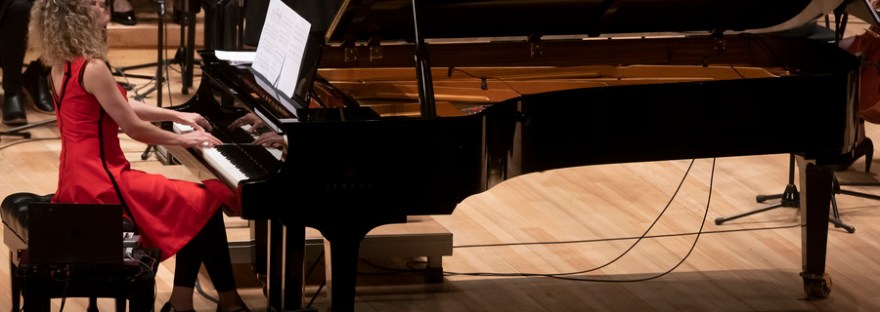
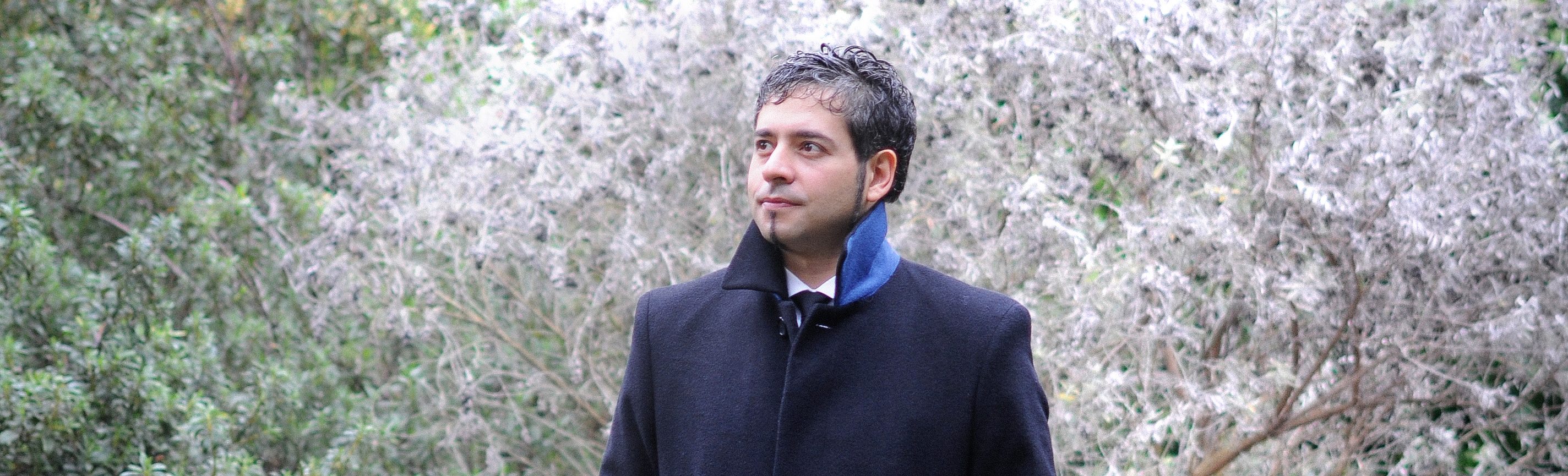
I’m thrilled to be conducting Eliza Brown’s a toy boat on the serpentine at the Mondavi Center in Davis on June 1, alongside Gershwin’s Rhapsody in Blue, with Erina Saito, and Daniel Brewbaker’s Playing and Being Played, with Rachel Lee Priday. Eliza is a composer whose work moves seamlessly between disciplines, drawing on literature, sound ecology, and collaborative creation with other artists and thinkers. Their music invites deep listening—not just to the sounds themselves, but to the questions those sounds ask about memory, space, and meaning.

Eliza’s pieces have been performed around the world by top new music ensembles, and their recent projects have included everything from music-theater inspired by a year of field recordings in Indiana to collaborations with sculptors and video artists. They are also a thoughtful scholar and passionate educator, currently serving as Associate Professor of Music at DePauw University.

It was a joy to speak with Eliza about the ideas that fuel their music, the power of listening, and some of the unexpected surprises that shape their creative life.

Christian Baldini: Your work “a toy boat on the serpentine” will be performed alongside Gershwin’s Rhapsody in Blue—two pieces that inhabit very different worlds. Could you tell us about the origins of a toy boat and what kind of space or imagery you hope it evokes for the listener?

Eliza Brown: This piece was commissioned by my former youth orchestra, Philadelphia Sinfonia, in honor of my mother, who served as the president of their board for many years after I graduated from the organization. I asked for her input while composing the piece, and incorporated musical elements that we extrapolated from the Classical music she finds most moving. She and I are both fans of Virginia Woolf, and the title is a reference to Woolf’s novel Orlando. Orlando, the main character, sees a toy boat bobbing on the calm Serpentine river in London’s Hyde Park, and takes it as a sign that her sea-captain husband is safe after sailing through a storm. Orlando experiences a surge of ecstasy from this simple everyday sight, thanks to her vivid imaginative inference. So the piece moves from very small musical fragments bobbing on a glittery surface to big, Romantic musical phrases and gestures at its peak. I hope listeners feel free to imagine their own imagery along with this, and to layer their own personal significance onto the piece, just as Orlando does with the toy boat.

CB: You’ve described your music as being driven by sound’s “potential for meaning.” What does that mean in practice—how do you begin shaping a piece when there’s no narrative, only sonic intention?

EB: I think there’s a lot of space, and a complex spectrum of different kinds of musical meaning, between the 19th-century poles of “programmatic” – i.e. based on an extra-musical narrative – and “absolute music” – i.e. the “purely” musical. I don’t think sound is ever completely devoid of referential meaning, because human brains are wired to interpret sensory inputs. We are always hearing sounds in reference to other sounds we have experienced, and this is deeply ingrained in our survival instincts – sounds indicate safety, danger, sources of food and water, etc. In a less life-or-death example, if we hear the sound of a cello, we’re subconsciously referencing that against other examples of cello we’ve heard in the past. Every experience we have with sound contributes to the way we listen and understand what we hear. The meanings of sound and music are of course very complex and layered and culturally and personally contingent, so we can’t use sound to sort of paint meaning by numbers and have it translate exactly the same way to every listener. But we can create combinations of sonic and musical references that come from a place of awareness about their potential meanings in cultural context, and there’s a richness there, and fun to be had in combining all these different signifiers, just as there is when writing text. So as I’m developing material, I’m often asking myself questions like, what does this remind me of? Where have I heard sounds like this before, in music or from any other source? Do I want to make compositional choices that bring the material closer to or further from those origins, references, influences? If the answer is, “further,” then in what direction? How will we get there? It’s a way to kind of map my way between recognizable landmarks or reference points, or play in the space between them.

CB: In The Listening Year, you integrated field recordings, scientific insights, and community stories from a single creek in Indiana. How did that immersive process change the way you compose—or even perceive music itself?

EB: I think that The Listening Year was an outlet to deepen and confirm approaches I was already exploring, rather than a catalyst for unexpected turns in my work or listening. As someone who has done a lot of outdoor soundwalks, and spent many hours listening in silence in Quaker meeting as a child, environmental listening feels like second nature. And I often start a piece by paying close attention to something outside of myself –  an existing piece of music, conversations with collaborators, recordings of the performers I’m writing for. My ideas come from that attentive, relational process. The Listening Year amplified that process, as I spent about 16 months making and studying fifty-two weekly field recordings and seeking many perspectives on the creek before writing any music. I thought of this as an ecological process, in which my composing was inextricable from the web of inputs and relationships created during that time. There’s also something attractive to me about this kind of devotional practice of attention: my creativity stems from being devoted to this place, these people. 

CB: Your work sussurra grew out of a kinetic sculpture and became a cross-disciplinary collaboration. How does your creative process shift when working alongside artists in other media, especially in film or visual art?

EB: This question follows well from my previous answer, in the sense that I don’t think my process is fundamentally different when working with artists from other fields. It starts with this process of exploration, listening, attention, and seeing what emerges and following those threads. In interdisciplinary collaborations there’s also an element of translation, where we gain an understanding of each other’s thinking in the terms of both disciplines, which usually leads to really delightful moments of discovery and recognition: oh, you think about this too with different words; oh, yes, we understand each other. We’re also figuring out the intersections and spaces between our disciplines and our specific practices that we want to spend time in, that expand our thinking about what we do as individual creators. That process takes time and iteration, so I think the biggest difference is in the development timeline rather than the way I’m thinking about composing or collaborating. In some ways the biggest difference between my interdisciplinary projects and my more traditional music projects is the production infrastructure. Interdisciplinary projects are less likely to fit into traditional producing models like “concert,” “play,” “gallery exhibition,” etc., so they often involve more administrative and production work on the part of the artists to get the project off the ground.

CB: Many of your compositions have an intertextual layer—responding to earlier music, texts, or traditions. What draws you to engage with the past, and how do you balance homage with innovation?

EB: I think what has drawn me to engage with the past – particularly early in my career as I was finding my voice – is my simultaneous sense of resonance with and appreciation for it, but also alienation and distance from it. I love so much music from the Western canon, and find it fascinating and moving, but I am not of the eras and cultures that found it necessary to make that music. And I would not want to be – in those eras and cultures, I likely would not have had access to a music education or career due to sexism! So I look at these historical objects with both attraction and wariness, and have written a number of pieces that pass historical musical artifacts – style elements, forms, fragments, whole pieces – through a kind of compositional filter that reflects this duality. In these pieces one might hear echoes of the past, but they’re echoes, removed from the source – veiled, re-contextualized, reverberations rather than re-creations. I don’t think they are homages, though there is affection there – they are more the product of passing these objects through the filter of my complex relationship with them.   

CB: Your academic research focuses on narratology in music—particularly in Czernowin’s Pnima…ins innere. Does that analytical lens ever influence how you compose your own music?

EB: Yes, absolutely! I have always been a very interdisciplinary thinker, and I really resonate with notions of storytelling across media. Pnima is an opera that has no textual libretto – the singers sing phonemes rather than words. Yet it is based on a novel and tells that novel’s story through what the composer calls “an internal theater,” or a sonification of the characters’ psychological journeys. My research was about the theoretical frameworks one could use to understand how this kind of storytelling works, and it drew on theories of narrative from literature and screen media as well as music theory and aesthetic philosophy. Without giving a full dissertation here, I will say that that research has been so influential to me that it would be almost impossible to excavate all of the ways it is ingrained in my thinking and practice. But perhaps the most significant thing has been understanding musical gesture, sound, and time as metaphors for embodied experience – understanding musical activity in terms of human behavior, or the ways that we experience psychological and emotional states in our bodies. 

CB: As a professor and mentor to young composers, what are some values or skills you most hope your students carry forward into their careers?

EB: One of the biggest things I hope students take with them is a sense of permission to explore whatever it is that excites them artistically. I find that many students enter a music degree with a lot of assumptions about what music is, what composition is, what counts as composing. These assumptions can really limit them from exploring avenues of creation that they might love. So I hope students encounter a broad range of practices presented without judgment, and feel a sense of permission to pursue their instincts and passions into any of these directions, whether they fit their initial assumptions or not. I also hope that students shed the need for anyone else’s approval to be an artist – what makes you a composer is the fact of composing, not external recognition. Everyone needs technical skills, too, but those vary depending on individual practices and goals. It’s so difficult to make a career in the arts, so I think it’s fundamentally important that young artists develop a sense of internal permission and agency, and a personalized technical skillset, that no one can take away from them, regardless of the challenges of funding, finding opportunities, and all of the practical considerations that come along with artistic careers.

CB: Looking ahead, are there any upcoming projects—musical, theatrical, environmental, or otherwise—that you’re particularly excited about right now?

EB: Yes, I’m kind of at a turning point between projects so there’s a lot to look forward to right now! In June I’ll finish a piece for Duo della Luna (Susan Botti, voice and Airi Yoshioka, violin) setting poetry by Elizabeth Bradfield, and I’ll also be working on two small-scale interdisciplinary projects this summer, each a collaboration with another artist who is a composer-performer. In the fall I’ll start working on an opera based on a Renaissance painting that I’ve been thinking about for almost 15 years! That’s going to be a long-term project, but I’m excited to finally start getting it out of my head and into the world.

CB: Finally, for a fun one: What’s something personal or unexpected that you’d be willing to share—perhaps a favorite sound, a ritual in your composing process, or a surprising influence?

EB: I couldn’t choose a favorite sound (every sound that exists could be my favorite in the right context!) but I do enjoy “unexpected soundtrack moments” in daily life – when the music in a public space, or looping in my head, isn’t what I would first think to pair with the activity or scene around me, but somehow goes with it perfectly or adds a subversive layer to it. The most recent one I can think of was on May 4, when some nerdy DJ at my climbing gym had a playlist that was about 90% John Williams – not what one typically hears in a gym! It was pretty delightful. Three strangers and I had been working on the same bouldering route for a bit, and as soon as the Indiana Jones theme came on we all topped it out like a quartet of Williams-activated climbing sleeper agents. I don’t know if the music helped or not, but it was a fun coincidence!

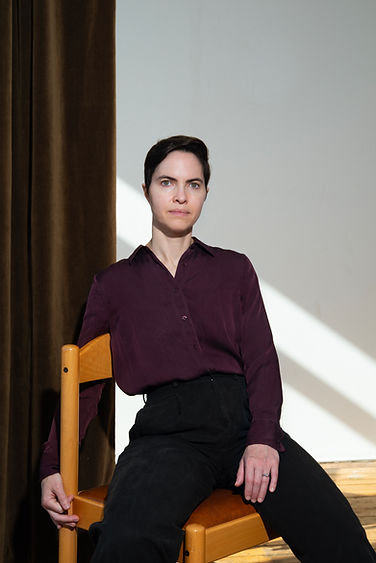
Eliza Brown’s music is motivated by sound and its potential for meaning; questions about the nature of human existence, social relationships, and responsibilities; and vivid sensory experiences. Their compositions have been performed by leading interpreters of new music, including Ensemble Dal Niente, Spektral Quartet, ensemble recherche, International Contemporary Ensemble, Network for New Music, Ensemble SurPlus, Quince Contemporary Vocal Ensemble, and Wild Rumpus New Music Collective; heard on stages throughout the USA and in Mexico, Colombia, Germany, Hungary, Spain, Canada, and the UAE; and recorded on multiple labels. Eliza’s work has been supported by grants from the Illinois Council on the Arts and the Paul R. Judy Center for Applied Research, among others, as well as residencies at the Ragdale Foundation (IL) and A Position on Retreat (BC).

Eliza’s work is frequently intertextual, opening dialogues with existing pieces of music, historical styles, field recordings, and other artifacts. It is also frequently interdisciplinary, with a particular focus on music-theater and opera. Recent projects include The Listening Year (2024), an hour-long music-theater work for cello-percussion duo New Morse Code and fixed media that incorporates and responds to a year of field recordings made along Big Walnut Creek in Greencastle, Indiana. Eliza consulted with scientists, conservationists, local residents, fellow artists, and students to interpret the recordings; the form and content of the piece reflect the site’s ecology and annual cycles, human uses and understandings of the site, and the transformative experience of a year-long environmental listening practice. This work was awarded the 2023-24 DePauw University Fisher Fellowship. The chamber work sussurra (2023), commissioned by Classical Music Indy for the Micro Composition Project, was inspired by visual artist Antonia Contro’s kinetic sculpture foglia, and in turn became the sonic layer of a film featuring the sculpture that Eliza co-created with Contro and video artist Jon Satrom of studiothread. 
Eliza Brown_030.jpg

Eliza’s artistic interests give rise to questions about the interpretation and meaning of music and words that drive their scholarship, creation, and teaching. Their dissertation, A Narratological Analysis of ‘Pnima…ins innere’ by Chaya Czernowin, used methods drawn from the interdisciplinary field of narratology (the study of narrative) to examine how Czernowin’s opera tells its story by means of music alone, as singers in Pnima sing phonemes and wordless vocal sounds. Eliza writes original and co-created texts and libretti, drawing upon a wide range of influences including scholarship, contemporary poetry, and a childhood steeped in protest, folk, parody, and camp songs. 

Eliza is a dedicated teacher who enjoys helping students develop as creators and engage complex ideas with rigor and enthusiasm. They are currently Associate Professor of Music at DePauw University, where they teach composition, music theory, and career development courses. Eliza has enjoyed a long-term affiliation with the Walden School Young Musicians Program, where they spent many summers in various roles including faculty and Academic Dean. Eliza holds a B.Mus. summa cum laude in composition from the University of Michigan and a D.M.A. in composition with program honors from Northwestern Universit
Buenos Aires, Christian Baldini, Compositora, Conductor, violin

Javier Weintraub en diálogo con Christian Baldini

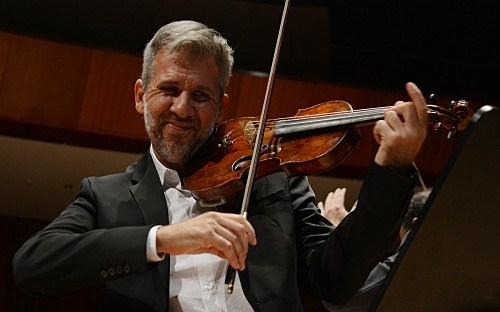
El próximo 5 de Agosto (de 2022) tendré el placer de dirigir la Orquesta Nacional de Música Argentina “Juan de Dios Filiberto” en el Auditorio Nacional del CCK, en un programa que presenta obras de Victor Lavallén y de María Laura Antonelli. “Criaturas del fuego” es una obra para violín y orquesta, y va a contar con el excelente violinista argentino Javier Weintraub como solista. Debajo hay una breve entrevista con Javier acerca de la obra.

Christian Baldini: Querido Javier, cómo comenzó el proyecto de “Criaturas de fuego”? Hoy en día no es tan habitual que los compositores (sobre todo en Argentina) escriban un concierto para violín y orquesta. Tampoco es tan habitual que en Argentina se encarguen obras a nuestros compositores. Tuviste mucho que ver en lograr este encargo para María Laura Antonelli? Tuviste mucha comunicación con María Laura en cuanto a la obra mientras ella la estaba escribiendo?

Javier Weintraub: No solo no es habitual la composición de un concierto para violín y orquesta de estas características, sino que además debe ser unos pocos conciertos escritos por una compositora mujer, cosa que muestra de alguna manera el cambio de los tiempos, o mejor dicho, la distribución de espacios que hasta hace poco era casi reservada para los hombres.  

La obra fue encargada por el Ministerio de Cultura a través de la Dirección Nacional de Organismos Estables. Es extraordinario que la Orquesta tenga como función encargar obras originales, porque abre un espacio único para los compositores argentinos. 

En cuanto al intercambio que tuvimos con María Laura, fue fluido sobre todo al final del proceso, en donde me fue compartiendo el progreso de la obra. Para mi fue la primera vez que me encontré con la posibilidad de ver el nacimiento de una composición, y la verdad es que me dio la sensación de que es la misma energía la que necesita una creación artística para nacer, que la que requiere cualquier otro formato vital, como una planta o algún animal. Nacen, crecen, toman forman.

CB: Qué le contarías al público acerca de ésta obra? Cuáles son algunas de sus características que la hacen única?

JW:  En principio me surge destacar el lenguaje que mezcla las características más europeas de los conciertos para violín conocidos, con el tango argentino. No es que el tango aparezca de manera explícita, pero hay algo que requiere el toque de los instrumentos y los tiempos de la orquesta, que de alguna manera casi obligan a a sacar de adentro el estilo porteño y citadino.  Es más que destacable, también, la hermosa idea de construir el segundo movimiento sobre la base de un dúo de violín y timbal que genera una tensión extraordinaria hasta la entrada de la orquesta casi hacia el final.

CB: Cómo fueron tus comienzos con la música? Quienes fueron tus grandes influencias (tanto maestros como colegas)?

JW: Mi encuentro con el violín fue gracias a mi hermano mayor, ex director de orquesta y actual psicólogo, que en algún momento de nuestra niñez comenzó a explicarme cómo estaban constituidas las sonatas y partitas de Bach para violín solo. Esos momentos, que eran casi un juego, me armaron una base musical muy amorosa, que recuerdo hasta hoy. Al poco tiempo estaba estudiando violín con Cristina Monasterolo, después con Ljerko Spiller y finalmente con Rafael Gíntoli. Mis influencias fueron variadas, porque como argentino tengo esa característica de estar alimentado por muchas músicas distintas. Tal vez el tango es el mejor resumen de esa influencia, porque se nutre de tantas músicas, que ese tapiz de estilos termina despertando la intriga de indagar en cantidades de formatos musicales distintos. 

    Yo creo que las personas que más me han influido son aquellas que tuve cerca en mi formación. Rafael Gíntoli sin duda fue y es una gran inspiración para mí en cuanto a lo referido a la enseñanza del instrumento y al manejo de la profesión. Manfredo Kremer fue también un pilar importante en relación al estudio de la música antigua, un estilo que me llama poderosamente todo el tiempo. Y después los colegas mas cercanos con los que aprendo todo el tiempo compartiendo proyectos. Tengo la suerte de ser contemporáneo de grandes músicos e instrumentistas.

CB: Qué consejos le darías a alguien que está empezando con la música y que busca convertirse en un violinista profesional? Cuáles son las mejores maneras de lidiar con  las frustraciones y fracasos que indudablemente le afectan a todo el mundo en algún momento de sus vidas?

JW: Yo tiendo a buscarle la trascendencia a todo lo que hago, es decir, ¿qué es lo que me deja de enseñanza mas allá del resultado que busco, aquello que estoy encarando? La música, y los instrumentos son recursos de búsqueda profunda para cualquier persona, y yo creo que es importante intentar despegarse de la meta y sumergirse profundamente en el camino. Siempre digo en broma, cuando me preguntan por mi carrera, que si yo hubiera querido correr carreras les hubiera pedido un Karting a mis padres, y no un violín. Es verdad que hay ciertas señales que nos marcan que vamos bien por dónde vamos, y esas señales son disfrutables por supuesto (como este concierto que vamos encarar el 5 de Agosto), pero creo que el mejor síntoma de que voy por buen camino es la felicidad y entusiasmo que siento al hacer las cosas. Empezar con felicidad y entusiasmo, seguir con felicidad y entusiasmo, y, porque la vida es así, en algún momento terminar con felicidad y entusiasmo. 

Cuando pienso en la frustración, siento que el violín es el rey. Es un instrumento para practicar el frustrarse, sobre todo al principio. Pero, aunque no parezca, yo creo que eso es muy bueno, porque como decís vos, la frustración y los fracasos son parte de la cuestión, y es bueno aprender de ellos. Hace mucho, un querido amigo que ya no está me dijo algo que cambió radicalmente mi observación sobre los procesos de aprendizaje. Hablando sobre la afinación en los instrumentos de cuerda frotada, me dijo que él creía que, al igual que todo en la vida tiende a la armonía, uno tiende a la afinación, entonces la desafinación no existía en su filosofía de enseñanza, sino que lo que existía era el acercarse cada vez mas a la afinación. Esto puede aplicarse a todo en la vida. Uno puede pensar que los pasos equivocados no existen, sino que existen los pasos perfeccionándose cada vez mas y mas. 

CB: Muchas gracias por tu tiempo Javier, y especialmente por el trabajo extraordinario que has hecho con esta nueva obra. Creo que la compositora y la gente en el público van a estar muy felices, y  para mí ha sido un gran placer trabajar con vos.

JW: Para mí estos días van a quedar en la vitrina de los recuerdos de mi vida. Una oportunidad única para un violinista, no solo estrenar un concierto, sino trabajar tan cerca con músicos tan increíbles. Miles de gracias por esta experiencia compartida!

Javier Weintraub

Violinista versátil, se ha sumergido en gran cantidad de estilos a lo largo de su carrera. Comenzó sus estudios a la edad de ocho años en el Conservatorio Nacional López Buchardo, del cual es egresado como Profesor Nacional de música y Licenciado en Artes Musicales con especialización en violín, y fueron sus maestros Cristina Monasterolo, Ljerko Spiller y Rafael Gintolli.

Integró numerosas orquestas de cámara y sinfónicas como la Orquesta de Cámara Crescendo, la Orquesta Sinfónica Juvenil de Radio Nacional, la Orquesta Sinfónica Franco-Argentina, La Orquesta de cámara de Lyon, Francia, la Orquesta de Cámara Scherzo. Realizó gran cantidad de conciertos como solista, ejecutando las obras más reconocibles del repertorio violinístico, como por ejemplo los conciertos para violín de Mendelshon, Tchaikovski, las estaciones de Vivaldi, los conciertos de Bach, etc.

En 1996 gana por concurso el puesto de primer violín en la Orquesta de Música Argentina Juan de Dios Filiberto, la cual integra actualmente. A partir de ese momento comienza a tener una importante actividad como violinista de tango, realizando conciertos como integrante en una gran cantidad de grupos protagonistas de la escena porteña como El Arranque, Decarísimo, el Noneto de Osvaldo Piro, el Sexteto de Fernando Marzan, el dúo Weintraub-Greco, entre otros. Fue integrante de importantes espectáculos como Rojo Tango en el hotel Faena, Tango Dance Premiun que se llevó a cabo en 60 ciudades de Japón, y Los Ojos de la Traición, opera Tango presentada en el Auditorio del Hotel Sheraton, codirigido con Verónica Vidán y de idea compartida con Fausto Lomba. Entre 1997 y el 2013 realizó giras por Estados Unidos, Japón, España, Alemania, Suiza, Inglaterra, Italia, Francia, Suecia, Holanda, Finlandia, Venezuela, Chile y Colombia, Vietnam, Cuba entre otros, llevando la música argentina a las principales salas de estos países.

En el año 1999 es convocado por Ricardo Masun para integrar, como primer violín, el ensamble de música Barroca Latinoamericana Louis Berger y comienza así su incursión en la música antigua. Con el ensamble Luis Berger realiza giras a Bolivia, Paraguay, Francia, Italia e Inglaterra. Graba dos discos en París, uno de los cuales obtiene el primer premio especializado de la crítica francesa en el año 2006.

Ha sido fundador e integrante de numerosos grupos de música antigua, como el ensamble Ecos lejanos, el ensamble Dulcis Fidius, especializado en música de los siglos XVI y XVII, el Dúo Weintraub-Cativiela o La Compañía de la Luces entre otros. Estudió violín barroco con Manfredo Kraemer y en el año 2012 adquiere su violín Aegidius Klosz de 1767, con el cual realiza sus conciertos actualmente.

Su actividad como solista en todo tipo de conciertos y espectáculos es permanente e intensa. Durante el año 2013 y 2014 ha sido invitado para dar conciertos y espectáculos en salas de Argentina, Francia, Italia. Durante los años 2012 y 2016 escribe el material “Estudios y Caprichos tangueros”, obra integral de 24 estudios para violín sólo progresivos, basados en tangos tradicionales y tangos nuevos, fusionados con la más alta técnica virtuosa en el violín. Este material fue editado en formato de libro de partituras por la editorial Melos en el año 2016

Entre sus grabaciones se encuentra el disco Furias (Acqua Records 2017), siendo ésta la primer versión de las sonatas de Euyene Ysaye para violín sólo editadas en Latinoamérica.

Por otro lado desarrolla una intensa actividad como escritor, participando en distintos espacios literarios propios y de diferentes autores. Durante el año 2019 edita su primer libro “De tu piel esas Flores“

Durante el año 2020 realizó junto con Rafael Gintoli el proyecto “El violín en el Tango“, una serie de nueve videos para la prestigiosa plataforma Suiza iClassical Academy, y durante el año 2021 coprodujo junto a Julián Caeiro el programa de cocina y música “Plato Forte, la cocina de la música“

Buenos Aires, Christian Baldini, Compositora

Maria Laura Antonelli en Diálogo con Christian Baldini

El próximo 5 de Agosto (de 2022) tendré el placer de dirigir la Orquesta Nacional de Música Argentina “Juan de Dios Filiberto” en el Auditorio Nacional del CCK, en un programa que presenta obras de Victor Lavallén y de María Laura Antonelli. “Criaturas del fuego” es una obra para violín y orquesta, y va a contar con Javier Weintreib como solista. Debajo hay una breve entrevista con la compositora.

Christian Baldini: María Laura, cómo comenzó la génesis de “Criaturas de fuego”? Cuál fue el disparador que te inspiró a escribir un concierto para violín y orquesta?

María Laura Antonelli: Esta obra “Criaturas del fuego” para violín y orquesta nació después del estreno de mi obra “Infernadero, seis piezas para Orquesta con piano y gritos olvidados”, en la que yo estuve como piano solista y con medios electroacústicos en vivo también. “Infernadero…” fue encargada y estrenada por la ONMA en 2019, a raiz de que yo lanzara mi disco de composiciones propias en piano “Argentígena, piano tango & electroacústica”(Acqua Records – 2018). Desde ahí me convocaron y empezó el trabajo con la Filiberto y “Criaturas” es un desafío porque es la primera vez que escribo un concierto solista para un instrumento que no es el piano. Sentí que la Orquesta estuvo muy feliz por el estreno de Infernadero y además recibí el premio de la Asociación de Críticos Musicales de la Argentina por mi labor compositiva de 2019, que atribuyo a Infernadero porque fue donde puse mi mayor energía ese año. Apenas se estrenó Infernadero, los programadores me propusieron componer una obra para violín solista y el orgánico de la ONMA. Empecé a escribirla en 2020 y luego se retrasó su estreno por la pandemia, estuve con otras obras, y hoy acá estamos. 

CB: Qué le dirías al público que son los aspectos más importantes de tu música? Cuáles son los elementos que les aconsejarías escuchar, como punto de partida?

MLA:  Me parece fundamental no subestimar jamás al público. Mi música está construida como un tejido de eventos sonoros que aparecen en la línea de tiempo, que a través de las intensidades y matices muestran la tímbrica, los colores y las texturas de ese tejido. Está atravesado por el tiempo de la escucha interna y la búsqueda de gestos de músicas que ya pasaron, algo así como si intentara reconstruir recuerdos de cosas que no ocurrieron. Los aspectos más importantes son la diversidad de los eventos sonoros que convergen en el espacio acústico, y para eso hay que diseñar ese espacio, que es el trabajo más difícil. Y creo que debe haber un factor de sorpresa en el ritmo en el que, aun habiendo propulsión, es decir, aunque podamos seguirlo con el cuerpo, sin haber sorpresa en esa propulsión, la música se apaga. Me gusta el desafío que tiene construir con un ancla en algo de la tradición, y también pienso que la capacidad de asombro está intacta y que hay que mantenerla viva cada vez que alguien escucha una música por primera vez. Lo que más deseo que me pase a mí al escuchar música es que la obra me permita desalienarme por un rato. Y eso mismo deseo para los otros que escuchan mi música.

CB: Cuáles han sido las influencias musicales más importantes en tu mundo compositivo?

MLA: Te los digo en cualquier orden, no cronológico ni en orden de importancia para mí, sinó así como me salen: Bach, Troilo, Piazzolla, Schaeffer, Schumann, Stravinsky, Bartok, Messiaen, Berio, Spinetta, Gobbi, De Caro, Gardel, Gismonti, Sting, y así sin nombrarte nada de jazz, el abanico es enorme igual, no sé…..todos mundos muy diferentes que desde el academicismo coexisten casi como una incongruencia dentro mío, pero es así como impactaron también en mí. Son músicas que conocí tanto al tocar el piano como escuchando en grabaciones o en vivo y que determinaron con mucha fuerza mi búsqueda de la creatividad musical y mi vocación.  

CB: Sos pianista, y me pregunto, cómo comenzó todo musicalmente para vos? ¿En que momento tuviste la necesidad de comenzar a componer?

MLA: Supongo que ambas cosas nacieron juntas. En principio empecé a tocar el piano porque quería aprender, pero ya tocaba de oído en un tecladito que había en mi casa desde muy chica, incluso antes de ir al colegio. En esa época ya inventaba melodías y formas en el tiempo, improvisaba un poco y luego la formación musical apuntó al piano en primer lugar y después a la composición especialmente en la adolescencia, cuando me peleaba con la partitura y quería poder tocar de oído lo que estudiaba leyendo y viceversa, y sentía que todo eso que inventaba y grababa empezaba a agigantarse y tuve la necesidad de hacerle lugar. Pasaron varios años hasta que pude encontrar la forma del discurso sonoro en el espacio acústico más o menos parecido a lo que imaginaba y descuadrarme de lo pianístico. Creo que, por suerte, casi nunca se llega a lo imaginado, sino que en el mejor de los casos la música cobra vida propia y aparece. Por eso me parece fundamental escuchar la voz interna que es la que pide la música.

CB: Muchas gracias por tu tiempo, y espero que tengamos un hermoso estreno de “Criaturas del fuego”.

MLA: Muchas gracias a vos Christian, será un gran concierto y es un placer enorme para mí estar trabajando juntos y que “Criaturas del fuego” tenga tu mirada.  

María Laura Antonelli al piano

Sobre María Laura Antonelli

Pianista, compositora y arregladora argentina. Tuvo experiencias como solista académica y pianista de tango en diferentes proyectos en las más importantes salas de Buenos Aires así como en el circuito under, el interior y en países europeos como Italia, Austria, Holanda, Alemania, Escocia y República Checa. Hizo música para danza contemporánea y cine. Integró proyectos como compositora, improvisadora y arregladora con formaciones desde dúos hasta orquesta típica. Cuenta con dos discos previos de tangos clásicos. El último, Argentígena, piano tango & electroacústica (Acqua Records-2018), netamente instrumental y de composiciones propias, fue considerado un trabajo “de frontera” por sintetizar elementos del tango, la música contemporánea y el jazz y nominado a los premios Gardel 2019. Actualmente trabaja en su próxima obra orquestal y en música de piano solo. Además es docente en el Conservatorio de la Ciudad A. Piazzolla y Conservatorio Superior M. de Falla.