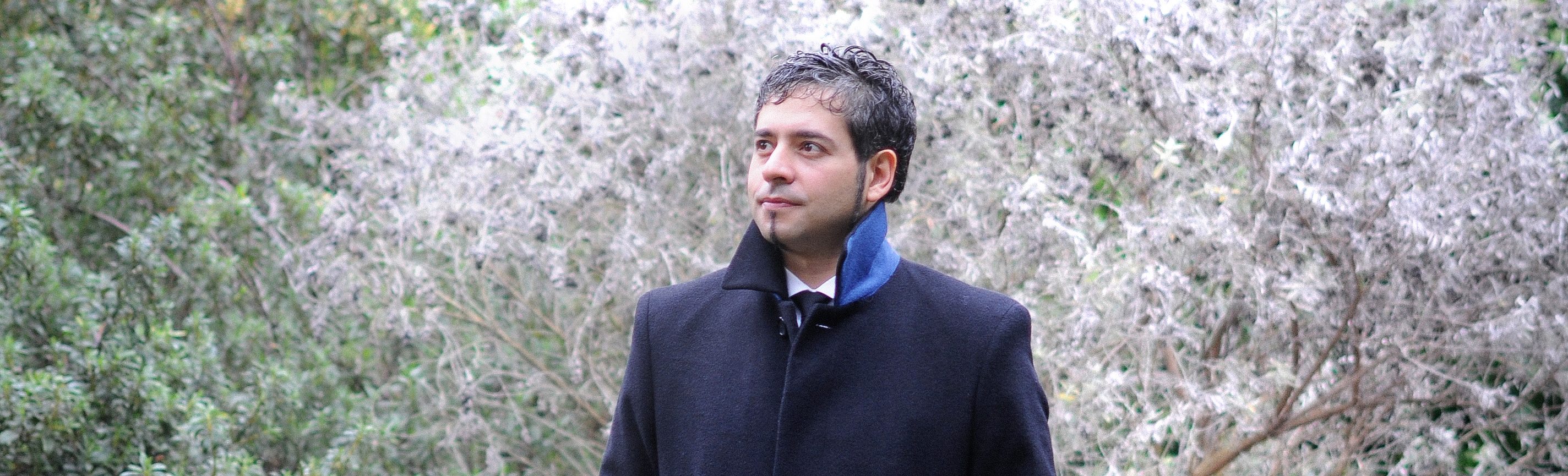
On November 19, 2022, I will have the pleasure of welcoming the wonderful cellist Eduardo Vassallo as our soloist in Alejandro Civilotti’s work “Auris Concertum”, with the UC Davis Symphony Orchestra at the Mondavi Center. I had the opportunity of asking Eduardo some questions, and below are his answers.
Christian Baldini: Dear Eduardo, what a pleasure to have you with us here in Davis to perform as our soloist in Alejandro Civilotti’s work for cello and orchestra “Auris Concertum”. I know you played the world première performance of this piece with the Buenos Aires Philharmonic. Tell us, why is this piece so special to you? How would you describe it to someone who doesn’t know it?
Eduardo Vassallo: It is a great pleasure to be here with you guys. Yes indeed I did the world première of this amazing piece. On saturday will be the USA premier. This piece is very special because it was written during a terrible time for Alejandro; he won the Queen Sofia Competition (Spain);at that time he started losing his hearing and by the time the Queen gave him the prize he couldn’t hear anymore; She was shocked by the situation and a few weeks later he got a call from the Palace with an invitation to go and see the Queen’s doctors. They couldn’t do much but the only possible hope was a Cochlear Transplant, (One of the first in Spain at that time). The Queen Sofia paid for the operation. The “Auris Concertum” was written as a thanks to Her Majesty Queen Sofia. He started working as soon as he new about the operation and finished it on the morning one hour before going to the hospital. Without knowing what the outcome would be, this piece is full of desperation, anger, memories and hope. I love very much the language, using all the registers of the cello is very challenging not only for the soloist but also for the orchestra.
CB: Tell us more about the composer, Alejandro Civilotti. How did you become acquainted with his music? Has your relationship with him evolved over time?
EV: We met many years ago, he is a very interesting person and we got on really well together. He invited me to participate in a very interesting project in Formosa North East of Argentina, a province without any classical music connection; he moved from Barcelona for more that 5 years, I used to go once every year to play chamber music and to supervised the creation of the “Tecnicatura de Musica”. The programme after much work it is up and running!!!!! We became very good friends and I have played many of his pieces, in Birmingham, Buenos Aires, Brazil and Barcelona.
CB: Last month we had the pleasure of hosting at the Mondavi Center the wonderful orchestra that you play in, the City of Birmingham Symphony Orchestra. You have been their principal cello for quite some time now, playing under revered music directors such as Sir Simon Rattle, Andris Nelsons, Sakari Oramo, and now Mirga Gražinytė-Tyla. Could you share with us some anecdotes or amazing experiences that you may recall from playing in (and from being one of the leaders of) this wonderful orchestra?
EV: I considered myself lucky to have worked with these great musicians. For me the most important thing was to witness the way an orchestra matures and moves on; each music director brought some different creativity and they each helped making the orchestra feel alive and with a purpose.
CB: You have played a lot of new music in Birmingham. Simon Rattle was a champion of promoting living composers. Are there any composers, works or experiences that you remember very fondly from this?
EV: Many, very difficult to single one out but the cycle Towards the Millennium was spectacular, it last 10 years with concerts in Cardiff, London, Birmingham and Vienna. We started in 1990, and finished in the year 2000; each year we would be playing pieces from that decade, in 1990 we will played pieces from 1900 to 1910; in 1991 pieces from 1910 to 1920; finishing with the millennium playing pieces that had just been written!!! It was unique and I am very proud of having been a part of it.
CB: Thank you so much for your time and great answers. I look forward to sharing your wonderful musicianship with our audiences this coming weekend here in Davis!
EV: Looking forward to seeing you all there in this beautiful hall. I hope you enjoy my playing!!!
Eduardo Vassallo Born in Buenos Aires, Argentina, by the age of 17 Eduardo Vassallo was a founder member of the String Quartet of the National Radio, and the solo cellist of the National Symphony Orchestra. Not long after, he came to Europe to study at the International Menuhin Music Academy in Switzerland, where, as a key member of the Camerata Lysy Gstaad he took part in numerous recordings, and toured throughout the world with Sir Yehudi Menuhin and Alberto Lysy. From there Eduardo moved to Germany, where he became increasingly active in the field of contemporary music as a member of the WNC Ensemble für Moderne Musik. In 1989 he became Principal Cellist of the City of Birmingham Symphony Orchestra, firstly under the musical direction of Sir Simon Rattle, then Sakari Oramo, Andris Nelsons and Mirga Grazinyte-Tyla, then as of next season, Kazuki Yamada. He was one of the founding directors of the Birmingham Ensemble (a chamber group drawn from the ranks of the CBSO). He has also guest led the cello sections of most of the main British symphony orchestras. As a soloist Eduardo has given recitals throughout Europe and South America, and has appeared frequently with orchestras including several major concertos with the CBSO. In England he gave the world premieres of the Sonata for cello and piano and the Duo no. 2 for violin and cello by his compatriot Jorge Bosso, and the Sinfonia Concertante by Indian composer Vanraj Bhatia, and he performed the UK premiere of “Azul” by Osvaldo Golijov. In Buenos Aires his world premieres include the cello concerto “Auris Concertum” by Argentine Alejandro Civilloti with the Philharmonic Orchestra of Buenos Aires, and the Grand Tango by Astor Piazzolla. In 2009, he formed a collaboration with Tim Garland (saxophone) and Marcelo Nisinmam (bandoneon) to create a multimedia jazz/tango fusion show called Transtango, first performed in the Bloomsbury Theatre in London, then at various festivals around the country (Salisbury Festival, Vamos Festival Newcastle, Buxton Festival etc). As a result of this collaboration, the CBSO commissioned Tim Garland to write a double concerto for cello and saxophone to celebrate Eduardo’s 20 years in the orchestra, which he performed with the composer under the direction of Christian Jarvi. Eduardo Vassallo has 2 solo recital CDs, “Latin American Masters” on the ASV label, and “Tangos by Piazzolla” on the Somm label. His love for the tango caused him to form “El Ultimo Tango”, a quintet dedicated to music from Buenos Aires, with which group he has released 3 CDs He was also a guest artist on the CD “Conception” by the jazz fusion John Turville Trio. Eduardo taught for 32 years at the Royal Northern College of Music, and still teaches at the Royal Birmingham Conservatoire, and has taught at summer courses in Switzerland, Portugal, Spain, England, and South America. He has regularly participated in the International Festival of Chamber Music in Formosa, Argentina, and Femusc in Brazil, and is the founder and director of the Latin-American Cello Festival, which takes place every 2 years in Buenos Aires. In 2014, he became the Musical Patron of Rutland Sinfonia. Eduardo Vassallo plays a Paolo Testore cello made in Milan 1710 and a Ferdinando Gagliano cello made in Napoli 1792.
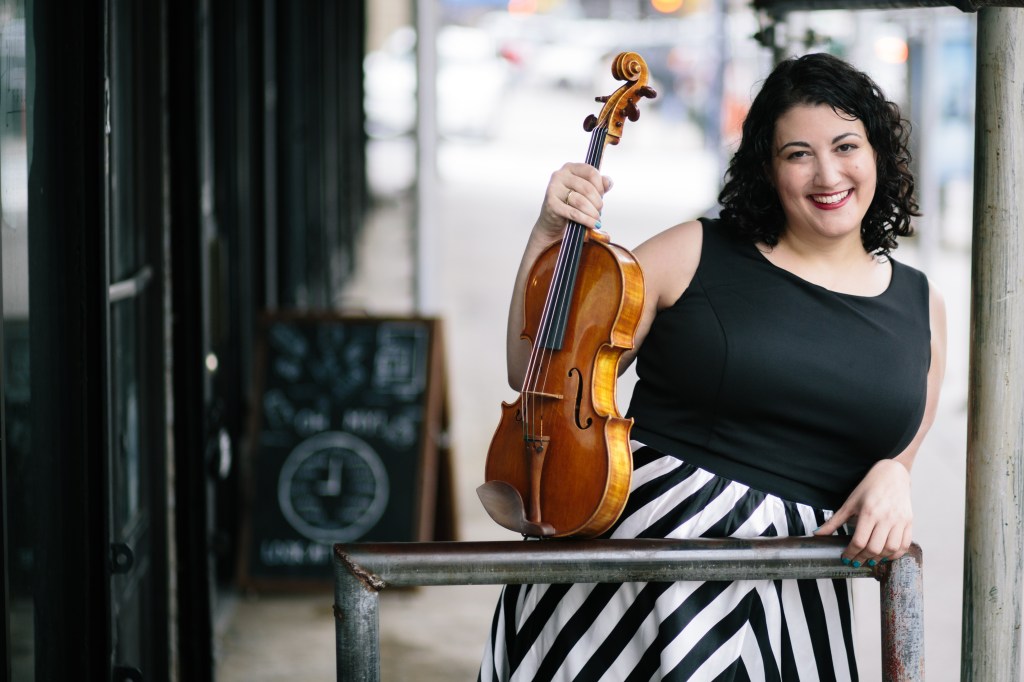
On Friday, October 14, 2022, I will be conducting Harold in Italy, by Hector Berlioz at the Mondavi Center in Davis. Our distinguished soloist with the UC Davis Symphony Orchestra will be Wendy Richman, a highly acclaimed viola player who has been hailed by The New York Times and The Washington Post for her “absorbing,” “fresh and idiomatic” performances with “a brawny vitality,” I had the opportunity to ask Wendy a few questions in preparation for our performance, and below are her responses.
Christian Baldini: Wendy, welcome, I am delighted to have you with us at the Mondavi Center to perform this marvelous music with our orchestra. Tell me, what are some of the features of Harold in Italy that you’d like to share with people in the audience? How do you see Berlioz as a composer? In your view, what makes this music so very special?
Wendy Richman: Thank you so much for having me here and inviting me to share this incredible piece with the students and community! I have always loved Harold in Italy, and it’s been an absolute joy to finally learn and explore it.
In contrast to Paganini’s initial opinion, I love that Harold isn’t a “bona fide” viola concerto. The standard viola concerti are wonderful and should be heard more often, but they’re not all written with the central idea that the viola’s more mellow sound can be in the forefront. It’s not always fun as a soloist to try to project with an acoustically imperfect instrument (more on that later) over a huge orchestra, and I imagine it’s not the most fun for a conductor to constantly implore the orchestra to play pianissimo. Berlioz, though, was one of the greatest orchestrators of all time. He knew what would work best for the viola. Instead of making the violist play in the highest registers that aren’t always our best feature, Berlioz created a viola part that can sing in so many different registers, with huge orchestral tutti sections that allow the ensemble to play fully without constant shushing from the conductor. Harold features all the things I love so much about my instrument: rich, human sound; subtle shadings and major contrasts of character and color; and most of all, its ability to blend and weave into and out of textures in partnership with so many other instruments. That is what viola and violists do best: we are musical chameleons and chamber musicians by nature, so it makes sense that we’d be excited in this piece to play along with English horn, bassoon, the viola section, and even the trombones!
Of all the moments I love in the piece, my favorite movement by far is the second, the “March of the Pilgrims Singing the Evening Prayer.” The “march” aspect is as important as the “prayer”: there is a calm, stately flow to the music, a feeling of timeless inevitability carrying us to the fleeting clarity of the last chord. I imagine that we musicians are quietly sojourning through narrow cobblestone streets, hearing intermittent church bells in the distance (represented by dissonant long notes in the French horns and the harp). My favorite part of my favorite movement is a long middle section with gorgeous, clear orchestration. The woodwinds alternate with the upper strings and cellos to play a hushed chorale, the basses anchor the chorale with a pizzicato (plucked) walking line, and the solo viola outlines the many harmonic changes with arpeggiated chords. These arpeggios are played with a sound that Berlioz only uses in this single section of the entire work. I play sul ponticello, with my bow hair right up against the instrument’s bridge, producing a slightly scratchy, haunting sound with lots of high overtones. I don’t know for sure, but I want to think it’s a linguistic wink from Berlioz: maybe the pilgrims are crossing a long footbridge…since sul ponticello means “on the bridge” in Italian.
CB: You are a distinguished new music performer, having been a member and performed with the International Contemporary Ensemble, and also the Orpheus Chamber Orchestra. Can you tell us how you first became interested in new music? Why is new music important and/or relevant?
WR: When I was a freshman at Oberlin in 1998, I was asked by a friend—a senior who was really into contemporary music—to play with CME (Contemporary Music Ensemble). Unlike a lot of schools that emphasize only the most traditional playing styles and repertoire, Oberlin was and is still known for its advocacy for new music. CME was where the cool kids were, and I felt so cool.
Then I picked up my music. Insert scream emoji here. It was a set of two pieces (Funerailles I and II) by a composer named Brian Ferneyhough, who is known for a style called “New Complexity.” It looks a bit like those joke scores that were meme-ish before memes were a thing. There is a lot of scholarly discussion about the philosophy of this music, about the inherent effort in learning and playing Ferneyhough’s scores. But I didn’t know any of that at the time—I just knew it was about 100 times more difficult than any music I’d ever seen.
The concert was structured so that Funerailles I opened the program and Funerailles II closed it. All I remember is walking onstage with great trepidation, followed by playing a bunch of notes, followed by panic, followed by walking offstage and bursting into tears. Tim Weiss, the incredible CME director, looked at me with wide eyes and an incredulous smile. He gave me a hug.
“What’s WRONG?!?!”
“I…I…I got SO LOST! I’m so sorry. I ruined it.”
Tim threw his head back and laughed, probably rolling his eyes.
“WENNNdy! NO! I mean…that’s what this music is! ……….We were ALL lost!”
I walked back onstage for the last piece and played with a focus and determination I’m not sure I’ve replicated since. I may or may not have played a lot of correct notes, but I did quickly discover that I loved playing challenging music requiring a different skill set to prepare and perform convincingly. I also loved playing with the seemingly fearless musicians on that concert, many of whom later became my fellow founding members of the International Contemporary Ensemble.
In some ways, it makes a lot of sense for a violist to be interested in playing new music: it was kind of a novelty for the viola to be featured in pieces until the mid-19th century, and it wasn’t until after WWII that composers truly figured out how to write for us. I mentioned previously that the viola is “acoustically imperfect,” which is due to the fact that we hold it like a violin. It would be too heavy and awkward to play if violas were the right size for our pitch range—half the size of a cello, as our strings are an octave higher than a cello’s. When we started holding it like a violin, luthiers “cut down” instrument like Amati and Stradivarius violas and made the necks thinner, eventually making slightly smaller violas the norm. (That’s the short explanation—that the viola should actually be almost twice as big as it is! I don’t really know WHY we hold it like a violin, but I’ll let someone else lead the resistance for that.)
So in the middle of the 20th century, more composers were compelled to write for the viola as a solo instrument, and they experimented with chamber instrumentations that didn’t force the viola to compete with its acoustically superior (read: louder) counterparts, the violin and cello. That’s not to say there isn’t a ton of incredible repertoire for us prior to that time. I love playing string quartets, which were my first musical love. I also play Baroque/historical viola and live for a Monteverdi suspension. And I’m thrilled to play Schumann’s Märchenbilder when I have the chance. We don’t have to stop playing and listening to all the older stuff! I’ll admit that I went through a long phase of that, but I’ve come around to feeling more fulfilled by programs that are simply good music, from a variety of times and places, with a satisfying connecting thread. When composers started thinking more outside the box with the viola, there was simply much more repertoire for us to choose from.
CB: You recently released your debut solo album on New Focus Recordings, including nine works in which you play, and also sing. Can you tell us about this project? How did it all fall into place? How did you choose the composers that you would include in it?
WR: Thank you for asking about my album. It was a long, intense journey: I started working with the composers around 2010, recorded in 2016, and spent several years editing on and off (and crowdfunding!). It is a scary and vulnerable process, made more so because I was listening to myself sing. I’d had plenty of experience listening to recordings of myself playing, and I had come to terms with generally despising that activity but dealing with it. But I was unprepared for the emotional weight I’d feel with my voice being part of the picture, because it had been a long time since I had been a semi-serious singer. So it took a lot to get myself to listen to each round of edits. I think the hardest part of the whole experience was that it was released just two months before the beginning of the pandemic. It didn’t get as much attention as I had hoped, and I didn’t get to tour with it. I still could, but the world is different from March 2020, and I think in some ways I’m a different musician from March 2020, too. That’s all to say that there’s a lot I would do differently if I could do it again, but ultimately I’m proud of what I created.
I was sort of equally committed to viola and voice when I was in high school. In college, I focused on viola but was very lucky to study voice with Marlene Ralis Rosen during my time at Oberlin. When I moved to Boston to pursue my master’s degree, singing kind of fell by the wayside—I didn’t have a teacher, and I felt like I needed to solely focus on viola. From time to time, I sang something short on a recital, mostly the Brahms op. 91 songs with viola. (I wasn’t performing both parts on those, though!) I also learned a piece by Giacinto Scelsi called Manto, of which the third movement is written for “singing female violist.” The piece is difficult for performer and audience alike; it’s not conventional and is frankly very strange! But I just loved everything about it. I began performing Manto III often, and audiences’ positive responses to it taught me that any piece of music can be “accessible” if the performer believes in it.
I missed singing, and I started to think I’d been a better violist when I was also singing regularly. The positive response to Manto III got me thinking about whether there were other pieces written for singing violist. When my now-husband and I moved to Ithaca, NY, in 2007, I started taking voice lessons with the wonderful late soprano Judith Kellock. Judy was excited by the idea of my commissioning pieces to play and sing, and the project started to take shape thanks to her encouragement.
At the time, I was very active on Twitter, and through that platform I met and/or reconnected with a lot of composers. I decided that I wanted to work with people whose music I liked, of course, but also people who I really loved personally. That aspect of the project ended up being even more important than I realized early in the process, as becoming close friends with each composer helped our communication and understanding when the album took longer than I’d originally hoped.
CB: What would you say to people who don’t like new music, or who say they don’t understand it, or that they simply prefer their usual music by Bach, or Beethoven or Brahms?
WR: Listening to certain things can be challenging, and sometimes we equate “challenging” with “work.” It’s a bit like reading something like a Haruki Murakami novel, or watching a Jim Jarmusch film, or looking at a sculpture by Louise Bourgeois. The abstract stuff is not always for everyone, and it’s not for every moment of every day. I also don’t want to feel like I’m forcing it upon people. I just ask everyone to approach it with an open mind and open ears, not trying to understand but rather simply experience. Once you get used to the language, the aesthetic, it can be enormously rewarding. Sometimes it doesn’t speak to you, and that’s totally fine! But it does feel more approachable with more time and more contact.
As those references may tell you, I also find it helpful and enriching to explore other avant-garde and experimental art forms, both historical and contemporary, as well as music from other cultures, like Indonesian gamelan ensembles or Tuvan throat singing. That music has been around much longer than some of the Western European musical tradition we think of as “classical.” If we consider the entire history and breadth of music as a spectrum—but one with multiple dimensions—it becomes easier to keep ourselves open to unfamiliar things. All music, all art, was “new” at some point, and Berlioz was certainly ahead of his 19th century contemporaries in many aspects of his composing.
CB: Lastly, what is your advice for young performers? How should one get ready for the profession? I also ask this because we have all faced challenges, failures and sometimes even (or especially) extremely gifted people end up giving up and quitting. What is a healthy mindset to fight this, and to keep going?
WR: It’s completely normal to feel discouraged sometimes, and even to go through long periods of questioning the profession. I wish it weren’t such a normal thing, but musicians and artists are a bit cursed in the overthinking department. Don’t worry if your career doesn’t look exactly like your teacher’s, or your friend’s or the way you thought it would look. No matter how many hours a day you might spend doing something different like working in an office environment or teaching fourth grade, if you’re still doing the thing, you’re still doing the thing. Allow your present self to define yourself, not other people or abstract, years-old goals.
My advice to young performers is to remain flexible. Develop and maintain “chops” for a variety of musical styles and jobs. My goal as a teenager was to play in a string quartet and perform with Orpheus Chamber Orchestra. When I began to focus on contemporary music, I still played as much “conventional” chamber music as I could, but I turned my attention pretty fully to the contemporary rep. I still took orchestra repertoire classes but never imagined I’d take orchestra auditions. I ignored my parents’ advice to take a pedagogy class because I thought I hated teaching.
But along the way, I’ve done every single one of those things. I’ve taken orchestra auditions and won jobs, allowing me to have a steady source of income and travel to New York to play with International Contemporary Ensemble, as well as giving me enough credibility as an orchestra player to sub with some of the country’s best orchestras. When I finished my master’s degree and was faced with the reality of trying to make ends meet, I discovered that I love teaching. Again, this provided a steady source of income, and the love of teaching led me to return to school for my doctorate. The full-circle moment came when I moved to New York in 2017 and started subbing with Orpheus—still a dream come true. And when I moved to Los Angeles in 2020, my varied experiences and skill sets allowed me to reach out to people who might be interested in hiring me. It’s hard work and takes some mental juggling to piece together a career that way, but I love the variety and challenges. Be open to serendipity, and don’t knock something until you’ve tried it again ten years later.
Wendy Richman (courtesy photo)
Wendy Richman has been celebrated internationally for her compelling sound and imaginative interpretations. As a soloist and chamber musician, she has performed at Carnegie Hall, Lincoln Center Festival, Metropolitan Museum of Art, Miller Theater, Mostly Mozart Festival, Park Avenue Armory, Phillips Collection, and international festivals in Berlin, Darmstadt, Helsinki, Hong Kong, Karlsruhe, Morelia, and Vienna. Former violist of The Rhythm Method string quartet, Wendy is a founding member of the New York-based International Contemporary Ensemble (ICE).
Hailed by The New York Times and The Washington Post for her “absorbing,” “fresh and idiomatic” performances with “a brawny vitality,” Wendy collaborates closely with a wide range of composers. She presented the U.S. premieres of Kaija Saariaho’s Vent nocturne, Roberto Sierra’s Viola Concerto, and a fully- staged version of Luciano Berio’s Naturale. Upon hearing her interpretation of Berio’s Sequenza VI, The Baltimore Sun commented that she made “something at once dramatic and poetic out of the aggressive tremolo-like motif of the piece.”
Though best known for her interpretations of contemporary music, Wendy enjoys performing a diverse range of repertoire. She regularly performs with NYC’s Orpheus Chamber Orchestra and has collaborated with fortepianist Malcolm Bilson, the Claremont and Prometheus Trios, and members of the Cleveland, Juilliard, and Takács Quartets. She has also been a frequent guest with the viola sections of the Atlanta Symphony, Minnesota Orchestra, and St. Louis Symphony.
From 2017 to 2021, Wendy served on the string faculty of New York University (NYU Steinhardt), where she taught viola, chamber music, and a class on extended string techniques. She has also held teaching positions at the University of Tennessee, University of Alabama, and Cornell University, as well as NYU Summer Strings, Walden School Summer Young Musicians Program, Sewanee Summer Music Festival, and Music in the Mountains Conservatory.
Wendy earned degrees from Oberlin Conservatory (BM), New England Conservatory (MM), and Eastman School of Music (DMA). She studied viola with Carol Rodland, Kim Kashkashian, Peter Slowik, Jeffrey Irvine, and Sara Harmelink, and voice with Marlene Ralis Rosen, Judith Kellock, and Mary Galbraith.
Her debut solo album, vox/viola, was released in 2019 on New Focus Recording’s TUNDRA imprint.
Christian Baldini: Querido Javier, cómo comenzó el proyecto de “Criaturas de fuego”? Hoy en día no es tan habitual que los compositores (sobre todo en Argentina) escriban un concierto para violín y orquesta. Tampoco es tan habitual que en Argentina se encarguen obras a nuestros compositores. Tuviste mucho que ver en lograr este encargo para María Laura Antonelli? Tuviste mucha comunicación con María Laura en cuanto a la obra mientras ella la estaba escribiendo?
Javier Weintraub: No solo no es habitual la composición de un concierto para violín y orquesta de estas características, sino que además debe ser unos pocos conciertos escritos por una compositora mujer, cosa que muestra de alguna manera el cambio de los tiempos, o mejor dicho, la distribución de espacios que hasta hace poco era casi reservada para los hombres.
La obra fue encargada por el Ministerio de Cultura a través de la Dirección Nacional de Organismos Estables. Es extraordinario que la Orquesta tenga como función encargar obras originales, porque abre un espacio único para los compositores argentinos.
En cuanto al intercambio que tuvimos con María Laura, fue fluido sobre todo al final del proceso, en donde me fue compartiendo el progreso de la obra. Para mi fue la primera vez que me encontré con la posibilidad de ver el nacimiento de una composición, y la verdad es que me dio la sensación de que es la misma energía la que necesita una creación artística para nacer, que la que requiere cualquier otro formato vital, como una planta o algún animal. Nacen, crecen, toman forman.
CB: Qué le contarías al público acerca de ésta obra? Cuáles son algunas de sus características que la hacen única?
JW: En principio me surge destacar el lenguaje que mezcla las características más europeas de los conciertos para violín conocidos, con el tango argentino. No es que el tango aparezca de manera explícita, pero hay algo que requiere el toque de los instrumentos y los tiempos de la orquesta, que de alguna manera casi obligan a a sacar de adentro el estilo porteño y citadino. Es más que destacable, también, la hermosa idea de construir el segundo movimiento sobre la base de un dúo de violín y timbal que genera una tensión extraordinaria hasta la entrada de la orquesta casi hacia el final.
CB: Cómo fueron tus comienzos con la música? Quienes fueron tus grandes influencias (tanto maestros como colegas)?
JW: Mi encuentro con el violín fue gracias a mi hermano mayor, ex director de orquesta y actual psicólogo, que en algún momento de nuestra niñez comenzó a explicarme cómo estaban constituidas las sonatas y partitas de Bach para violín solo. Esos momentos, que eran casi un juego, me armaron una base musical muy amorosa, que recuerdo hasta hoy. Al poco tiempo estaba estudiando violín con Cristina Monasterolo, después con Ljerko Spiller y finalmente con Rafael Gíntoli. Mis influencias fueron variadas, porque como argentino tengo esa característica de estar alimentado por muchas músicas distintas. Tal vez el tango es el mejor resumen de esa influencia, porque se nutre de tantas músicas, que ese tapiz de estilos termina despertando la intriga de indagar en cantidades de formatos musicales distintos.
Yo creo que las personas que más me han influido son aquellas que tuve cerca en mi formación. Rafael Gíntoli sin duda fue y es una gran inspiración para mí en cuanto a lo referido a la enseñanza del instrumento y al manejo de la profesión. Manfredo Kremer fue también un pilar importante en relación al estudio de la música antigua, un estilo que me llama poderosamente todo el tiempo. Y después los colegas mas cercanos con los que aprendo todo el tiempo compartiendo proyectos. Tengo la suerte de ser contemporáneo de grandes músicos e instrumentistas.
CB: Qué consejos le darías a alguien que está empezando con la música y que busca convertirse en un violinista profesional? Cuáles son las mejores maneras de lidiar con las frustraciones y fracasos que indudablemente le afectan a todo el mundo en algún momento de sus vidas?
JW: Yo tiendo a buscarle la trascendencia a todo lo que hago, es decir, ¿qué es lo que me deja de enseñanza mas allá del resultado que busco, aquello que estoy encarando? La música, y los instrumentos son recursos de búsqueda profunda para cualquier persona, y yo creo que es importante intentar despegarse de la meta y sumergirse profundamente en el camino. Siempre digo en broma, cuando me preguntan por mi carrera, que si yo hubiera querido correr carreras les hubiera pedido un Karting a mis padres, y no un violín. Es verdad que hay ciertas señales que nos marcan que vamos bien por dónde vamos, y esas señales son disfrutables por supuesto (como este concierto que vamos encarar el 5 de Agosto), pero creo que el mejor síntoma de que voy por buen camino es la felicidad y entusiasmo que siento al hacer las cosas. Empezar con felicidad y entusiasmo, seguir con felicidad y entusiasmo, y, porque la vida es así, en algún momento terminar con felicidad y entusiasmo.
Cuando pienso en la frustración, siento que el violín es el rey. Es un instrumento para practicar el frustrarse, sobre todo al principio. Pero, aunque no parezca, yo creo que eso es muy bueno, porque como decís vos, la frustración y los fracasos son parte de la cuestión, y es bueno aprender de ellos. Hace mucho, un querido amigo que ya no está me dijo algo que cambió radicalmente mi observación sobre los procesos de aprendizaje. Hablando sobre la afinación en los instrumentos de cuerda frotada, me dijo que él creía que, al igual que todo en la vida tiende a la armonía, uno tiende a la afinación, entonces la desafinación no existía en su filosofía de enseñanza, sino que lo que existía era el acercarse cada vez mas a la afinación. Esto puede aplicarse a todo en la vida. Uno puede pensar que los pasos equivocados no existen, sino que existen los pasos perfeccionándose cada vez mas y mas.
CB: Muchas gracias por tu tiempo Javier, y especialmente por el trabajo extraordinario que has hecho con esta nueva obra. Creo que la compositora y la gente en el público van a estar muy felices, y para mí ha sido un gran placer trabajar con vos.
JW: Para mí estos días van a quedar en la vitrina de los recuerdos de mi vida. Una oportunidad única para un violinista, no solo estrenar un concierto, sino trabajar tan cerca con músicos tan increíbles. Miles de gracias por esta experiencia compartida!
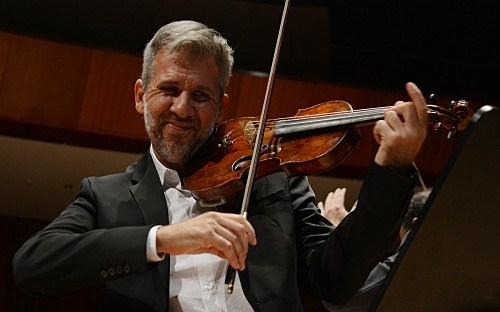
Javier Weintraub
Violinista versátil, se ha sumergido en gran cantidad de estilos a lo largo de su carrera. Comenzó sus estudios a la edad de ocho años en el Conservatorio Nacional López Buchardo, del cual es egresado como Profesor Nacional de música y Licenciado en Artes Musicales con especialización en violín, y fueron sus maestros Cristina Monasterolo, Ljerko Spiller y Rafael Gintolli.
Integró numerosas orquestas de cámara y sinfónicas como la Orquesta de Cámara Crescendo, la Orquesta Sinfónica Juvenil de Radio Nacional, la Orquesta Sinfónica Franco-Argentina, La Orquesta de cámara de Lyon, Francia, la Orquesta de Cámara Scherzo. Realizó gran cantidad de conciertos como solista, ejecutando las obras más reconocibles del repertorio violinístico, como por ejemplo los conciertos para violín de Mendelshon, Tchaikovski, las estaciones de Vivaldi, los conciertos de Bach, etc.
En 1996 gana por concurso el puesto de primer violín en la Orquesta de Música Argentina Juan de Dios Filiberto, la cual integra actualmente. A partir de ese momento comienza a tener una importante actividad como violinista de tango, realizando conciertos como integrante en una gran cantidad de grupos protagonistas de la escena porteña como El Arranque, Decarísimo, el Noneto de Osvaldo Piro, el Sexteto de Fernando Marzan, el dúo Weintraub-Greco, entre otros. Fue integrante de importantes espectáculos como Rojo Tango en el hotel Faena, Tango Dance Premiun que se llevó a cabo en 60 ciudades de Japón, y Los Ojos de la Traición, opera Tango presentada en el Auditorio del Hotel Sheraton, codirigido con Verónica Vidán y de idea compartida con Fausto Lomba. Entre 1997 y el 2013 realizó giras por Estados Unidos, Japón, España, Alemania, Suiza, Inglaterra, Italia, Francia, Suecia, Holanda, Finlandia, Venezuela, Chile y Colombia, Vietnam, Cuba entre otros, llevando la música argentina a las principales salas de estos países.
En el año 1999 es convocado por Ricardo Masun para integrar, como primer violín, el ensamble de música Barroca Latinoamericana Louis Berger y comienza así su incursión en la música antigua. Con el ensamble Luis Berger realiza giras a Bolivia, Paraguay, Francia, Italia e Inglaterra. Graba dos discos en París, uno de los cuales obtiene el primer premio especializado de la crítica francesa en el año 2006.
Ha sido fundador e integrante de numerosos grupos de música antigua, como el ensamble Ecos lejanos, el ensamble Dulcis Fidius, especializado en música de los siglos XVI y XVII, el Dúo Weintraub-Cativiela o La Compañía de la Luces entre otros. Estudió violín barroco con Manfredo Kraemer y en el año 2012 adquiere su violín Aegidius Klosz de 1767, con el cual realiza sus conciertos actualmente.
Su actividad como solista en todo tipo de conciertos y espectáculos es permanente e intensa. Durante el año 2013 y 2014 ha sido invitado para dar conciertos y espectáculos en salas de Argentina, Francia, Italia. Durante los años 2012 y 2016 escribe el material “Estudios y Caprichos tangueros”, obra integral de 24 estudios para violín sólo progresivos, basados en tangos tradicionales y tangos nuevos, fusionados con la más alta técnica virtuosa en el violín. Este material fue editado en formato de libro de partituras por la editorial Melos en el año 2016
Entre sus grabaciones se encuentra el disco Furias (Acqua Records 2017), siendo ésta la primer versión de las sonatas de Euyene Ysaye para violín sólo editadas en Latinoamérica.
Por otro lado desarrolla una intensa actividad como escritor, participando en distintos espacios literarios propios y de diferentes autores. Durante el año 2019 edita su primer libro “De tu piel esas Flores“
Durante el año 2020 realizó junto con Rafael Gintoli el proyecto “El violín en el Tango“, una serie de nueve videos para la prestigiosa plataforma Suiza iClassical Academy, y durante el año 2021 coprodujo junto a Julián Caeiro el programa de cocina y música “Plato Forte, la cocina de la música“
El próximo 5 de Agosto (de 2022) tendré el placer de dirigir la Orquesta Nacional de Música Argentina “Juan de Dios Filiberto”, en un programa que presenta obras de Victor Lavallén y de María Laura Antonelli. “Lavallén Sinfónico” es una Suite sinfónica con 11 tangos de este gran compositor y bandoneonista que ha tocado con todos los grandes, incluyendo sus 10 años como arreglador y bandoneonista de Osvaldo Pugliese. Diego Schissi ha realizado estos arreglos sinfónicos, y tendremos al Quinteto Lavallén como solistas al frente de la orquesta (Victor Lavallén, Diego Schissi, Juan Pablo Navarro, Guillermo Rubino y Alejandro Bruschini). Nos hemos sentado a conversar con el Maestro Victor Lavallén (quien a sus 86 años muy humildemente me insiste que por favor lo trate de “vos”) para charlar sobre este interesantísimo proyecto y música en general. Debajo están las respuestas.
Comienzo esta entrevista comentándole al Maestro Lavallén que hace pocos días, almorzando con mi amigo Juan Pablo Jofré (luego de habernos presentado juntos con la Orquesta Sinfónica Nacional en Buenos Aires), le comenté del proyecto que haríamos con Victor. Juan Pablo es un gran bandoneonista y compositor argentino que vive en los Estados Unidos hace unos 15 años, y que trabaja por todo el mundo. Cuando le conté del concierto con Victor Lavallén, Juan Pablo me dijo “No te puedo creer! Victor es el más grande. El mejor de todos. Nos pasa el trapo a todos.” Esa humildad de Juan Pablo está totalmente en coincidencia con la gran humildad que tiene el Maestro Lavallén, quien es realmente una parte viviente de nuestra cultura musical como argentinos, y como amantes del tango.
Christian Baldini: Querido Victor, contame por favor acerca de tu experiencia no solamente como uno de los más grandes virtuosos del bandoneón, sino también como arreglador de varias de las grandes orquestas de tango, incluída la de Pugliese!
Victor Lavallén: Si bueno, yo te digo, yo comencé a los 14 años a trabajar profesionalmente. En la década del ’50 había muy pocos músicos. Yo había estudiado en Rosario primero con mi tío, y después en Buenos Aires con Eladio Blanco, que tocaba con D’Arienzo. Al año o algo así me puso en una orquesta. Cuando me pusieron la música delante, yo empecé a llenar todos los silencios. “Pibe venga”, me dijeron. No se tuteaba antes. Yo tenía 14 años pero parecía que tenía 18. Me dicen “Usted se dió cuenta que no dió una, no?” Y ahí me echaron. Pero una semana después me llamó mi maestro y me dijo que en la orquesta no conseguían a nadie entonces me llamaron a mí. Entré y me quedé dos años. Era muy difícil ehh… Había cosas como con siete bemoles para solo de bandoneón…
Después de ahí empecé con Miguel Caló. Ahí estaba Julián Plaza, estaba Bajour. Después con Atilio Stampone. Y con Franchini. Todo lo que está grabado lo grabé yo. Y con el flaco Paz.
Christian Baldini: Cuando yo le cuente a mi viejo todo esto no lo va a poder creer. A mi viejo le gusta muchísimo el tango y conoce mucho de su historia.
Victor Lavallén: Y si… te digo, yo estaba en un momento en cinco orquestas. Me levantaba a las 10am y volvía a las 5am. Estuve con un montón, hasta que después… un día me fui a Radio El Mundo. Y me encontré con Romero, el pianista de Pugliese. Me pidió que pusiera mi nombre. Había tipos muy conocidos, que eran carteles. A la semana me llamaron a mí. Me citan en la radio, Radio Splendid. Me preguntaron: “usted escribe”, y yo dije que sí, aunque en realidad no había hecho casi nada. Y me pidieron que hiciera un arreglo de “Gallo ciego”. Y bueno, dije. Pero yo no estaba en la onda todavía. Y le digo, che, como hago acá? Y le preguntaba a Ruggiero y a Pitani, y a todos les pedía ayuda para hacer el arreglo. Y salió. Zafó. Después me dice Sergio Maciel, por ahí vamos a Rusia, y necesito que me hagas un arreglo del tango “El pañuelito”. Y con ese ya me mandé solo. Y cuando volvimos de Rusia, el éxito era “El pañuelito”.
Y en ese interín, se va De Marco. Y me preguntan a mí, y lo recomendé a Julián Plaza. Ellos no querían carteles. Por eso me habían contratado a mí que no me conocía nadie! Y después empecé a estudiar. Estudié con Rovira, estudié con el Maestro Nistal, ahí por Congreso. Después con Juan Carlos Cirigliano. Pero yo ya sabía para ese entonces. Yo con Pugliese probaba todo. Y a veces me decía “pero pibe, no se piante”, porque yo me rajaba. Estuve 10 años con Pugliese.
Después en el sexteto, con Osvaldo Ruggiero. Estuve con un montón de orquestas.
Después apareció Forever Tango. Juntos con Marconi, estabamos en la televisión y nos fuimos tres veces a Londres. Con Walter Ríos. Había dos orquestas, en Londres y en San Francisco. Y Ríos se fue y me puse a dirigir esa orquesta 18 años. Y después estuve a cargo de la orquesta escuela. (la Emilio Balcarce)
Después grabé lo mío, con Luis Bravo.
CB: Y con la orquesta escuela cuántos años ha estado?
VL: Desde el 2011. Primero estaba Emilio Balcarce. Después vino Marconi. Y después de Marconi me llamaron a mí, y estoy desde el 2011.
CB: Y aparte es una orquesta impresionante a la cual viene gente a formarse en la tradición tanguera de todo el mundo, verdad? Yo conozco a una pianista Coreana (Sumi Lee) que vive en San Francisco y que vino a hacer la orquesta escuela. Ahora conozco a un Puertorriqueño (Ishtar Hernandez) que también está haciendo el programa. Cómo sucede esto?
VL: Suena una barbaridad, son todos buenos músicos, y aparte son todos pibes jóvenes, que vienen de todos lados! Venite a un ensayo!
CB: Me encantaría, cuando?
VL: Venite el miércoles 3.
CB: Perfecto, muchas gracias!
VL: Hoy me tuve que levantar a las siete y no dormí nada (para llegar a tiempo al ensayo con la Orquesta Nacional de Música Argentina)
CB: Una pregunta importante: el tango, que significa para vos?
VL: El tango es todo para mí! Yo nací en una familia de tango, en Rosario y mi papá tenía una orquesta de tango. Mis tíos eran todos músicos. El tango para mí es lo máximo.
Pero yo al principio, vivía en Gorriti y Bustamente. Y a una cuadra vivía el gordo Pichuco. Y yo tocaba la trompeta, me gustaba mucho el jazz. Pero a mi mamá le llenaron la cabeza que era peligroso, y no era bueno para los pulmones. Con lo del bandoneón también trataron de convencerla que era malo. Pero después me fuí a Rosario a estudiar con mi tío, y cuando volví, arranqué con Eladio Blanco. Yo tengo 86!
CB: Qué consejos le darías a la gente joven que está arrancando y tratando de iniciarse en una carrera en el tango?
VL: Yo pienso que está bien, que tienen que estudiar como hacen ahora, que antes no se estudiaba tanto. Pero tienen que fijarse en no desvirtuar el género. Entonces hacen todos Piazzolla o más que Piazzolla. Y Piazzolla es melódico aparte. Los que son muy contemporáneos no se entiende nada. Hay que investigar y escuchar mucho. A las orquestas. Las orquestas de antes eran muy modernas. Parece que son las de ahora. Hay que escuchar a Miguel Caló, Franchini, Osvaldo Pugliese. Era muy avanzado.
CB: Cómo lo describiría a Pugliese?
VL: La idea de Pugliese era muy avanzada. Esa yo también la hubiera querido hacer. Tener una orquesta pero que escribieran todos. Encontrarle una forma. Lo que hizo Pugliese. Por la forma de él, todos fueron a parar ahí. Después había muchos que ponían lo propio. Julián Plaza, Ruggiero, yo, Balcarce, y también Julio Carrasco que era un violinista que no era muy conocido. Pero el tipo sabía un montón. Yo le preguntaba todo a él al principio.Los pibes de ahora me gustan mucho. Les interesa el género. No lo toman como una cosa así nomás. Vas a ver como te va a gustar el ensayo. Me gustaría que vinieras.
CB: Y por supuesto que voy a ir, ahí nos vemos! Maestro, ha sido un placer impresionante. Me siento muy privilegiado de estar colaborando juntos en este hermoso programa que presenta tus tangos con vos mismo como solista.
VL: Que gusto che, encantado, y va a salir muy bien esto!
Victor Lavallén
Victor Lavallén
Nació en Rosario, provincia de Santa Fe. Debieron pasar algo más de cincuenta años para que decidiera dejar de ser «un muchacho de la orquesta», ocupando un lugar en la línea de bandoneones. En varias oportunidades declaró ser persona de bajo perfil, quizás el ideal para ser invitado por algunos directores como refuerzo para las grabaciones o, como ocurre en la actualidad, ser el director de la Orquesta Escuela Emilio Balcarce, o bien director de la Orquesta de la Municipalidad de Lomas de Zamora (ciudad colindante a la ciudad de Buenos Aires).
Qué mejor para los muchachos que tenerlo a él como maestro. Pero este tanguero no comenzó con la mirada puesta en el fueye sino en la trompeta y, sus oídos, en el jazz. Por suerte cerca suyo, rondaba un tío bandoneonista que trabajaba en orquestas rosarinas, Héctor Chera, hermano de su padre Luis (director de orquesta), quien no sólo lo entusiasmó con el instrumento sino que le enseñó y lo fue formando.
Con muy poca experiencia se largó a Buenos Aires con no más de catorce años y, en el Picadilly, aquel local que estaba en el subsuelo de la calle Corrientes casi Paraná, consigue ingresar en una agrupación pequeña llamada Los Serrano, a cargo de un señor Eduardo Serrano que lo despidió al poco tiempo.
Más adelante fue a estudiar, durante largos meses, con Eladio Blanco, músico de Juan D’Arienzo. Ya con mejor respuesta, volvió a la orquesta de Serrano y permaneció a su lado un par de años. Durante aquel tiempo de estudio alternó en la agrupación de Antonio Arcieri —violinista decareano que falleció poco después, el 5 de mayo de 1952—, y en la de Lorenzo Barbero.
Desde 1951 hasta 1954, estuvo con Miguel Caló, que incluyó una recordada gira por tierra brasileña y también grabaciones. Es digna de elogio su participación en varios discos, entre los que podemos citar a “En fa menor” (de Roberto Caló) y “El chamuyo” (de Francisco Canaro).
Fueron diez años de músico y arreglador, inmerso totalmente en el estilo y el espíritu del maestro. Alguna vez me comentó que Pugliese insistía a sus músicos que intentaran componer y hacer sus arreglos, a fin que la orquesta no resultara monótona. Era una forma de que, sin perder su particular secuencia rítmica, pudiera escucharse algo nuevo. Y así fue. Cada uno aportó lo suyo, y es posible que esa haya sido la causa por la que don Osvaldo siguiera tan vigente hasta su fallecimiento.
En cuanto a esta modalidad impuesta por Pugliese a sus muchachos respecto a los arreglos, Víctor me contó que generó algunos pequeños disturbios: «Como todos opinaban, ocurrían discusiones fuertes, varios tenían su trabajo hecho y no lo podíamos escuchar porque dos o tres decían que el que corría era el de Emilio Balcarce o el de Penón, por ejemplo, y uno que había hecho el suyo se quedaba con bronca. Ahora si yo con mi orquesta tuviera mucho trabajo me gustaría que los músicos compusieran y arreglaran porque así se irían formando». Y más adelante agregó: «hoy las orquestas se acabaron, de las que llevan años en la lucha están la de Leopoldo Federico y Rodolfo Mederos y alguna otra reciente, pero se trabaja poco, o son contratados para eventos especiales o para el turismo, no hay campo de acción y el baile, que sí funciona, se arregla con discos».
Volviendo al repaso de su trayectoria, llegamos al año 1968. Pugliese estaba enfermo y había otras cuestiones. Alguno de sus muchachos comenzaron a reunirse para tocar como sexteto y, en poco tiempo, sobrevino la retirada definitiva. Así nació el Sexteto Tango.
Estuvo 19 años consecutivos con el sexteto, hasta que decidió retirarse. A partir de ese momento, participó en dos formaciones: la Orquesta Municipal del Tango entonces dirigida por Carlos García y Raúl Garello y la Orquesta Color Tango junto a Roberto Álvarez (bandoneón), Carlos Piccione y Fernando Rodríguez (violines), Amílcar Tolosa (contrabajo), Roberto Cicaré (piano) y Juan Carlos Zunini (tecladista).
Luego participó en el espectáculo Forever tango, con un grupo de músicos, cantores y bailarines, que recorrió Estados Unidos y Canadá. El director orquestal era Lisandro Adrover, y el cantor, nuestro amigo Alfredo Sáez.
En 2007, y dirigiendo su propia orquesta, graba un disco con el título, Amanecer ciudadano, editado por el sello EPSA que contiene diez temas, combinando tangos clásicos y páginas propias como: “Amanecer ciudadano”, “Meridional”, “A la sombra del fueye”, “Mistongueando” y “De norte a sur”.
En el 2010, hizo su segunda producción discográfica con el titulo Buenosaireando, junto a Alejandro Bruschini (bandoneón), Pablo Estigarribia (piano), Silvio Acosta (contrabajo) y Washington Williman (violín). El compacto tiene 12 temas, en los que se destacan dos composiciones suyas: “Buenosaireando” y “Romance de primavera”.
Christian Baldini: María Laura, cómo comenzó la génesis de “Criaturas de fuego”? Cuál fue el disparador que te inspiró a escribir un concierto para violín y orquesta?
María Laura Antonelli: Esta obra “Criaturas del fuego” para violín y orquesta nació después del estreno de mi obra “Infernadero, seis piezas para Orquesta con piano y gritos olvidados”, en la que yo estuve como piano solista y con medios electroacústicos en vivo también. “Infernadero…” fue encargada y estrenada por la ONMA en 2019, a raiz de que yo lanzara mi disco de composiciones propias en piano “Argentígena, piano tango & electroacústica”(Acqua Records – 2018). Desde ahí me convocaron y empezó el trabajo con la Filiberto y “Criaturas” es un desafío porque es la primera vez que escribo un concierto solista para un instrumento que no es el piano. Sentí que la Orquesta estuvo muy feliz por el estreno de Infernadero y además recibí el premio de la Asociación de Críticos Musicales de la Argentina por mi labor compositiva de 2019, que atribuyo a Infernadero porque fue donde puse mi mayor energía ese año. Apenas se estrenó Infernadero, los programadores me propusieron componer una obra para violín solista y el orgánico de la ONMA. Empecé a escribirla en 2020 y luego se retrasó su estreno por la pandemia, estuve con otras obras, y hoy acá estamos.
CB: Qué le dirías al público que son los aspectos más importantes de tu música? Cuáles son los elementos que les aconsejarías escuchar, como punto de partida?
MLA: Me parece fundamental no subestimar jamás al público. Mi música está construida como un tejido de eventos sonoros que aparecen en la línea de tiempo, que a través de las intensidades y matices muestran la tímbrica, los colores y las texturas de ese tejido. Está atravesado por el tiempo de la escucha interna y la búsqueda de gestos de músicas que ya pasaron, algo así como si intentara reconstruir recuerdos de cosas que no ocurrieron. Los aspectos más importantes son la diversidad de los eventos sonoros que convergen en el espacio acústico, y para eso hay que diseñar ese espacio, que es el trabajo más difícil. Y creo que debe haber un factor de sorpresa en el ritmo en el que, aun habiendo propulsión, es decir, aunque podamos seguirlo con el cuerpo, sin haber sorpresa en esa propulsión, la música se apaga. Me gusta el desafío que tiene construir con un ancla en algo de la tradición, y también pienso que la capacidad de asombro está intacta y que hay que mantenerla viva cada vez que alguien escucha una música por primera vez. Lo que más deseo que me pase a mí al escuchar música es que la obra me permita desalienarme por un rato. Y eso mismo deseo para los otros que escuchan mi música.
CB: Cuáles han sido las influencias musicales más importantes en tu mundo compositivo?
MLA: Te los digo en cualquier orden, no cronológico ni en orden de importancia para mí, sinó así como me salen: Bach, Troilo, Piazzolla, Schaeffer, Schumann, Stravinsky, Bartok, Messiaen, Berio, Spinetta, Gobbi, De Caro, Gardel, Gismonti, Sting, y así sin nombrarte nada de jazz, el abanico es enorme igual, no sé…..todos mundos muy diferentes que desde el academicismo coexisten casi como una incongruencia dentro mío, pero es así como impactaron también en mí. Son músicas que conocí tanto al tocar el piano como escuchando en grabaciones o en vivo y que determinaron con mucha fuerza mi búsqueda de la creatividad musical y mi vocación.
CB: Sos pianista, y me pregunto, cómo comenzó todo musicalmente para vos? ¿En que momento tuviste la necesidad de comenzar a componer?
MLA: Supongo que ambas cosas nacieron juntas. En principio empecé a tocar el piano porque quería aprender, pero ya tocaba de oído en un tecladito que había en mi casa desde muy chica, incluso antes de ir al colegio. En esa época ya inventaba melodías y formas en el tiempo, improvisaba un poco y luego la formación musical apuntó al piano en primer lugar y después a la composición especialmente en la adolescencia, cuando me peleaba con la partitura y quería poder tocar de oído lo que estudiaba leyendo y viceversa, y sentía que todo eso que inventaba y grababa empezaba a agigantarse y tuve la necesidad de hacerle lugar. Pasaron varios años hasta que pude encontrar la forma del discurso sonoro en el espacio acústico más o menos parecido a lo que imaginaba y descuadrarme de lo pianístico. Creo que, por suerte, casi nunca se llega a lo imaginado, sino que en el mejor de los casos la música cobra vida propia y aparece. Por eso me parece fundamental escuchar la voz interna que es la que pide la música.
CB: Muchas gracias por tu tiempo, y espero que tengamos un hermoso estreno de “Criaturas del fuego”.
MLA: Muchas gracias a vos Christian, será un gran concierto y es un placer enorme para mí estar trabajando juntos y que “Criaturas del fuego” tenga tu mirada.
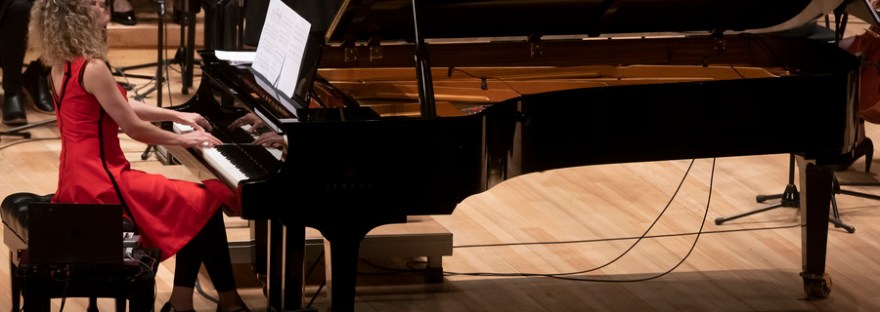
María Laura Antonelli al piano
Sobre María Laura Antonelli
Pianista, compositora y arregladora argentina. Tuvo experiencias como solista académica y pianista de tango en diferentes proyectos en las más importantes salas de Buenos Aires así como en el circuito under, el interior y en países europeos como Italia, Austria, Holanda, Alemania, Escocia y República Checa. Hizo música para danza contemporánea y cine. Integró proyectos como compositora, improvisadora y arregladora con formaciones desde dúos hasta orquesta típica. Cuenta con dos discos previos de tangos clásicos. El último, Argentígena, piano tango & electroacústica (Acqua Records-2018), netamente instrumental y de composiciones propias, fue considerado un trabajo “de frontera” por sintetizar elementos del tango, la música contemporánea y el jazz y nominado a los premios Gardel 2019. Actualmente trabaja en su próxima obra orquestal y en música de piano solo. Además es docente en el Conservatorio de la Ciudad A. Piazzolla y Conservatorio Superior M. de Falla.





 Christian Baldini's Interviews